
August 19, 2023 - PBS News Weekend full episode
8/19/2023 | 24m 9sVideo has Closed Captions
August 19, 2023 - PBS News Weekend full episode
Saturday on PBS News Weekend, as the death toll in Maui climbs, we look at how communities can improve disaster warnings and responses. Then, families in Montana prepare for a new law banning certain medical treatments for minors with gender dysphoria. Plus, the impact the writers' strike is having on reality and unscripted TV.
Problems playing video? | Closed Captioning Feedback
Problems playing video? | Closed Captioning Feedback
Major corporate funding for the PBS News Hour is provided by BDO, BNSF, Consumer Cellular, American Cruise Lines, and Raymond James. Funding for the PBS NewsHour Weekend is provided by...
Support provided by:

August 19, 2023 - PBS News Weekend full episode
8/19/2023 | 24m 9sVideo has Closed Captions
Saturday on PBS News Weekend, as the death toll in Maui climbs, we look at how communities can improve disaster warnings and responses. Then, families in Montana prepare for a new law banning certain medical treatments for minors with gender dysphoria. Plus, the impact the writers' strike is having on reality and unscripted TV.
Problems playing video? | Closed Captioning Feedback
How to Watch PBS News Hour
PBS News Hour is available to stream on pbs.org and the free PBS App, available on iPhone, Apple TV, Android TV, Android smartphones, Amazon Fire TV, Amazon Fire Tablet, Roku, Samsung Smart TV, and Vizio.
Providing Support for PBS.org
Learn Moreabout PBS online sponsorshipJOHN YANG: Tonight on PBS News Weekend, as the death toll in Maui rises, a look at how officials can improve warning systems and emergency responses to better handle future disasters.
Then, families in Montana prepare for a new law banning certain medical treatments for minors with gender dysphoria.
MAN: The biggest thing that I see is taking away our ability to make an informed decision.
I mean, a decision that's taken five years to make is not taken lightly.
JOHN YANG: And what the ongoing writer strike means for reality and unscripted television.
(BREAK) JOHN YANG: Good evening.
I'm John Yang.
Tonight, southern California and Mexico's Baja Peninsula are already feeling the effects of Hurricane Hilary hours before it makes landfall.
In the desert east of Los Angeles, what's expected to be three days of rain has begun.
Forecasters say a year's rain could fall in a matter of hours leading to catastrophic and life threatening flash floods.
Hurricane Hilary, now a category two storm, is expected to become a tropical storm by the time it makes landfall as early as tonight in a sparsely populated area of the Baja Peninsula.
Then, forecasters say it will surge north as the first tropical storm to hit southern California in 84 years.
High winds and heavy rains are expected from the Pacific Coast to southern Nevada and central Arizona.
Residents are preparing.
In Newport Beach, they stocked up on sandbags.
And San Clemente, workers put down tarps to try to prevent mudslides.
More natural disasters, wildfires are affecting the United States and Canada.
In Maui, the death toll from the deadliest wildfire in modern U.S. history now stands at 114.
More than 900 are reported missing.
In Canada, Yellowknife, the capital of the Northwest Territories is a virtual ghost town after its 20,000 residents were ordered to leave as a large and out of control wildfire threatens the city.
And British Columbia is under a state of emergency.
With several fires out of control, 15,000 people evacuated and 20,000 more under evacuation alerts.
And a Russian missile strike in the northern Ukrainian city of Chernihiv today killed at least seven people and injured more than 100 others, 12 of them children.
Officials say a theater and a university were hit.
Ukrainian president Volodymyr Zelenskyy condemned the attack while visiting Sweden.
Zelenskyy is asking for fighter jets from Sweden which is in the process of joining NATO.
Still to come on PBS News Weekend, what a new Montana law means for transgender children and their families and the effect of the writers' strike on the production of reality and unscripted TV shows.
(BREAK) JOHN YANG: The head of Maui County's Emergency Management Agency resigned earlier this week amid criticism of his decision not to activate warning sirens during the deadly fast moving wildfire.
He said he was quitting for health reasons.
The fire and the high death toll have put a spotlight on how communities respond to all sorts of emergencies, both natural and manmade.
Tricia Wachtendorf is director of the Disaster Research Center at the University of Delaware.
Tricia, how significant was that or how big a factor was that decision not to use the sirens in the high death toll that resulted?
TRICIA WACHTENDORF, University of Delaware: I want to start off by saying, of course, how tragic this event is.
And I think all of our hearts just go out to not only the survivors of this just devastating disaster, but also the emergency responders.
One of the things that we know very clearly from decades of research on disasters is that there is a sequence of behaviors that people need to go through before they even begin to start reacting to a disaster or to a warning.
They have to hear it.
They have to understand it.
They have to believe it.
They have to personalize it.
So is this actually me that one is talking about?
And they have to confirm it.
And that can be with people in their household.
It can be calling up a friend or a family member.
It could be checking on the Internet and trying to find out, is this something that I need to do some action, protective action toward.
So anything that can speed up that decision making to get them to that point, be it using different ways to reach people through cell phone, through the media, through sirens, through other kinds of warning mechanisms gets people just a little bit more closer to be able to start that very time consuming step of actually evacuating or taking protective action.
JOHN YANG: Well, in the Southwest now, they've got a tropical storm, it's currently a Hurricane Hilary bearing down on them, and they're already warning about potentially catastrophic and deadly flash flooding over the next 36 hours or so.
Flash flooding is something that, by definition, comes on very quickly.
What's the best way to warn people about that?
TRICIA WACHTENDORF: The more advanced notice that you can give people to be on guard, to be ready for an evacuation, the better.
The fact that it takes some people much more time to get to that point.
They may have a mobility issue.
They may not be able to get out of an area because they don't have transportation.
So having that advanced warning gets people thinking.
They get people talking about this to each other.
And then when there is a warning that comes through, they're much more close to the point of actually reacting.
Those seconds, those minutes really count.
JOHN YANG: The Maui County emergency manager said that the reason he did not sound the sirens is because they were intended, he said, for tsunamis, and he didn't want people rushing inland, perhaps toward the fire.
What do you make of that explanation?
And can emergency responders afford to have a one alert system for one particular event?
TRICIA WACHTENDORF: There's a few things at play there.
One, there's sometimes a misconception that people will panic during a disaster, that there will be widespread panic that takes place that's not backed up by the data unless there is a window of opportunity for escape that's quickly closing.
It's actually more difficult to get people to move, to start taking action.
That's why those extra minutes and hours count so much.
It will be really important to look at the plans that are in place for that part of Maui.
Whether or not community residents believe that those sirens are something that should be used for all different types of hazards, whether or not there was a failure to activate them, and they should have been, whether or not there were repairs that needed to be done.
So I think part of the real investigation that will happen is the extent to which how much this was decision making and how much it was a lack of planning or different types of planning that didn't take into account the severity or the quick onset of this particular fire.
JOHN YANG: If you were designing a warning system from scratch, someplace that's never had one before, and they called you and asked you to do it, what would it look like?
TRICIA WACHTENDORF: It would, first of all, involve the input of that community and understanding the very different types of community members that are in place.
You can't design a warning system for a community.
It really has to be with them.
It might be fine for an official to say that this is what we use particular warning mechanisms for, but if a community has a different understanding of that warning system isn't going to be effective.
There are residents in this community.
There are people who've lived there for a long time, for a short time.
There are tourists who are in the area, people who commute back and forth.
All of those will have a different response and understanding to those warning strategies.
And we also know that we have to use a multipronged approach.
So it can't just be sirens, it can't just be cell phone or media.
Different kinds of channels of communication reach people in different ways.
People trust different sources of information.
All of that needs to be taken into account, not simply when that hazard is threatening people immediately, but thinking about those plans years in advance.
JOHN YANG: You mentioned trust.
I would suspect some people in Maui may not - - may have lost trust in the government emergency response.
How do they rebuild that?
TRICIA WACHTENDORF: The recovery process is extremely challenging at the best of times.
This community has a long road ahead, unfortunately, in thinking about the amount of paperwork that's involved, the claims that have to be filed, trying to make sense of the financial and the community aspects, when you add that element of blame and mistrust, it can be a real challenge.
And they really will need our support in moving forward.
JOHN YANG: Tricia Wachtendorf from the University of Delaware.
Thank you very much.
TRICIA WACHTENDORF: Thank you.
JOHN YANG: A new Montana law is set to take effect in October, banning certain medical treatments for minors with gender dysphoria.
The bill's backers say the intent is to protect children from making irreversible medical decisions that they may regret later.
Opponents say the ban is dangerous and unethical.
Joe Lesar of Montana PBS reports on how families and medical providers are preparing for the new reality.
SID BEARDSLEE: A disgrace to the cooking world because I put corn in my fried rice.
JOE LESAR: In Helena, Montana, it's 17 year old Sid Beardslee's turn to cook dinner for the family.
WOMAN: Okay, come get shop.
SID BEARDSLEE: Yes.
WOMAN: Okay.
SID BEARDSLEE: When I was twelve, I hit the point where my brain just like, I don't really feel like a female.
Then once I hit 14, I kind of hit the point of like, no, I'm definitely not a female.
JOE LESAR: Sid identifies as nonbinary trans, masculine.
Assigned female at birth, Sid neither identifies as a boy nor a girl, but feels a connection to masculinity.
JESSY BEARDSLEE: Like they've never been perfection of any type of child.
They've been every kid.
They've been a monkey climbing trees.
They've been my Rapunzel princess wearing the dress and the beautiful long flowing hair.
BRANDON BEARDSLEE: It wasn't really a surprise when Sid came out.
I mean, I kind of always knew they were a little different.
But -- JOE LESAR: While they weren't exactly surprised when Sid came out, it did take some time to adjust.
SID BEARDSLEE: It's definitely scary for 5 seconds because you say, what does that mean?
JOE LESAR: For the Beardslees, that meant getting treatment to affirm Sid's gender identity.
At 14, Sid started taking puberty blockers, and at 17 began hormone therapy.
The Beardslee's firmly feel that this was the right choice for Sid.
SID BEARDSLEE: It's basically just grown my confidence.
It's made me a lot happier.
And I actually feel like I have a future.
I can grow up, be an adult.
Like I'm ready to exist on this planet.
JOE LESAR: Sid is among the last group of transgender youth in Montana who can legally receive gender affirming care.
A new law, Senate Bill 99, takes effect on October 1.
It prohibits the use of puberty blockers, hormones and surgeries to treat minors with gender dysphoria.
Montana is one of 19 states that have passed similar laws.
Healthcare providers can be suspended from practicing medicine for one year if they provide the care.
ZOOEY ZEPHYR (D) Montana State Representative: If you vote yes on this bill and yes on these amendments, I hope the next time there's an invocation, when you bow your heads in prayer, you see the blood on your hands.
JOE LESAR: Democratic state representative Zooey Zephyr, Montana's first openly transgender lawmaker, directed that remark at the bill's supporters during debate in April, Republican state senator John Fuller sponsored the bill.
Fuller says his motivation is to protect children from what he contends are the poorly understood long term effects and the irreversibility of some of the treatments.
JOHN FULLER (R) Montana State Senator: Children live under the guidance and guardianship of adults precisely because they lack the maturity, prudence, and experience to make safe and responsible decisions for themselves.
JOE LESAR: The use of puberty blockers and hormones to treat gender dysphoria has been shown to reduce depression and suicidal thoughts.
Major medical groups, including the American medical association, the American academy of pediatrics, and the US.
Department of Health and Human Services, deem them medically necessary in many cases.
DR. LAUREN WILSON, President, Montana Chapter of American Academy of Pediatrics: When your child is struggling, it's really difficult to say there's nothing we can do to help you, especially when we have tools to offer that are really proven to improve mental health and reduce suicidality.
JOE LESAR: Dr. Lauren Wilson is the president of the Montana Chapter of the American Academy of Pediatrics.
LAUREN WILSON: The response that we're seeing where people ban care completely is the antithesis of what we need to do in medicine, which is to study and improve care as we go.
JOE LESAR: When Sid Beardslee began expressing their gender identity, they were mocked in public and bullied at school.
SID BEARDSLEE: I struggled a lot with suicidal thoughts.
I didn't have an idea of who I could possibly be in the future.
JOE LESAR: Proponents of the ban argue that social media and the impressionability of minors has created what they consider a fad.
They also point to cases where adults who transitioned come to regret their care and are now reidentifying as their birth sex.
Some feel they were rushed into treatment or not given adequate mental health screening beforehand.
Studies suggest rates of regret are low around 1 percent.
But for the bill's sponsor, John Fuller, the stakes are too high.
JOHN FULLER: We protect children from all kinds of things.
We don't allow them to consume alcohol.
We don't allow them to consume tobacco products.
JOE LESAR: A challenge to the law is already underway.
An ACLU lawsuit claims the bill infringes on fundamental rights enshrined in the Montana constitution.
Among them, the rights of parents.
BRANDON BEARDSLEE: The biggest thing that I see is taking away our ability to make an informed decision.
I mean, a decision that's taken five years to make is not taken lightly.
JOE LESAR: But timing was on the Beardslee side.
Jessy and Brandon say they're grateful for Sid's treatment.
And Sid says they're living a more authentic life.
SID BEARDSLEE: I've never been so happy in my life to just get to be myself.
JOE LESAR: While Montana waits for the new law to take effect, families of transgender children are preparing for a new reality.
For PBS News Weekend, I'm Joe Lesar in Helena, Montana.
JOHN YANG: The broadcast TV networks are heading into the fall season with writers and actors still out on strike.
That means no new episodes of scripted dramas or comedies.
Instead, the primetime schedules are leaning heavily on reality and competition shows.
So you'd think the people who work on reality shows would be celebrating.
But as Ali Rogin reports, in Hollywood, appearances are not always reality.
ALI ROGIN: To give us more insight on how the writer strike is affecting reality and Unscripted TV is Ryan Gajewski, digital staff editor at The Hollywood Reporter.
Ryan, thank you so much for joining us.
So is the reality TV industry celebrating the current state of Hollywood?
RYAN GAJEWSKI, The Hollywood Reporter: This has been a surprisingly tough moment for reality TV, and I think that for outsiders and initially, I sort of assumed that, you know, this would be kind of a boom moment for unscripted, right.
You know, when you look at the fall schedules coming up for broadcast TV, a number of networks CBS, ABC, Fox are really leaning heavily on unscripted without having any new scripted episodes to air.
And so I think that it seemed to be something one would assume is that there's a lot of work and a lot of more projects getting greenlit, and that doesn't seem to be the case for some reason.
You know, I've talked to a number of producers who said this is the toughest moment they've seen for unscripted TV right now in terms of people aren't working.
There have been long stretches where since maybe December that a lot of people have been in without work.
And the jobs that are available, as with unscripted, tends to be long hours working weekends, no health benefits.
I think it's surprising for many to learn that unscripted has not necessarily been thriving right now.
ALI ROGIN: The last big writer strike happened between 2007 and 2008.
What were the circumstances then?
RYAN GAJEWSKI: Reality TV certainly had success prior to the strike, but certainly once the strike took place in 2007, there were shows that came about to support the lack of scripted options.
So now I think that the WGA East has unionized some unscripted workers.
But for the most part, the majority of shows are not union.
They're not under union contracts in unscripted.
Certain ones are sort of they call the shiny floor shows tend to be union shows like MasterChef and The Voice kind of those bigger competition shows, but most aren't.
You know, when you look at the schedule for this fall, there are 38 hours of unscripted programming across the five broadcast networks, which is an 81 percent uptick from last year how many shows were being included on fall schedules at this time last year.
So definitely reality is being brought in to help save all these networks, and yet the jobs aren't there right now.
ALI ROGIN: Fascinating.
And you mentioned the shiny floor shows.
How is the strike affecting the celebrity guests, the celebrity judges that take part in these competition shows, other types of reality television who are otherwise participating in the strike?
RYAN GAJEWSKI: Sure.
So I think that, you know, reality hosts who are often well known A listers and people who have acting careers and judges and potentially contestants on shows like Dancing with the Stars, they're covered separately.
So it's not part of the deal that's being currently ironed out that have led to the strike, but just the idea of producing content for a strut company.
I think that some, you know, involved in the undiscripted industry thought that it's possible that hosts would and judges would, for optics reasons, perhaps not want to create new episodes of shows.
But -- so far it appears that right now most shows are still moving forward, even with actors involved.
ALI ROGIN: And producers of reality shows are not considered writers.
They're not part of the writer's union.
But certainly they play a large role in shaping the storylines of these shows.
They do a very similar job that writers do.
So why aren't they covered by the union?
RYAN GAJEWSKI: Yeah, I think that, you know, you talk to people in the industry and there is confusion as far as why that wouldn't be considered.
Writing unscripted has been seen sort of as this cheaper, quicker alternative, and I think that's helped it thrive.
I've talked to people who think that kind of some unscripted programming has kind of leaned in on maybe less experienced producers and people behind the scenes who are able to get work and develop Hollywood experience but are willing to work these longer hours, maybe not getting residuals, not having health benefits.
And so once studios have found a way to create this content in a cheaper way, are you going to be able to change that?
And certainly certain shows have managed walkouts.
So Survivor, I talked to an editor who has worked on two shows, Survivor and History Swamp People, who she was part of walkouts for both shows, and they were able to make those shows union.
So certainly that's a possibility, but it becomes tricky.
You sort of need the show to be seen as indispensable to your platform, and certainly not all shows have that luxury.
And then if you haven't worked in a while, it becomes a little bit scary for work security to then be willing to be part of a walkout because people take your job.
So it gets tricky.
ALI ROGIN: Ryan Gajewski with The Hollywood Reporter, thank you so much for joining us.
RYAN GAJEWSKI: Thanks so much.
JOHN YANG: And that is PBS News Weekend for this Saturday.
I'm John Yang.
For all of my colleagues, thanks for joining us.
See you tomorrow.
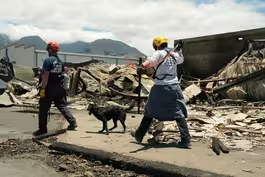
How officials can improve disaster responses
Video has Closed Captions
How communities can improve warning systems and disaster responses (6m 30s)
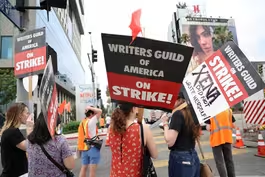
How the ongoing writers' strike impacts reality TV
Video has Closed Captions
How the ongoing writers' strike impacts reality and unscripted TV (5m 50s)
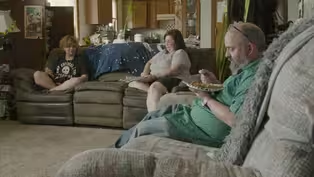
What a new Montana law means for transgender children
Video has Closed Captions
What a new Montana law means for transgender children and their families (6m 5s)
Providing Support for PBS.org
Learn Moreabout PBS online sponsorship
- News and Public Affairs

FRONTLINE is investigative journalism that questions, explains and changes our world.

- News and Public Affairs

Amanpour and Company features conversations with leaders and decision makers.












Support for PBS provided by:
Major corporate funding for the PBS News Hour is provided by BDO, BNSF, Consumer Cellular, American Cruise Lines, and Raymond James. Funding for the PBS NewsHour Weekend is provided by...