
Celebrating 25 Years of The Musicians of Ma’alwyck
Season 10 Episode 10 | 26m 46sVideo has Closed Captions
The Musicians of Ma’alwyck celebrate 25 years of unique chamber music.
Join Ann-Marie Barker Schwartz as she reflects on the 25th anniversary of The Musicians of Ma’alwyck, a chamber music group specializing in 18th and 19th-century American music. Discover their journey, unique performances, and exciting plans for their milestone season.
Problems playing video? | Closed Captioning Feedback
Problems playing video? | Closed Captioning Feedback
AHA! A House for Arts is a local public television program presented by WMHT
Support provided by the New York State Council on the Arts (NYSCA), M&T Bank, the Leo Cox Beach Philanthropic Foundation, and is also provided by contributors to the WMHT Venture...
Celebrating 25 Years of The Musicians of Ma’alwyck
Season 10 Episode 10 | 26m 46sVideo has Closed Captions
Join Ann-Marie Barker Schwartz as she reflects on the 25th anniversary of The Musicians of Ma’alwyck, a chamber music group specializing in 18th and 19th-century American music. Discover their journey, unique performances, and exciting plans for their milestone season.
Problems playing video? | Closed Captioning Feedback
How to Watch AHA! A House for Arts
AHA! A House for Arts is available to stream on pbs.org and the free PBS App, available on iPhone, Apple TV, Android TV, Android smartphones, Amazon Fire TV, Amazon Fire Tablet, Roku, Samsung Smart TV, and Vizio.
Providing Support for PBS.org
Learn Moreabout PBS online sponsorship(gentle music) - [Matt] Chat with violinist, Ann-Marie Barker Schwartz and celebrate the 25th anniversary of The Musicians of Ma'alwyck.
It's all ahead on this episode of "AHA!
The House for Arts."
(gentle music) - [Narrator] Funding for "AHA!"
has been provided by your contribution and by contributions to the WMHT Venture Fund.
Contributors include the Leo Cox Beach Philanthropic Foundation, Chet and Karen Opalka, Robert and Doris Fischer Malesardi, and The Robison Family Foundation.
- At M&T Bank, we understand that the vitality of our communities is crucial to our continued success.
That's why we take an active role in our community.
M&T Bank is pleased to support WMHT programming that highlights the arts and we invite you to do the same.
(upbeat music) - Hi, I'm Matt Rogowicz, and this is "AHA!
A House for Arts," a place for all things creative.
The Musicians of Ma'alwyck, founded in 1999 by violinists Ann-Marie Barker Schwartz is not your typical chamber music ensemble.
The group specializes in music performed in America during the 18th and 19th centuries.
I had the pleasure of speaking with Ann-Marie to learn more about The Musicians of Ma'alwyck as they celebrate their 25th anniversary.
Ann-Marie, you've been a fixture in the local music scene for decades.
How did you get started in music?
- Well, when I was little, my mom was actually a classically trained pianist.
And from my earliest memories, she would play the piano and I would dance around the living room to it.
And it was always sort of a special part of my life.
And then my father was sort of a devotee of the Metropolitan Opera broadcast on Saturdays.
So we would listen together to the broadcast and I always loved them.
I was unusual for a little girl, I think.
But the classical music was always a part of my early life.
- What did your mom play in the piano?
- She played works of Schubert and Chopin and one of my favorites was the Richard Addinsell "Warsaw Concerto," which was part of her repertory.
And I remember hearing that a lot when I was growing up.
- And you ended up playing violin.
- [Ann-Marie] I did.
- How did that happen?
- Well, I started with piano, but somehow it wasn't the right instrument for me.
And in third grade, they came around and sort of had a instrument petting zoo, I guess.
And the violin was there and I picked it up and it was kind of love at first sight.
And so I started with a violin and always, I never thought twice about pursuing another instrument after I started playing violin.
- That's wonderful, and you have had a wonderful career in music.
Joined the Albany Symphony.
- I did.
- Glimmerglass Festival now.
- Yes.
- So what led you to start a chamber group?
- Well, playing symphonic music is quite different from playing chamber music.
They are really two different sides of music making.
So symphony, you're a part of a big group, and while your contribution matters a lot, it's about blending in, it's about matching, it's about following the conductor's musical concept.
But when you play chamber music, it's about being an individual in the context of playing with the group, but using your creativity, using your artistry in a completely different kind of way that I find very satisfying.
It's playing chamber music is sort of conversational and you're so important.
Each voice in a quartet or a trio is intrinsic to the quality of what's coming out.
So it's a very different kind of focus.
- Sounds like fun.
- It's a lot of fun.
It's hard work too, but it's really, it's very emotionally satisfying.
- How did The Musicians of Ma'alwyck come to be?
How did you decide to form that group and where did the name come from?
- In 1999, I had had my second child and was feeling perhaps a little bit obsolete.
And so I thought, you know, I really, I've always wanted to found a chamber as a group.
That's what I'm going to do.
We had just bought a house called Ma'alwyck built in 1712 in Scotia.
And I thought, wow, think about the music that was happening when this house had its first inhabitants and Handel was alive and you know, there's gonna be this whole legacy of music.
I should go back and sort of recreate what was happening back then but in America.
I went to the Schuyler Mansion because it's the 1761 home of General Philip Schuyler and I thought surely a person as prominent as Philip Schuyler would've had amazing music in his home and I'm just gonna look at their archives.
And instead I just found these little clues about music, that they had purchased a German flute, which is a transverse flute.
That they had paid a music master, that they had entertained and paid musicians, but I had no idea what they played.
And so that actually led me to go back to graduate school and get my degree in American history and focus on music in early America, which was this surprisingly different realm of music than what was going on in Europe.
And it's been an amazing journey actually.
There's been so much research since I started, not just my research, but going on in America is kind of a new area of musicology and it's fascinating.
- And so tell me a little bit more about that.
So what did you learn about the music itself and how did that form the instrumentation of the group?
- Sure.
So I think that I had this, you know, kind of European centric view that it was gonna be string quartets and string trios, very much like what Mozart and Haydn were playing in Vienna at the time.
That was not the case in America.
We were not quite that sophisticated or culturally savvy at that point.
We didn't have instrument-making companies here yet in, you know, late 1700s.
So portable music was important and that led me away from works with piano to works with guitar, violin, flute was very popular.
Singer was very popular, cello of course.
And so we had a core that's different than what you would normally find in Europe at the time of flute, violin, guitar, and cello.
And the guitar sort of serves as that, you know, more than single line accompaniment figure that the piano would fill out normally.
When we first formed back in 2000, our core instrumentation featured Linda Greene on flute and Linda subsequently won a really big job for Syracuse Symphony, then Buffalo Philharmonic, which full-time symphonies and sort of prohibited continuing with us.
But luckily close friend of mine from high school actually had moved back to the area, Norman Thibodeau.
So it just completely dovetailed at the right time and he's been with the group since 2005.
And then our original cellist was Petia Kassarova and Petia I met through Albany Symphony.
And unfortunately she contracted cancer in about eight years ago and so she passed away in 2020.
And our new cellist is Andre O'Neil, another capital region native who came back after spending time in Europe.
And he knew Petia very well and she sort of gave him her, you know, stamp of approval.
So after she passed, he joined the group, and we have a really wonderful quarter of musicians.
- And you formed the group in 2000, right?
- In 2000, yes.
- So 25th year anniversary coming up.
- It is indeed.
- So what are some of your favorite memories overall this time?
- You know, I've been thinking about that a lot because we've done a lot of different things while sticking to this sort of mission of bringing history to life through music.
And so because vocal music was such a prominent component of performances in America and the 1700s and early 1800s, I think some of my favorite, and I think greatest achievements with the group have been to present a couple of operas.
So we did in 2003, Thomas Arne's opera "Alfred," and you probably think you don't know what "Alfred" is, but "Rule, Britannia!"
is the final chorus.
And it was the first opera ever staged in America in 1750s in Philadelphia.
So we did that and collaborated with Glimmerglass Opera actually.
Then we did "The Poor Soldier," which was George Washington's favorite opera.
And that was, I think, a huge feat for us because it was staged and costumes and we built footlights and we had to redo the score because there were no existing orchestral scores.
They had burned up in fires.
So we only had like a piano manuscript to work with.
We knew it had been performed in Albany in 1808.
So we followed that libretto, which I stumbled on in the stacks of the New York State Library.
And we sold out three performances and did an exhibit with the New York State Museum.
And that was a huge, huge thing for us.
We commissioned an opera in 2018 based on an episode in the women's suffrage movement.
And we commissioned a local composer, max Kaplan, who's just prodigiously gifted and has become a member of the group and a fabulous pianist as well.
And that was another huge success.
And we mounted that at a recycling facility that they turned into a theater for us, which was incredible.
And we just did an opera actually a few weeks ago at the Troy Music Hall called "Water Bird Talks."
So that's certainly been a big part of our history.
Another really special memory that happened very early on was to be invited to play for television producer Norman Lear for his purchase of the last private copy of The Declaration of Independence.
And he flew us down to Atlanta.
We were sort of contacted through the costumer who Kathy and Bob Sheehan owned it.
And they did these parties for the board of General Electric and some other big organizations.
So we got wigs from Hollywood.
It was pretty amazing.
And even our cello had a seat on the plane, and I mean, not just our cellist, the cello too.
And we were picked up in limos and they had rented out the Atlanta Galleria Mall for two days and it was a really special event.
And you know, presidents were invited, Supreme Court justices were invited.
So that was a huge deal for us and we were the classical music of the event.
- That's awesome.
I mean, it really sounds like you've been able to combine your love of music and history- - Oh, absolutely.
- through this group.
So looking ahead, what do you have, any special plans for this 25th anniversary season?
- We do indeed.
So we have a big season coming up and one I'm really truly proud of.
So we started these wine tastings that are, we call them wine triptychs, and they're pairing of certain nationalities of wine with food and music.
And we started it last year, hugely successful.
So we have a French wine tasting, we have a Romanian wine tasting, all with the appropriate food and music.
We are collaborating with the modern dance company Ellen Sinopoli in January, and making our capital repertory sort of debut with that performance.
We continue our residency at both Schuyler Mansion and at SUNY Schenectady.
So we have lots of things going on there.
We have our silver anniversary Viennese Ball right here in the WMHT TV studios and that's in March and we're so excited about that.
What else?
And then we have a tour of this Zoellner String Quartet program.
The Zoellner Quartet was a very famous early American quartet, a family quartet with the first violinist, the daughter of the group, which of course in the early 1900s was unheard of.
And she became sort of an idol for the suffrage movement, of course.
They were fabulous.
They were very active touring schedule.
They appeared all throughout New York State and New England, all over the United States actually.
So we're going to some of the places that they played, including Wyoming, New York, Wrentham, Massachusetts, they were a good friend of Helen Keller who lived in Wrentham, Massachusetts.
We're going to Vassar College where they played.
Playing up here, Glove Theatre, so very exciting.
- There's a lot going on.
- There is a lot going on.
- That's awesome.
Well congratulations on your anniversary.
- Thank you.
- And thank you so much for joining me on "AHA!"
today.
- Oh, it's just my pleasure.
Thank you for having me.
(gentle orchestral music) (gentle orchestral music continues) (gentle orchestral music continues) (gentle orchestral music continues) (gentle orchestral music continues) (gentle orchestral music continues) (gentle orchestral music continues) (gentle orchestral music continues) (gentle orchestral music continues) (gentle orchestral music continues) (gentle orchestral music continues) (gentle orchestral music continues) (gentle orchestral music continues) (gentle orchestral music continues) (gentle orchestral music continues) (gentle orchestral music continues) (gentle orchestral music continues) (upbeat orchestral music) (upbeat orchestral music continues) (upbeat orchestral music continues) (upbeat orchestral music continues) (upbeat orchestral music continues) (upbeat orchestral music continues) (upbeat orchestral music continues) (gentle music) - Thanks for joining us.
For More arts, visit wmht.org/aha and be sure to connect with us on social.
I'm Matt Rogowicz, thanks for watching.
(gentle music) - [Narrator] Funding for "AHA!"
has been provided by your contribution and by contributions to the WMHT Venture Fund.
Contributors include the Leo Cox Beach Philanthropic Foundation, Chet and Karen Opalka, Robert and Doris Fischer Malesardi, and The Robison Family Foundation.
- At M&T Bank, we understand that the vitality of our communities is crucial to our continued success.
That's why we take an active role in our community.
M&T Bank is pleased to support WMHT programming that highlights the arts and we invite you to do the same.

Celebrating 25 Years of The Musicians of Ma’alwyck: Preview
Video has Closed Captions
Preview: S10 Ep10 | 30s | The Musicians of Ma’alwyck celebrate 25 years of unique chamber music. (30s)
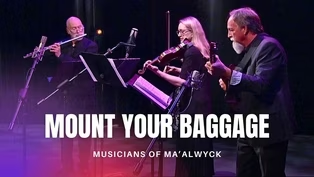
Musicians of Ma’alwyck Perform "Mount Your Baggage"
Video has Closed Captions
Clip: S10 Ep10 | 3m 21s | The Musicians of Ma’alwyck’s perform "Mount Your Baggage". (3m 21s)
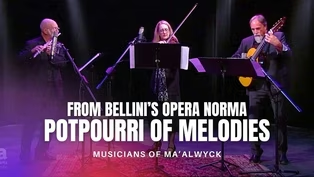
Musicians of Ma’alwyck Perform "Potpourri Of Melodies"
Video has Closed Captions
Clip: S10 Ep10 | 8m 39s | The Musicians of Ma’alwyck’s perform "Potpourri Of Melodies" from Bellini’s' opera Norma. (8m 39s)
Providing Support for PBS.org
Learn Moreabout PBS online sponsorship

- Arts and Music
The Best of the Joy of Painting with Bob Ross
A pop icon, Bob Ross offers soothing words of wisdom as he paints captivating landscapes.









Support for PBS provided by:
AHA! A House for Arts is a local public television program presented by WMHT
Support provided by the New York State Council on the Arts (NYSCA), M&T Bank, the Leo Cox Beach Philanthropic Foundation, and is also provided by contributors to the WMHT Venture...