
Chicago's New Air Pollution Monitors Face Intense Summer Heat
Clip: 7/7/2026 | 10m 31sVideo has Closed Captions
Air pollution is impacting the life expectancy of Black and Latino residents, according to CDPH.
Last fall, the Chicago Department of Public Health and the University of Illinois Chicago joined forces to install nearly 300 air quality monitors around the city.
Problems playing video? | Closed Captioning Feedback
Problems playing video? | Closed Captioning Feedback
Chicago Tonight is a local public television program presented by WTTW
WTTW video streaming support provided by members and sponsors.
Chicago's New Air Pollution Monitors Face Intense Summer Heat
Clip: 7/7/2026 | 10m 31sVideo has Closed Captions
Last fall, the Chicago Department of Public Health and the University of Illinois Chicago joined forces to install nearly 300 air quality monitors around the city.
Problems playing video? | Closed Captioning Feedback
Where to Watch Chicago Tonight
Chicago Tonight is available to stream on pbs.org and the PBS app.

WTTW News Explains
In this Emmy Award-winning series, WTTW News tackles your questions — big and small — about life in the Chicago area. Our video animations guide you through local government, city history, public utilities and everything in between.Providing Support for PBS.org
Learn Moreabout PBS online sponsorshipChicago Department of Public Health says air pollution is impacting the life expectancy of black and Latino residents in Chicago last fall.
Cdph and University of Illinois, Chicago joined forces to shrink this gap by installing nearly 300 quality.
My air quality monitors around the city, the most in the United States.
Now the project is facing its biggest test yet the summer heat high temperatures tend to make air quality worse, especially for communities on the city's south and west sides.
Joining us to talk more about the project and how air pollution affects millions throughout the city are syrup earned all open Air Chicago Project Leader and University of Illinois Chicago School of Public Health Professor Grace Adams, Environmental Health Project administrator at the Chicago Department of Public Health.
And Jamie Groff's, Earl founder and executive director of the Southwest Collective neighborhood Organization working to improve the quality of life on Chicago's Southwest Sides.
Thanks to all of you for joining us.
Grace on start with you.
The American Lung Association's 2026.
State of the Air report ranks the Chicago's Airpot Lucian.
We're in a Chicago area is air pollution as one of the worst in the country.
What is your reaction to that?
>> I'm not surprised.
You historically Chicago has seen, you know, poor air pollution.
We've seen air quality issues across the board.
Experiences have been voiced from all of our community members.
You know, I'm not surprised to hear that.
And I'm really hopeful that, you know, this project is the next step in addressing that.
>> Sarah, what kind pollutants are in the air?
What makes air pollution air pollution is >> the >> formed in the atmosphere south of emissions from there.
It of sources specifically industrial mobile sources like cars, trucks and also more and more wildfire smoke.
It air pollutants.
directly emitted into the atmosphere or they are formed in the atmosphere to chemical reactions.
But in summary and pollution contamination of that we breathe.
And with chemicals, toxic gases and particles that released from there.
It pollution.
Sources air pollution does it impacts all of us because we all breathe the air or is it mostly a concern for those with respiratory There are vulnerable populations that are at higher risk for adverse health effects air pollution.
>> And these are specifically children.
>> Pregnant women and the >> Grace, tell us more about opening Chicago and how it works.
coming to you, Jamie.
To worry.
>> opener.
Chicago is community network of 277 air sensors across the city.
And so its collecting on concentrations of fine particulate matter and nitrogen dioxide, which are 2 of the pollutants.
My colleague just mentioned.
And so all of these sensors, there's one and at least every community area and at least one in every ward.
So that way we are getting full citywide coverage and we can understand, you know, what's happening at the hyper local level and you know where encouraging residents to really take advantage of this tool and use as like health education piece.
You know what they can do?
We're putting that power of public health in the hands of the public syrup, the open air Chicago map.
Or I'm gonna put that up on the screen for our viewers to see it because this is what it looked like earlier this afternoon.
>> Why do you think it is important to have these monitors on a neighborhood level?
>> It is very important to measure air quality, particularly in our because as you mentioned, the American Lung Association identified Chicago as one of the most polluted cities in in the country.
In terms of particulate matter pollution.
It is the 13th most pollutant in didn't pollute prelude to that.
A city in the nation.
And in terms of ozone, it's to 15 the 15th most polluted city.
on top of it, as we have witnessed in 20, it's 3 Both in this that the wildfire smoke from Western U.S.
and the and Canada formed unhealthy conditions for our residents Chicago.
And in addition, we are experiencing higher temperatures reaching 90 degrees longer periods in the summer and that serves a means to trap pollutants to to the high pressure system, to trap to pollutants over the city for longer periods of time and all of what kind describing serves as higher air pollution burden associated higher health risk for our Chicago residents, but particularly for residents in the South East, south and west in parts of the city due to this proportion air pollution in DOS specific community.
Right.
And I want to get into that.
We all remember, of course, last summer and the summer of 2023 when the skies orange and the days were ugly.
Jamie, tell us a little bit more about how poor air quality, how it disproportionately affects the resident said that Sarah just mentioned on the city's south and west sides, OK?
So if you take it back, 100 years or so the areas that you're talking about to the southwest in the southwest side and from the southwest side.
>> We're all very industrial in nature.
And so you're seeing like a key word being thrown around here, which is industrial industry.
What does that >> It means that there's a lot happening.
A lot being made a lot being trans transported across like our into interstates, our rivers, our airways, so there are some neighborhoods where that is happening a lot more than others and they happened to be on the south, the West and the Southwest and southeast sides.
>> these are folks that are, you know, naturally lower income.
We are, you know, Jordy black and brown.
And and you know, because you have low income, you also have less ability to, you know, afford health insurance.
And so you're starting to see a lot of this domino effect across generations.
And so it's not just this generation that has this issue.
You know, this.
These are chronic issues that are generational for families.
You know, I have asthma.
And so does my kid, for example, I'm pregnant and I have complications because, you know, when I'm out in the heat, really hard to walk around and move, for example, people need to about, you know, going out into their communities when the air quality is high or when the air quality is poor.
>> And why is that important information?
>> It's super important.
And the reason important is because you need to know when it's safe to go outside.
So, you like mention, if you are pregnant, you know, you may have a little bit more complication.
The normal, something you're not used to.
And that is labored breathing, especially as you get into the final trimester.
You might have a child asthma or another respiratory issue.
You might have an elderly parent or someone living with you like an aunt or an uncle who might have a respiratory difficulty.
And so knowing when those days are moderate, severe or just straight up orange, should stay home or maybe make alternate arrangements for the day.
That's important to know.
Yeah.
Grace, how can air quality be so different?
Just a few miles apart.
So it's based off of hot like the actual monitors that we're using in this network are, you know, Hyper-local they're getting.
>> Granular information.
And so it's like what's happening right there when you're looking at your weather app, for example, and you're seen air quality, you know, on that screen, it's different because it's pulling in from, you know, the federal reference monitors and like those are not so close together in the city.
And so as a result, or, you know, aggregate like how you can look at it from a city perspective.
And so this network allows us to actually see what's going on in your area.
And so each of those little dots on the map really shows you like what your're sense or is.
And you know what that quality is going to be.
If you go outside and so that's what we're really trying to like.
Stress to people, syrup.
We've seen an increase in poor air quality over the last several years.
Why is that?
Why is it worse in the summer?
Obviously the heat is a factor.
>> As I noted that there are variables is student associated with that.
One on the wildfire at the so it's that we've been experiencing, particularly we experienced in June July 2023. and July August 2025. increased number of days during the summer with temperatures reaching up to 9 to decrease and higher.
That serves pollution entrapment with the high pressure system causing trapped men pollute comes the city the staff thing higher exposures to harmful air pollutants and also the higher temperatures serve as a catalyst for chemical reactions in the atmosphere.
So that formation highway summer, ation of and other pollutants.
Yep.
Okay.
A lot.
We're out of time amid a lot
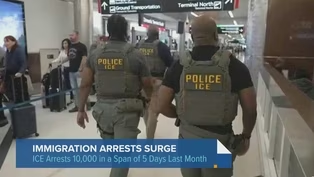
Reports of ICE Activity Surge. What Community Groups Are Seeing in Chicago
Video has Closed Captions
Immigration-related arrests are surging nationwide. (8m 29s)
Providing Support for PBS.org
Learn Moreabout PBS online sponsorship New Episode
- News and Public Affairs

Top journalists deliver compelling original analysis of the hour's headlines.
 New Episode
- News and Public Affairs

Today's top journalists discuss Washington's current political events and public affairs.

 New Episode
 New Episode
 New Episode
 New Episode
 New Episode


 New Episode
 New Episode
Support for PBS provided by:
Chicago Tonight is a local public television program presented by WTTW
WTTW video streaming support provided by members and sponsors.