
Dec. 29, 2025 - Full Show
12/29/2025 | 26m 49sVideo has Closed Captions
Watch the Dec. 29, 2025, full episode of "Chicago Tonight."
New laws are taking effect in the new year — what you should know. And America’s fight for independence is documented in a new series.
Problems playing video? | Closed Captioning Feedback
Problems playing video? | Closed Captioning Feedback
Chicago Tonight is a local public television program presented by WTTW
WTTW video streaming support provided by members and sponsors.
Dec. 29, 2025 - Full Show
12/29/2025 | 26m 49sVideo has Closed Captions
New laws are taking effect in the new year — what you should know. And America’s fight for independence is documented in a new series.
Problems playing video? | Closed Captioning Feedback
How to Watch Chicago Tonight
Chicago Tonight is available to stream on pbs.org and the free PBS App, available on iPhone, Apple TV, Android TV, Android smartphones, Amazon Fire TV, Amazon Fire Tablet, Roku, Samsung Smart TV, and Vizio.

WTTW News Explains
In this Emmy Award-winning series, WTTW News tackles your questions — big and small — about life in the Chicago area. Our video animations guide you through local government, city history, public utilities and everything in between.Providing Support for PBS.org
Learn Moreabout PBS online sponsorship>> thanks for joining us on Chicago tonight on Brandis Friedman.
Here's what we're looking at.
Hundreds of new state laws are taking effect in the new year.
How they could impact you.
And it was a time of deep Division.
No, we're not talking about our current political climate.
What about the American Revolution?
We revisit our conversation with filmmaker Ken Burns on his latest series.
>> First off tonight, just a couple days away from the big countdown to a new year.
And city officials say Chicago is ready, but after the deadly shooting that marked the city's Christmas tree lighting last month, top cop, Larry Snelling has this message for parents.
>> Have an idea of where your kids are because kids that go down there to act is out there doing something that they saw on social media they're going into downtown for that particular purpose.
And we want to make sure that if your kid is going somewhere check double check and triple check and make sure that that's where they're going to be.
>> The city says police officers will be enforcing a 10:00PM curfew for everyone.
17 years old and under and starting at 10:00PM Free Train and bus rides run until 04:00AM festivities will take place along the Chicago Riverwalk at Wacker Drive from Well Street to Lake Street within Mainstage Walker in Franklin and for more on performances and start times, please visit our website.
Chicago neighborhoods that had that used to have shot spotter saw a steep drop in homicides even after the controversial gunshot detection system was removed at the request of Wt Tw News, the EU, Chicago Justice Project analyzed crime data in those 12 south and West side neighborhoods that had shot spotter and found homicides decreased by about 32% between January.
1st and September.
22nd September 22nd marked one full year since Mayor Brandon Johnson scrapped the shot spotter technology despite attempts from some older people to keep the system in place, the city's budget that takes effect Thursday does set aside funding for some other software maintenance and licensing.
For more on check out our Web site.
And the weather event known as the Bomb Cyclone barreled across the Midwest, bringing blizzard conditions, roller coaster temperatures and even a tornado.
Forecasters say a bomb cyclone is a system that rapidly strengthens as surface pressure drops the sharp cold front left parts of central U.S.
as much as 50 degrees colder than yesterday.
Meanwhile, an EF one tornado damaged buildings and snapped power poles in central Illinois yesterday.
Forecasters say we're going to break from the high wind but not the cold this week.
What you should know about how some of the new state laws taking effect January first.
That's right.
After this.
>> Chicago tonight is made possible in part why the Alexandra and John Nichols family.
The Pope Brothers Foundation.
And the support of these donors.
>> The new Year is approaching quickly and with it comes a whole slate of new state laws.
Hundreds of new Illinois laws are set to take effect January 1st covering everything from AI regulation to background checks for police.
Here to walk us through some of the most, the most, the biggest additions and how they could impact who you are.
Brendan, more state government and politics reporter at Capitol News, Illinois and via zoom been Zelenskyy.
Also a reporter for Capitol News, Illinois.
Welcome.
Thanks to both of you for joining us.
Great hear British so friend and one of the was it allows Illinois residents to sue federal immigration agents if they are arrested near court houses or if they believe that their constitutional rights have been violated tell us that, you know, the Trump administration we know is challenging this new law in court.
What can you tell us about the Sudan and what it could mean?
>> brings this is expected.
So the law was a response to Operation Midway Blitz which results resulted in the arrest of 4500 folks up here in Chicago area resulted in a lot of clashes between federal agents and folks in the community.
So lawmakers enacted this legislation that allows for right of private action as well as provides a safe zone around courthouse is state court houses.
We knew that the federal government was going was going to file a lawsuit, basically saying that states cannot tell federal agents where they can and cannot what they can and cannot do that.
They can't regulate their actions.
So it's a see cause We will see house where things go.
yeah, another another of many, legal actions between the state and the Trump administration.
Right.
Of course, want to wait and see if a court.
>> Over turns that long, if it makes its way all the way to the Supreme Court, as many cases have when it comes to the Trump administration been zelenskyy another new law was created in response to the police murder of Sonya Massey last year tells the story behind this new law on what it does.
>> Yeah.
This was a super high profile incident that happened in Springfield where it's a new mask, black woman, woman was shot and killed by a white Sonoma County sheriff's deputy.
Really what we have found Capitol News, Illinois investigations as well as other cases, legal cases that have come out front of the jury and Shawn Grate son's murder trial earlier this year was that Grayson had a very troubled history.
He was the deputy who shot Sonya Massey and you get a lot of history of disciplinary issues and not following orders that other police agencies that hired him before he became employed.
And second, the county in Springfield.
So you know what?
The state lawmakers are really looking at here is trying to find a way to kind of to fix issue.
How did how did these disciplinary issues get overlooked and what this new law does?
It's a basically requires police departments to take a look candidates entire background go through disciplinary records at prior agencies and see if any candidates an issue before they are hired on to a police department.
So things like what happened was on Grayson at police agencies don't fall through the cracks.
>> Another law, Brendan is the family Neo-natal intensive Care Leave Act expands.
Family leave to a larger swath of employees.
How does that work?
Tell us about that.
One.
>> Yeah.
So this would basically require that employers of 16 to 50 workers to provide up to 10 days of unpaid leave 2 for employees that have a child in the NICU for larger employers at the up to 20 days.
So the FMLA covers larger employers as well as public employees.
So this would cover of some smaller employers and would cover part-time workers as well.
So it would basically say they says that the your employer has to meet in your health insurance and has to reinstate you.
Want leave is concluded.
And they also can't force you to use your paid time off in lieu of this unpaid time off in orders.
Take that time off with a baby in the NICU.
>> I've course a hot button issue in 2025.
That's not going to stop in the year 2026. tells one of the new laws that focus focuses on regulating AI in Illinois.
>> Yeah.
So this law basically prohibits the use of AI in employment decisions if they could discriminate against a protected class, you know, race, gender.
It also there's a provision in this law that prohibit discrimination based on zip code.
Basically, I mean, protected.
Classes already are protected from discrimination.
But that's just kind of clarifies.
The AI is AI is included in that, although it we should be clear that this is kind of a gray area because the Trump administration a few weeks ago enacted an executive order that is trying to rein in state level regulations.
The Congress is also indicated they may enact a law that preempts state AI regulations.
So this one and other ones that Illinois has enacted in recent years May may be limbo depending on what the federal government.
Right.
that point, you mentioned President Trump signing an executive order earlier this year focusing on deregulating AI.
It reads, quote, United States AI companies must be free to innovate without cumbersome regulation, but excessive state regulation for its this imperative don't know if the Illinois law that's going to count as excessive.
If this is the kind of thing that we'll see in court.
>> Another law, then it changes the way Illinois INS can store guns.
Tell us about that.
>> Yeah, this was a very controversial law, but also big priority for Democrats in Springfield and really kind of what it does is it creates a new penalty.
Is that really our design, unspent, advise people to make sure their guns are locked up and completely stored away from any children.
And that's so this really takes place when children are present, donors must be keeping their firearms in a locked container.
going to have some heco combination more than likely.
That is completely inaccessible to a child or really anybody else who's not be able to own a gun.
So as a gun owner is somehow found violation of this, there subject to some pretty high fines up to $10,000.
But, you one of the things that kind of is grandfathered in being able to report guns that are people who have their gun still missing under this new law still have 48 hours to report them is missing before they face any penalties.
But lot of new firearm regulations here as part of this law that are really designed to keep guns out of the hands of children.
>> Another law, we don't really have time to get into it.
But I do want to mention that Illinois's ending that one percent statewide grocery tax.
You all have reported, Brendan, that 656 me now with municipalities which covers about 56% of the state's population.
They've enacted their own local grocery taxes.
Setting that aside in just a few seconds, what else are you keeping an eye on in Springfield in the New year?
>> And one word the budget.
We've seen a lot of cuts coming from the federal government and economic growth slowing in some ways that's going to impact on on state coffers.
So a challenging budget every year.
But it's especially going to be this year, especially this year, been just a few seconds in question to you.
>> Yeah, same thing.
But also we'll be keeping an eye keeping an eye on the bears just to see it.
State lawmaker is pitch from the bears that they're going to move to Indiana's something that as any opinions in Springfield, Gary Bears and not just the Bears game this weekend against the Lions.
Brandon Morgan Zelensky, thanks to both for joining us.
We appreciate it.
spent just thank you very And for more new law set to take effect January.
First, check out our Web site.
>> Up next, a new series explores America's struggle for freedom.
We revisit our conversation with filmmaker Ken Burns.
The American Revolution, a new film from Ken Burns, Sarah Botstein and David Schmidt tells the extraordinary story of the Birth of the United States.
>> But if you think you're familiar with that story, think again, more than 9 years in the making this 6 part 12, our documentary series tells the Tale of the country's founding struggle from viewpoints.
You haven't seen before.
It begins with a reminder that the United States we now know was not the first nation here.
>> Long before 13 British colonies made themselves into the United States.
The 6 nations of the Iroquois Confederacy Seneca.
Okay.
You got Onondaga Tusker Oneida and Mohawk had created a union of their that they called the hold in the show me a democracy flourished for centuries.
>> Joining us now with more about this monumental project.
Our filmmakers, Ken Burns and Sarah Botstein.
Welcome to Chicago tonight.
Glad to have you both here.
It's good to be back there grass on this massive project is quite the cover and longtime sure it has.
So as we just heard, you begin with a different confederation of states, not so much the colonies that we know becoming United States, but specifically Native American nations that long predated the American revolution.
How important was it to begin with that context, Timbers?
Well, I think, you know what we're taught in grammar school is that the American revolution is about taxes and representation.
And that's true.
But it's also about.
>> Native American land.
And I I thought it was interesting as we learn more and more about it, that Benjamin Franklin had himself been inspired by the Hood initiative.
Is this Iroquois Confederacy and their model that had worked for a long time as a model for the United States.
And he convenes 7 of the 13 colonies in Albany drew a picture of a snake cut into pieces under dire warning.
Join or die.
And then we just realize maybe that shouldn't be in the body of the film.
It may be at the very beginning so that we could realize that with the revolution is is a World War, a civil war and a war essentially over the prize of North America.
And what is the prize?
This land?
What and that land is already occupied by 13 British colonies super imposed over the land of British of Native nations and to the anymore.
Native nations that are extraordinarily complicated groups, each individual and is different from one.
Another is say France is from Belgian and we want to make sure that was understood that at the heart that this is about moving into this new space.
Pence Laney.
It for is that so much more fun than many of us really And and many people don't fully appreciate.
Once you get into the war part, right?
Just how savage that conflict is.
>> Here's a clip discussing the aftermath of the battle of Bunker Hill in June of 17, 75.
>> It's for the most awful hours of combat in American military history.
There are 1000 British casualties that day.
Are 220 some British debt.
40% of the attacking force was killed.
2 injured.
40%.
That's horrendous.
The high casualty rate.
It is the highest casualty rate for the British army for the state.
Some in 1916.
>> It is unbelievably >> about time we hear from one expert who says part of the Revolutionary War report of the Revolutionary History has been sanitized.
What are we mis understanding?
We're forgetting about the revolution.
>> Well, I think, you know, we forget that the American revolution at least 2 things happening at the same time.
One is huge revolution of ideas and how government might be structured and who might lead that government and who might be responsible in selecting coup rules that government and the other is a terribly broody brutal.
Very complicated as Ken was just saying, 18th Century war in 18 th-century war is really terrible and awful and and scary and violent and dark and in order to really understand our founding story.
I think you really have to brave the 2 together.
You have to understand the revolution for war of ideas and ideals and then the war that was fought for those ideals and principles to have a have a run.
>> Buchanan, other conversations.
You talked about democracy being sort of an unintended consequence of the revolution.
What mean by So the idea is, first of all, there's a quarrel between Englishman that gets broken out into natural rights.
It's the and so they're thinking of arguments about why Britain is wrong.
And all of a sudden they're no longer saying where you said this and you deserve But human beings themselves by being human beings deserve that natural Jefferson is going to say all men are created.
Equal value owns other human beings.
The cat is out of Now.
Human beings are going to have to be equal even though it takes 4 score 9 years have been in the United States.
That's over.
So things are beginning to change and more in the world.
And the American revolution is leading that change of how these ideas are moving.
So this assumption of democracy is that these people are going to come together and create a republic.
They mean of an elite almost like the example that kind of we inherit from from Greece and to a lesser extent, Rome.
But the people are going to fight and die and win this war or so-called ordinary people and they're going to have to they're going to deserve something.
So you can say that democracy is not an object of the American revolution.
It's a consequence of that.
And there's a big difference of that.
And we are all the beneficiaries of that big difference.
>> So obviously lots of voices, reenactments footage over 9 years of work.
We hear a number of very familiar celebrity voices how do you think the series is different from any other document reviewed?
And well, you know, first of all, goes back to what Sarah and you were talking about with with the violence.
You know, if you've got to photographs, if you get the newsreels, the violence is proven.
But if you've got a painting and 70's got Havana and maybe there's even a little trickle into field they seem different for us.
>> It is.
They are very much like us.
So I I think this is a story about how you tell all the real story of the revolution and you get under the surface of it and and forget the distance and time and a lot of it doing reenactments.
A lot of it is asking.
>> The finest actors in the world to read off camera.
And I think we have that better cast than any film that's ever been made or television series ever.
That helped bring alive.
Not just the familiar top down folks and you get to know Washington a little bit better with more dimension.
dozens scores of other people that you've never heard of.
Sometimes they're teenagers, sometimes a Native American.
Sometimes free or enslaved black people.
Here women who are half the population and are central to the success of the revolution and to keeping the resistance alive, whose stories are told, but also all the other players in this group, global struggle, the French, the Dutch, the Spanish English, all of their soldiers.
>> All of their kings, all of their ministers.
And so what you do is by having all of these different voices, you give a sense that this is what really took place.
And instead of putting your thumb on one side or the other, you're an umpire calling and strikes and everybody's got their play.
Everybody understands their role in it and you can make it the complex.
I think most interesting story we've ever tried to tell.
>> So we've got another clip.
This one about the belief of those who are fighting for their independence.
Here's that.
>> I think to believe in America.
Rooted in the American revolution.
>> Is to believe in possibility.
>> That to me is the extraordinary about the Patriots side of the fight.
I think everybody on every side including people who were denied even the ownership of themselves.
>> The sense of possibility we're fighting for.
>> So, Sarah, when watching the film, there are times that you would expect the British to prevail in a particular battle.
And that's kind of what you know, we all learned in 5th grade as well.
You know, very well trained and organized been, you know, you expect him to win the battle and then the war.
But of course, that's not always what happens in We know that history has written what actually has happened.
What does that say about, you know, the the Americans who call themselves patriots at the time they misunderstood.
I don't think the Patriots were misunderstood as much as I think we don't understand how.
>> Absolutely unlikely it was that we were going to win.
How surprising it was that we were going to win, that we were able to throw off the biggest, most mighty military power in the world with the greatest navy in the world.
And we actually wouldn't have done that without the French.
But I think the Patriots were very successful as they moved from 17, 75 to 17.
81 down the eastern seaboard and rallying support, inspiring people.
I think the words of our declaration more meaningful.
I think the war nobody knew how it was going to turn out while it was being fought.
So we look back on it with a lot of ideas.
And I think we overlay the revolution even more than our other wars and are other moments in history with as can often says, a kind of sentimentality and where it's a distance because of the paintings, because of it's 250 years ago.
And the people who we know come down Sunday's paintings with wigs and, you know, they were young revolutionaries making it up as they went.
They didn't know how it was going to turn out.
People on the ground did know how it's going to turn out.
And it is really unlikely that we were able to do what we did.
Tell they're a little bit about the importance of the Native American nations as well as black people.
African-americans be free or enslaved for both sides of >> this war.
So I think, you know, you can't tell a story of America without widening the lens to see who is actually living here and who was fighting the war and who if that, whatever way the war went was going to be impacted by it.
And so in any film we make, we want to widen the lens and have people think about who's on the ground in the house next door to you who lives down the street and the Native American populations were vast and different and there were hundreds of them and they were not a monolith.
Just like no population as a monolith.
And free black people.
We're all different and the enslaved back and people made all kinds of very reasonable and rational decisions that, again, we look back and judge and more lies about when, in fact, it was very reasonable to side with the British.
It was very reasonable to be a patriot and was very reasonable to say.
What does this have to do with me and get out of the way as we see even today speaking of today because we're living through a tumultuous time, of course, which there's this, you know, bitter political division in the country right now.
>> Can as you're working on this film, was there any you know, of that deep division that you felt still resonates today?
Well, I think first of all, the one we're covering the American Revolution is deep Division.
We began this when Barack Obama and 13 months ago on his presidency.
So we've been watching the rhymes of history.
The echoes of history changes.
We've done it.
>> But here's the central thing.
When person is in a struggle, having great difficulty, they go to a professional and the professional wants to ask an essential question.
Where are you from?
Tell me your story.
Tell me about your parents.
How did you get to where you are right now?
Because that's the way we're going to unravel what's going on right now.
The difficulty you're having.
So if you go back in a time of great division and internal turmoil for an entire country, you go back to your origin story and find out where you begin, you might be able to find the pieces in which it's your less thrown out by how much division is.
There's always been division, but you might find the path back to how you solve that.
So we're hoping that if anything, this story does is help put the U.S.
back in the U.S.
and and permit a chance to celebrate the glories of what we invented.
This is the most important event in world history since the birth of Christ.
He changed the way people were.
Everybody was a subject up until then and all of a sudden there are people who are citizens and the great responsibility that entails.
That's about as inspiring a story as I know.
And maybe it helps us get back to a place where there's less of that hand wringing less of the sky is falling.
Less of the sense of oh, it's so bad right now.
It's been a really bad.
It was bad in the revolution, a civil war.
It was bad during our civil war.
It's been bad at lots of different places that we've covered in the work that we've >> done together.
And so think there's a fundamental optimism.
When you study the past, there's also a fundamental sort of psychological therapy that takes place.
If we learn our origin story, we can help us get through this and begin to move on to the next grade phase, which is repair.
>> All right.
Around the it has been a pleasure and an honor to speak with you both.
Ken Burns and Sarah Botstein, thank you so much for joining us.
Congrats on the documentary series.
Thank you.
Thanks for having us.
And we're back right after this.
>> And that's our show for this Monday night.
Sign up for our free email newsletter.
The Daily Chicago one at W T Tw Dot Com Slash newsletter and join us tomorrow night at 5, 30 10.
Some residents are pushing for voters to decide whether local leaders should pull the plug on a massive quantum computing development on the city's south side.
Now for all of us here at Chicago Brandis Friedman, thank you for watching.
Stay healthy and safe and have a good night.
>> Closed caption is made
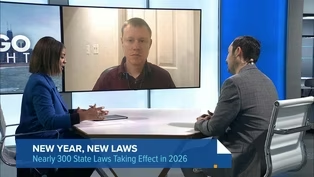
Nearly 300 New Laws Take Effect in Illinois in 2026. What to Know
Video has Closed Captions
Clip: 12/29/2025 | 7m 47s | The new year is approaching quickly — and with it, a new slate of laws. (7m 47s)
Providing Support for PBS.org
Learn Moreabout PBS online sponsorship
- News and Public Affairs

Top journalists deliver compelling original analysis of the hour's headlines.

- News and Public Affairs

FRONTLINE is investigative journalism that questions, explains and changes our world.








WHYY Series
Support for PBS provided by:
Chicago Tonight is a local public television program presented by WTTW
WTTW video streaming support provided by members and sponsors.