
Feb. 10, 2026 - Full Show
2/10/2026 | 26m 48sVideo has Closed Captions
Watch the Feb. 10, 2026, full episode of "Chicago Tonight."
Mayor Brandon Johnson vows to fight back after the Trump administration denies a disaster relief request. And why unplugged oil wells could cost Illinois residents more than $1 billion.
Problems playing video? | Closed Captioning Feedback
Problems playing video? | Closed Captioning Feedback
Chicago Tonight is a local public television program presented by WTTW
WTTW video streaming support provided by members and sponsors.
Feb. 10, 2026 - Full Show
2/10/2026 | 26m 48sVideo has Closed Captions
Mayor Brandon Johnson vows to fight back after the Trump administration denies a disaster relief request. And why unplugged oil wells could cost Illinois residents more than $1 billion.
Problems playing video? | Closed Captioning Feedback
How to Watch Chicago Tonight
Chicago Tonight is available to stream on pbs.org and the free PBS App, available on iPhone, Apple TV, Android TV, Android smartphones, Amazon Fire TV, Amazon Fire Tablet, Roku, Samsung Smart TV, and Vizio.

WTTW News Explains
In this Emmy Award-winning series, WTTW News tackles your questions — big and small — about life in the Chicago area. Our video animations guide you through local government, city history, public utilities and everything in between.Providing Support for PBS.org
Learn Moreabout PBS online sponsorship>> Hello, thanks for joining us on Chicago tonight on Brandis Friedman.
Here's what we're looking at.
Mayor Johnson pledges to fight back after the Trump administration denies the disaster relief request for Chicago residents.
Health concerns over abandoned oil wells that could cost Illinois taxpayers over a billion dollars will clean up.
>> The Chicago reader returns after a short hiatus.
Run to the grocery store or make a trip to the hardware store buy a new car.
>> Not so fast.
Not on Sunday before.
And we explain why you can't buy a car in Illinois on Sunday.
First off tonight, as officials in Indiana continue to woo the Chicago Bears to their side of the state line.
And Illinois lawmakers are.
>> Reportedly nearing a deal to bring the team to suburban Arlington Heights.
Mayor Brandon Johnson still maintains the Bears belong here.
>> More people visiting the city of Chicago than we seen.
Our airport is busier than it's ever been to the economic vibrancy in our city is strong.
To your point about those 2 locations.
Hammond, only tonight's.
They should gago.
>> And today the city of Portage, Indiana entered the chat saying it has a perfect location on its north side.
Portage mayor saying on social media, quote, it's a place where the highway, the train and Lake Michigan all come together and its position to become one of the most advanced destination concepts in the world.
Mayor Austin Bonta says it's planning a news conference tomorrow to share more details.
And mark your calendars early voting for the state's March primary starts as soon as this Thursday.
If you're heading to the city's downtown Super site location this year with a new address.
>> There's more space to our We have 80 voting machines and we have more prepared primary elections where we see a little bit of lower turnout.
We're ready for as many voters as we can have when it comes to our voting machines, though, there is not any major changes.
We are really business as normal.
>> The Chicago Board of Elections says it's in the process of testing voting machines after new super site location at one.
37 South State Street at Adams, meaning it is no longer at the secretary of state building at Clark in Lake, the new site opens this Thursday at 09:00AM early.
Voting opens at one location in all 50 wards on March.
2nd.
The city is fighting to bring disaster relief to affected residents right after this.
>> Chicago tonight is made possible in part why the Alexander and John Nichols family.
The Pope Brothers Foundation.
And the support of these donors.
>> Mayor Brandon Johnson is once again vowing to fight the Trump administration.
This time after the federal government rejected a disaster relief request for Chicago, residents still struggling to recover from severe storms last summer.
Here's the mayor at City Hall news conference earlier today.
>> We're going to push back obviously in.
Yeah, it's unfortunate that administration has shown so much animus towards working people.
But I'm gonna use every single tool that's available to me to protect our people in our city.
But to ensure that we receive our fair share from the federal government, particularly when these families desperately need relief as quickly as possible.
>> And our head to Sharon joins us now to break down this latest point of conflict between Chicago and the federal government had to remind us what happened in August.
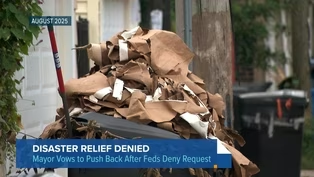
It was very stormy month and for some people on the city's southwest side, their houses flooded twice in 3 weeks as part of a severe storm that sent a deluge of rain water into the city sewer system.
Overwhelming them sending raw sewage into their basement and first floor and forcing them to struggle to make their houses livable Very big mess there.
The mayor wasn't the only elected official there to criticize the decision by the Trump administration.
He was not.
Governor JB Pritzker called it a, quote, new low for the president and said it was politically motivated.
Cook County Board, President Toni Preckwinkle accuse the federal government of turning their back on some of the people who need help the most.
Now to be clear, Illinois wasn't the only state to be hit by the storms, but the president approved just asked or declarations for Alaska, Nebraska, North Dakota, as he pointed out on social media, those 3 states voted for him in the 2020 2024 elections.
Illinois, Vermont and Maryland who had their disaster requests rejected, did It used to be routine for presidents to approve the governor's request for disaster assistance in cases like these what does the Trump administration up Well, they say they reviewed these requests carefully and they wanted to make sure that tax dollars was used appropriately.
They say responding to disasters of the responsibility of states, not the federal government, but this is clearly another instance where President Trump has not shied away from publicly using his power as president to reward those he sees as his political friends and punish his political opponents.
Of course, Illinois and Chicago has long been at the top of that list.
What can Illinois elected officials do now?
Well, the mayor said he's going to continue working with this with the city's congressional delegation.
Perhaps there's some money that can be stuck in a bill somewhere along the line.
I guess the city and the state could try to sue the federal government.
That's not clear.
The city has any recourse since this is a presidential decision and may not be subject to just due to shul oversight contender Sharon, thanks so much.
Thanks, Brandis.
And you can read full story on our website.
It's all at W T Tw Dot com Slash news.
Illinois taxpayers could be on the hook for more than a billion dollars due to tens of thousands of unplugged oil wells at risk of abandonment across the state.
A new report from Northwestern University says those unplugged wells could wreak environmental havoc.
We can talk sit chemicals into groundwater.
Joining us to break down that report is Robert Weinstock director of the Environmental Advocacy Center at Northwestern University's School of Law.
We also invited the Illinois Department of Natural Resources who declined as well as the Illinois Oil and Gas Association, which did not respond.
Robert, thank you for joining us.
Thank you for reading.
So your report found that the Illinois Department of Natural Resources tracks over 30,000 oil wells in Illinois that will eventually need to be kept unplugged appropriately.
What are the danger, dangers of leaving those Wells Unplugged.
>> Thanks.
So unplugged.
Oil.
Well really creates 3 categories of environmental hazard.
First.
>> Many of these wells leak methane, which is an incredibly potent greenhouse gas fueling climate change and contributing to the extreme weather events we've seen on oil just like was just featured on the program.
Second.
Well, it can leak contamination into groundwater and in downstate Illinois, many of our residents get their drinking water in their homes from private wells on their land.
Right from the same groundwater aquifers that these wells can be leaking.
All sorts of carcinogenic and other toxic chemicals into and then finally, some of some of the pollution from these wells can lead directly into the soil.
And in southern Illinois, you're talking about really productive agricultural soil.
That can be fouled by the contamination from these wells causing it to be worthless as the farmland is and could one of these unplugged wells look like.
And it sounds like you're saying many of them.
Most of them are in downstate Illinois where they that's right.
There heavily concentrated in southeastern what it looked like when we if I'm driving through southeastern Illinois, what I Yeah, I mean, really ranges.
That was one of the things that surprised me in doing this research.
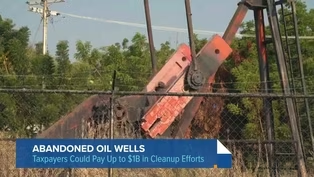
Sometimes it is sort of that iconic oil, derrick, that you might imagine.
And the Southern California skyline or something like that.
I sort of with right other times.
It's just a pipe sticking out of the ground.
Many times.
It's that pipe, which is the actual top of the of the boring along with all sorts of equipment or infrastructure left over from oil drilling, that might be tanks.
That might be small pipelines running out.
That could be actual waste pits itself.
It really varies quite a bit from site to site.
So in 2025 official records identified over 6,000 wells as requiring immediate closure.
But you find that the majority of Illinois's 30,000 plus wells.
>> Are currently tracked are likely at high risk of abandonment.
Why is there this discrepancy between the official records and what your report has found?
So our report is based entirely on idea our records.
And what we did was we looked at it in different ways so that 6,000 number actually sort of 2 buckets combined its one, a group of about 4,000 wells, which have been formally orphaned.
So the state has can't find the entities that are responsible for cleaning them up.
They've been abandoned by the oil companies that drill them in the first place 2000.
More of those wells, the state has identified a permit holder.
So someone who's supposed to be legally responsible for the cleanup.
They've sent that person a citation saying it looks like you're well as an active in time to be closed and that person hasn't responded, hasn't acted on that to fulfill that legal obligation.
30,000 is the entire set of wells that the that the state tracks in its pomp with through its permit program and the state itself says more than half of those are producing about a barrel or barrel half of oil a day at most, which makes them economically unproductive.
So what are they doing?
Still an close if they're not producing useful oil, I would also say there's another number that that's in the report that's really important, which is 155,000.
That's the number of wells that the state estimates have been drilled in Illinois throughout history of the oil That number is really important because those old can track them.
So the 120,000 wells out there that the state can't even tell you where they are when they stop producing oil or if they're properly closed early to be remediated further.
And of course, we know the state of Illinois is not producing the way it did years past when 155,000 wells, we're dog.
Yeah.
Over production.
Certainly down.
We're still the 16th largest oil producing state in the country and we still do produce useful products from some of these wells.
The problem is that trend line, it's less and Meanwhile, all these older wells are sending their top with the potential for extreme environmental and public health impacts and the companies, some which are there.
Others are disappearing day by day.
Many of them like you said, they've been, you know, abandoned by owners.
What does it mean for well, to be become abandoned who becomes responsible?
>> Because it cost to to clean it up to cap it and then to close that well off.
So should be responsible for this.
Well, state was actually quite clear that the people in the companies that drill those wells are responsible for closing them at the end useful life.
>> Closing them and cleaning up the site however, companies, many companies, certainly not all, but many simply walk away from their obligations in other states.
There's been documented cases where larger companies have sort of Well, that's no longer really making any money sold to a small company that they know is going to go bankrupt and that small company then declares bankruptcy, leaving the well clean up to go to the state.
And that's really orphan.
Well, program I mentioned before is the state's way to deal with that?
Unfortunately, it's wildly underfunded.
Most of the work done and that well, and that orphan well, program has been done using limited federal funds that come from all of our taxpayer dollars.
Your report also shows difficulty tracking a lot because of data collection.
House, Illinois compared to other states.
Yeah, this is one of the most remarkable things I think we found is that Illinois is an absolute laggard when it comes to simple data collection.
And you compare that I'm nationwide.
So any other state that produces significant quantities of oil, you can go on a publicly with helpful website.
Largely there's interactive Web sites where you can say that seems to be a well on my property who owns it, how much oil's of producing one was a drilled in Illinois?
None of that data out.
First of all, the production data isn't collected at all and much of those other pieces you have to go through and do for follow-up.
Put in formal records request to the agency and get that data.
Why is that such a big problem?
That lack of production data tracking because that's the easiest way to telephone.
Well, is no longer producing oil is just to ask.
And the agency doesn't do that.
The agency sends inspectors out routinely.
Sometimes they spot old wells, but they don't do the very simple thing of requiring the producer simply to tell them how much oil are you producing?
And then when those reports stop coming in, the agency would know it's no longer producing.
Let's go shut it down.
What are the steps that this state has taken so far to mitigate some of the dangers of these unplugged wells will.
So as I mentioned, the state, the only department natural resources has done a really great job in going out getting federal funding that was available under the Biden infrastructure law.
The bipartisan infrastructure law passed under President Biden.
They've they've receive that money.
They're spending it.
They are using that to plug a limited number of wells that they can with those proceeds with the with the revenues from the federal taxpayer That's great.
What they need to do is take these other steps and laid out in our to actually prevent wells from becoming orphaned in the first place to make sure the companies that profited from them actually pay to close and then to create a system whereby we know that the oil industry through permit fees through bonds that are appropriately set that actually match cleanup costs will be the one paying for the mess that they made a That's where we'll have to leave it.
I'll be curious to see how the state responds based on this report going forward.
Robert wants thank you so much.
Thank you.
Appreciate it.
Up next, the new editor-in-chief of the Chicago reader on her vision for the future.
>> A new era of the Chicago reader is here.
The city's most recognizable alternative newspaper has focused on arts culture and investigations since its founding in 1971.
But a few years of financial hardship.
But the paper on a brief hiatus last December until now, the reader has a new leader who says they are here to stay.
Joining us to discuss the rears new direction is the paper's new editor-in-chief, Pulitzer Prize winning investigative journalist Sarah Conway.
Welcome back.
Thank you for your address on the gig.
Thank you, So tell us about the readers first edition back.
We've got the cover here.
Newegg who did I love that.
It's very, very reader.
Thank more.
Thank you.
We wanted to come back with a splash.
We are a 50 year plus publication.
>> And we move from publishing weekly to publishing a print monthly magazine.
So we're going to be at over 600 locations across the city every first Wednesday of the month.
And we are now a print monthly newspaper, which means that.
We are going to be bringing new features investigations, a culture, Kerry to calendar called Reader Radar, which is full of events from like civic things you should be involved in 2 concerts plays movies events that should be on your radar that we really want Chicagoans to see to get out and, you know, participate in the city the reader in many ways is still its classic self are still breathing.
Bringing you criticism reviews and news about what's going on in the city.
But our print monthly is really going to be something that we want as sort of this analog paper.
Product to literally live in your home.
We wanted to be something that readers can really sit with.
And I think all the buzz that goes on that we're all living on social media, a digital life and to have a product that we're not giving up on.
We still see value in having a a print publication and it will in in this in this new addition, the that just came out last week.
What are some of the stories that folks can read about in the latest?
My favorite of share with you a couple.
My fear is right.
There's a lot of really great content.
I think we have an amazing editorial staff, our writers in our editor's, some of them that Bennett, the paper for decades.
And I personally and so proud to be a part of a publication that has an intergenerational staff that, you know, is from all over the city and Israeli making a vested interest to be more representative of Chicago.
Look, we want to be a publication that is truly a city paper that you see yourselves in our pages.
Some of my favorite stories, I would say KT Proud is a features writer.
We have.
She's doing a series on.
It's called Just neighbors.
That's going to be looking at the city's complex interpreter, interdepartmental process dismantling encampments.
And Katie really wants to show the human light out those policies have on people experiencing homelessness in the city.
On that going to be an ongoing series.
We have.
We also started a new series on that is an accountability series about the quantum campus.
It's it's done by a contributor named Gray Lucas and our first story in that series is really looking at community perspectives of this mega development that we know, you know, acquired many tax dollars from the state and has, you know, many different people and entities coming to the That's another feature that is also just extremely the layout is is so beautiful.
We have really talented people on staff.
And then we also looked at a program that was from the poetry Foundation.
Was the adult poetry programming kind of taking a look at like the human impact of closing these programs in the ways that people participated in them.
So those are 3 stories and also to shout out knows the launch of our first calendar, like our events calendar, the future radar.
So that's another thing to look out in the print product of which, yeah, I know.
It's very exciting for so, you know, coming back to print first Wednesday of every month.
But we do journalism in print journalism, in particular.
>> Been taking some hits.
The Atlanta Journal Constitution discontinuing print at the end of last year.
What do you think its important to to maintain a print presents?
you know, how do we get the viewers, the readers, the listeners to come back?
So I think print is very important for a few reasons.
One, I think that print is also about accessibility.
You know, not everyone can read or access to digital news.
>> And I think that we also have this flurry of digital information and I think having a print product that we distribute throughout the city that we're going to expand distribution beyond the 600 plus sites that we have currently is we we can make sure that Chicagoans can access news, particularly city news.
I think secondly, that it's really important to maintain in this digital age as we know the rise of AI like the ever, you know, attention grabbing things from social media that we have print things that people can have physical media, that they can keep in their home that they can sit with and really, you know, take time to understand.
And so that's really what we want our print publication to do is to be something you have in your home that you're using as a guide, you know, to understand the city and for thing that you physically pass on to others.
But we are still very much a digital newsroom.
We publish stories daily and we're going to be expanding that coverage this year.
We're going to be leading into doing more news and political coverage as well investigations and features as part you know, the the I would say the footprint of the reader online.
>> So we know that Chicago reader been around, as you said, for more than half a century on its hands on years of recently of some financial turmoil, changing ownership.
At one point, you know, in that risk of closure.
But you're under new ownership now you've got noisy creek.
Tell us a little bit about that company and and how you know you and they sort of work together to deliver.
What we all know is alternative journalism Chicago.
I think this is very interesting as a I see myself as a local journalist.
Look, I love local news and very vested in local news because I think news is so important in our society.
>> It is like one of the entities that protects the public and I think shines a light on things.
And so.
Noisy creek is a network of old newspapers right now.
It is the Chicago reader, the Portland Mercury in the strangers.
So it's been very interesting to be part of a a company that's a national company, but it is really like a constellation of old newspapers that eventually is going to be lax, indicating news between them and so noisy.
Creeks approach, is they?
It's a decentralized model.
We have these autonomous old papers, which I think is very much in the legacy of what the reader is like.
The reader is the, you know, like weird strange.
And I think in a lot of ways subversive newspaper that's been around for, you know, 50 plus years in Chicago and and means so much to people.
It's like one of those papers that I think about my own relationship to it was really the first place that I read literary journalism that I saw, you know, investigations that we're looking at things in a slightly different way than I would say.
Traditional news looks at them.
But also, you know, my my old landlord, she grew up.
She was a teenager when the new the reader came out.
And so you have these whole generations of people even within a family that see this publication have a relationship with it.
And I think the thing I really value about creek is that they are invested in keeping the reader life that they see that old newspapers are critical part of American life of civic life and that they should exist and really creating a model that's more sustainable that they can before we let you go, 600 locations.
Where can one get a physical copy of the reader?
So are locations or cross universities in the city coffee shops.
We also are in libraries.
So probably many of the civic spaces that are in your neighborhood that you love.
You can also go to Chicago reader dot com and look at the map to find an exact spot.
There you go and grab your copy.
We have our bartch.
Our marsh hit faster.
Chicago issue coming up first Wednesday entry to readers know where to find it.
Yes.
Sarah Conway, congrats.
Thanks so much.
Best of Luck.
Thank you.
>> Up next, we explain why buying a car on Sunday is a no-go.
It is that time of the year again, whether you are in the market for a new car or just an auto enthusiast.
The Chicago auto show is happening right now through Monday at McCormick Place.
Now, if you happen to get inspired to buy a new vehicle.
Remember, though, in Illinois you can't do that on a Sunday.
Nick Bloomberg has the story in this edition of our series W T Tw News explains.
>> The weekend, the perfect time to knock a few items off the old to do list, run to the grocery store or make a trip to the hardware store buy a new car.
Not so fast.
Not on Sunday since the 1980's, it's been illegal for car dealerships to operate on Sundays in Illinois.
Why?
Well, some owners and employees wanted to shut down to spend time with their families or for religious reasons, but and pay attention.
This is the key.
They didn't want their competitors to pope and have a chance to steal business.
The first attempts to close down dealerships on Sundays date back to the 50's and 60's.
But those laws never made it off the lot.
They were veto struck down courts.
But since 1984, Illinois car dealers must close their doors on Sundays.
Illinois isn't alone a dozen other states don't allow Sunday car sales either.
It's a vestige of so-called blue laws barring certain activities on the basis of religion like, say, buying a sports car on the 7th.
The religious angle is one reason Illinois's ban has been challenge multiple times.
One alternate proposal still restricted car sales to 6 days a week.
But a lot of dealerships to which day they take since, for example, Jews and Muslims don't observe a day of rest prayer on Sunday, some pro business groups argue the law restricts free commerce.
But so far, Illinois this Sunday car sale ban on the books would be test drives off the roads.
So if you're looking for a hot deal on a new set of wheels, you'll have to look day.
>> You can see more from our W T Tw News explains series on our website.
And that's our show for Tuesday night.
Join us tomorrow night at 5, 30 10 Congress members are at odds over how to reform the Department of Homeland Security has funding deadline looms.
Now for all of us here Chicago Brandis Friedman, thank you for watching.
Stay healthy and safe and have a good night.
>> Closed captioning is made possible.
Why Robert, a and Clifford A Chicago personal injury and wrongful death and

Chicago Reader Returns After a Short Hiatus
Video has Closed Captions
Clip: 2/10/2026 | 7m 46s | The beloved publication has focused on arts, culture and investigations since its founding in 1971. (7m 46s)
Johnson Vows to ‘Push Back’ After Trump Administration Denies Disaster Relief
Video has Closed Captions
Clip: 2/10/2026 | 2m 57s | Storms flooded basements across the Southwest Side twice during the summer of 2025. (2m 57s)
Taxpayers Could Be on the Hook for Cleanup Costs From Old Oil Wells
Video has Closed Captions
Clip: 2/10/2026 | 7m 57s | A new report says unplugged wells could wreak environmental havoc, leaking toxic chemicals. (7m 57s)
Providing Support for PBS.org
Learn Moreabout PBS online sponsorship
- News and Public Affairs

Top journalists deliver compelling original analysis of the hour's headlines.

- News and Public Affairs

FRONTLINE is investigative journalism that questions, explains and changes our world.












Support for PBS provided by:
Chicago Tonight is a local public television program presented by WTTW
WTTW video streaming support provided by members and sponsors.