
How an Impending Court Ruling Could Impact the Police Disciplinary Process
Clip: 12/22/2025 | 17m 45sVideo has Closed Captions
An impending Illinois Supreme Court decision could greatly impact police disciplinary hearings.
The Illinois Supreme Court is weighing in next year on whether serious police misconduct cases must be heard publicly. This comes after the Fraternal Order of Police — the city’s largest police union — appealed an earlier ruling from a lower court requiring public disciplinary hearings.
Problems playing video? | Closed Captioning Feedback
Problems playing video? | Closed Captioning Feedback
Chicago Tonight is a local public television program presented by WTTW
WTTW video streaming support provided by members and sponsors.
How an Impending Court Ruling Could Impact the Police Disciplinary Process
Clip: 12/22/2025 | 17m 45sVideo has Closed Captions
The Illinois Supreme Court is weighing in next year on whether serious police misconduct cases must be heard publicly. This comes after the Fraternal Order of Police — the city’s largest police union — appealed an earlier ruling from a lower court requiring public disciplinary hearings.
Problems playing video? | Closed Captioning Feedback
How to Watch Chicago Tonight
Chicago Tonight is available to stream on pbs.org and the free PBS App, available on iPhone, Apple TV, Android TV, Android smartphones, Amazon Fire TV, Amazon Fire Tablet, Roku, Samsung Smart TV, and Vizio.

WTTW News Explains
In this Emmy Award-winning series, WTTW News tackles your questions — big and small — about life in the Chicago area. Our video animations guide you through local government, city history, public utilities and everything in between.Providing Support for PBS.org
Learn Moreabout PBS online sponsorship>> The Illinois Supreme Court is set to weigh in next year on whether serious police misconduct cases must be heard publicly.
This after the Fraternal Order of Police, the city's largest police union appealed an earlier ruling from a lower court requiring public disciplinary hearings.
The case comes as the Chicago Police Department continues to work under a consent decree monitored by a federal judge.
How to handle discipline is an important part of that process as well.
Joining us to discuss that and more are John Catanzara president of the Fraternal Order of Police.
Chicago Lodge 7 Kyle Cooper, president of the Chicago Police Board.
David Melton and attorney with the Chicago Council of Lawyers and Jasmine Smith, an organizer with the Chicago Alliance against Racist and political repression.
We also invited the Chicago Police Department, but they declined to join us.
But we think the 4 of you for joining us this evening.
So, you Kyle Cooper for folks who don't quite know what the police board does.
Can you give us quick overview of its makeup and its mission?
Sure.
And take so much for having me.
Nick, really appreciate the invite to the Chicago Police board has 5 main functions.
One of them is hearing disciplinary cases involving the most serious cases >> of misconduct.
So cases where the punishment could be discharged from the CPD are suspension for over a year.
The board also has for their core functions.
We hear appeals by applicants who are looking to become police officers who are removed from the eligibility list due to the results of a background investigation.
We also hold monthly police board meetings where the superintendent and other key stakeholders are tend.
And we also propagate the rules and regulations governing the Chicago Police Department.
And after we are currently undertaking to revise in 2026.
So those are the core functions of the Chicago Police board and who sits on the board.
The board is made up of 9 members, all of which have to be citizens in who reside in the city of Chicago.
If the board also has to be composed of at least 2 lawyers community activists, a former or current law enforcement official.
So the board is comprised of a panoply of different backgrounds and professional experiences.
All of whom are Illinois in Chicago you know, Titans are the system of open police board.
Hearings has been in place for decades.
>> Why are you looking to change it?
The provision with in the contract has been there since the inception of the police board.
There's always been provision that said either party can opt out of that provision within the collective bargaining agreement.
All we did was exercise that option within the agreement for very specific reasons.
give you some quick stats here.
From the preceding years to taking office 2017 to 21.
There were roughly 49 police poured cases.
32 of those were recommended for termination.
The police board upheld.
32 of those 66%.
It gets worse, though.
that same time frame, the superintendent disagreed with Kopas recommendation of termination on 17 cases.
15 of those the police board upheld.
termination case is 88% of the time they overruled the superintendent's recommendation and still fired and upheld Kopas recommendation that excessive percentage of it was you're a dead man walking or woman per se with your career.
Let us to exercise that option within the contract.
And I will tell you, I'm sure cows come and go and say, well, those percentages are different.
Now, of course, it is because we exercise the option and we were granted relief from the courts who upheld that.
And now it's 3rd trying to justify their viability.
Long-term survivor Kokomo.
How about the yeah.
I think if you look at the heart doubt, especially let's talk about 2025.
The police board decided 5 cases this year.
>> In 3 of those cases, the board voted in favor of exonerating the officer to see this conduct.
And one of those cases, the board decided that a suspension was the appropriate amount of punishment and only one case in 2025.
To the board vote to remove a discharge.
officer from the Chicago police work.
If you look at the statistics since 2021, the percentage of cases in which the officer accused of misconduct was discharged from the Chicago Police Department.
It was around 2022%, which is in line with the number of cases where the officer who was exonerated and the number of cases where the officer was suspended.
So this to sticks in the stats.
Show a story where of the board is acting in good faith in taking each case on a case-by-case basis.
And so those allegations of bias or there's some anti police rhetoric I just think are completely unfounded.
And you have to look at the numbers to see David Melton, how do you see it?
I mean, are calling strikes?
selectively cited some statistics.
>> 50's he cited are from the post Laquan McDonald era.
People remember that in 2014 to 15 aquatic shot by police officers.
That shooting was unjustified.
And in the wake of that shooting, the police board procedures and membership was revised to make it fairer before that shooting.
If you look at the statistics in 1960, up to 2017, you will see that a disproportionate numbers of officers who did engage in misconduct were let off by the police board notwithstanding country findings by arbitrators.
So that process needed to be reformed to make a fair not only to police officers, which we want to be, but also to the victims when they engage in misconduct.
And that's what those reforms following one McDonald shooting accomplishment.
You know, Jasmine Smith, CPD has long had strained relationships with some Chicago communities.
>> Could a closed-door arbitration process, you know, make efforts to improve those relationships more difficult.
>> Yes, it would.
It would make it home.
if one is going to get a whole lot day when it comes to commend you trust in the police, know we then generations of done with it.
No accountability, really with offices when it comes misconduct when it comes to killing someone, they're not be in charge for the crimes that it they get a slap.
Some, madam.
even are even being fired.
But can a was sung like we have so many kids that within a week what a police kill a that protects, protection stops or no just Nick Pickett liking it and violating laws there's been put in place tonight.
Do not chase like chasing someone.
shooting and not be able to come for like Valley and those type Miles.
So it's just a lot when it comes to that trust with the police There's no accountability.
And if trying hide things but closed doors, have you know, because closed doors.
What is they really seen if you don't have anything ahead?
Why would you want to head things discuss?
Your case is ankles.
injunctions are, you know, if you're concerned about the system here being biased against police officers.
>> Could public hearings a public process be to your benefit so that people can witness any of that out in the open?
Well, let's tackle a couple things here because it is a little 3 on one dynamic.
So let's start with David's point about 1960, are we serious?
We didn't have collective bargaining rights to 1981 when that provision began.
Number one.
So again, we exercise that option within the contract and we can talk about the Laquan McDonald Post kind of police port existence.
But Kyle made my argument for me.
The recent that the percentages have dropped just cause they're trying to justify their existence, knowing that termination for arbitration is going to be the path forward and they're going to be forced into irrelevance at that point.
And then Jasmine brought up some relevant emotional arguments, which is always seems to be at the forefront of the opposition to this.
We could talk all day about people not be held accountable.
It's just not factual or talk about pretextual traffic stops.
There is no prohibition on track chases.
You have to have a balancing test.
It's a ridiculous balancing test that excessive, but it isn't prohibited.
All right.
So sit there and say that a shooting resulted from a foot chase or car.
Chase is absolutely disingenuous.
It's basically given the perception to the public that is not accurate.
And again, our members are simply looking at was you talk about being violated.
How about the actual law that says arbitration is a private entity for all unions in the state.
If the General Assembly in the city of Chicago wish to give police officers in the city the right to strike like the teachers will gladly trade debt for arbitration in a heartbeat.
Well, what what we heard from the court was that, you know, this is a longstanding practice to have these open hearings.
>> And for good reason, you disagree with that?
No, because I've actually experienced these hearings and they are to spear is they say they are.
>> I can give you 2 simple examples.
One personal, one other very notorious one personally.
When Lori Lightfoot decided I need to be fired because I was too much of a thorn in our side.
No doubt that she had conversations with Kendrick Kirsten, a cold year after I became president that they moved to finally fire me for an incident that occurred accusations 3 years prior to Cope, said on this.
And then one from a president for a year and too much of a pain in the behind.
They decide.
Now they need to fire me.
And when we made subpoenas to have Lori Lightfoot, an injured person testified my police board hearing.
They were denied by the hearing.
Officer the police port.
Again, it's not a fair process.
Arbitration doesn't have that obstacle.
Number 2, the most infamous case recently is the Eric Stillman and Adam Toledo here, a shooting.
Literally the way it goes is the superintendent couple makes a recommendation.
The superintendent concur sport does not.
The superintendent did not concur with firing.
That means it goes to the police report.
The police board randomly picks one person.
Surprisingly was guy on form in the police board at the time who was assigned randomly to make that decision.
And of course, he decided that he was going to side with COVID was going to a full hearing.
I see him couple days later at a function of police function and I tore into about it.
And he told me, don't worry about it.
He'll be fine.
I going to be fine.
You're basically telling me that you don't believe he's guilty, but you're still sending him for a full termination hearing tormenting this kid's life even further.
it's already been.
But that's that recurring theme with the police board.
It's not been fair.
Arbitration is.
And it is not totally private.
You do get the arbitration award submitted to the Labor Board, which for double result at the end of the process.
>> Yeah, I just a couple things to come in and Mr.
Cancerous comments, first of all, in a lot of what you just heard, you heard a lot of Boogie man.
sort of like personal grievances.
I can tell you as someone who's been on the board last 2 years as a president, the board, all 9 members of the board are non biased members of the city who deeply care about not only effective policing but accountability and that goes both ways.
It goes with respect to the officers are accused of misconduct, but also the victims or the complainants are the subject of the misconduct.
And so to sit here and to think that there's some nefarious purposes motivating the members of the board to make their decisions.
I think it's completely wrong and does a disservice to the good citizens who take time out of their day jobs to do this job.
And another thing markets there was talking about, I think most in favor of having this process be out in the open as you can go on to sports website or go to our hearings and see how these charges are being handled in dealt with in the public arbitration doesn't provide that level of transparency.
And I think it does a disservice to the officers that Mister Catanzara represents to have these officers choose a procedure, our process, that shields them and the public from looking into allegations of misconduct.
I think it only furthers a level distrust that I think is sorely lacking in the city.
And I just haven't heard of a good reason why given the option of of arbitration or not Mr.
Khan is is advocating for position that takes these disciplinary proceedings out from the public into the dark.
>> But, you know, Dave Melton, you've been involved in this legal fight over public hearings versus arbitration.
What kind of precedent is there in terms of having these hearings publicly?
Well, the police board was established around 1960, in order to reform a system where police officers were not being held accountable for their actions.
Since then, the police board has held public hearings.
The police board's effectiveness has varied over the years, frankly, with political appointments under different mayors but for many years under the Daily's to police, Porter is not particularly effective frequently there were that were recommendations made to fire officers and police board would not back them up after a One McDonald killing that process that proceed with the police board was reformed.
So now the police board members when they get a justified case where an officer has MS has engaged misconduct.
We'll back up the people who have done the investigation found that the police officer acted inappropriately.
The hearings have been public since 1960.
The been union agreed to that for 40 years and agreed to it for 4 years because for many years under the the police board was known to be very favorable to officers practiced in favor of officers.
Now that the system has been even up so that fair to both officers and victims.
Now the union wants to take you behind closed doors.
That is not a good thing to do.
You know, as we mentioned, Jansen Smith, this is all unfolding as the Chicago Police Department works to comply with the consent decree.
>> Which is thus far been somewhat of a slow process, according to the federal judge monitoring it.
Do you fear the department is having made significant reforms?
No.
And that's the reason why is slow to the process of them.
>> Honoring and a bye and report into the consent decree.
You know, it's a machine and I just want to say that.
We say nothing is special.
This effect Chicago is the number one capital for wrongful convictions and talked to.
So that was is the fact that we almost a billion dollars a wrongful conviction losses due to misconduct is the fact that the consent decree is not even nowhere near 50% of being asked you to or follow that that the judge presented by CPD.
No transparency yet again, the only thing that we are number one is people are innocent in prison.
People loved ones have been killed, unjustly these offices that played a role and lawfully could become people.
The Derby fire off the force.
Can these to be charged for the crimes that they committed.
We get Brandt.
The former can job possible was a command area They have losses.
They cause the city.
3.4 million dollars on red.
These are factual things that's happening and he will say that this family he will say is but the numbers don't lie.
The people who have been Spartan now and the people that we are fighting to get free.
This want to come home.
He's going to show that these cops, those calls a lot of harm, why they on the Why did they want to have their cases heard behind closed doors they care about transparency, if they care about pup public safety, no one is safe.
is the people I've in prison and these cops are still on the force that caused in in a criminal's ice.
streets so is is just bay is going to get If the judges don't side.
We transparency in this not allowing these cops to have arbitration in the cases to because closed doors.
If being at the wrong, you don't have that.
The knot.
You know, I want to ask about the consent decree.
You know, what's your view of of that process and its impact on officers, jobs?
>> Well, the judge even prior to touchdown prior to Judge Paul Meyer made it very clear to beginning he sent decree.
>> They were not going to interfere with anything that violated the collective bargaining rights of the members when it comes in a Russian ship to the consent decree, they weren't just going to do it.
They were going to better violate federal law labor law.
Any law that are protecting those officers, the same argument could be made that we're having this discussion right now.
This is ability under to public relations act in Illinois that affords arbitration as a process to every union member in this state.
Why should we be treated any different arbitration is a private matter?
Not a public.
The end result does go to a filing with the labor board that can be research to see what happened.
But we keep going back with a nationalist.
It's it's a tough, emotional sentiment.
It's a factual sentiment.
The facts are the facts.
These accusations and I could spend a week on this wrongful conviction stop.
We just had a federal jury basically exonerate 2 officers.
4, nothing wrong because someone was trying to get a quick payday.
The city has routinely said about these lawsuits that automatically makes the officer's guilty.
What happened?
A presumption of innocence.
So these offenders, the Wilson brothers who actually did kill somebody and got basically and Anderson certificate by Kim Foxx, who cared more about the offenders, then the victims, then you get them a nurse in significant.
They sued the state of the city.
The city gives a payout and then lost the law firms who represent those members then give political contributions to the same people who survived, provide the innocent certificate.
It's a vicious, dirty cycle.
yeah, we just just about under a minute left.
But yeah, just quickly say, you know, John talks about, you know, what's the difference about police officers that makes them not have to have the same rights and obligations of some of the Union members.
>> Police officers carry guns.
Police officers have the ability to decide life and death and is incredibly tough and dangerous job.
And I personally want to thank all the men and women, the Chicago Police Department for their lives on the line every day to do that job.
But at that same time because of that ability to decide those issues and there's a certain responsibility and a level transparency.
But I think that they owe to the city of Chicago to make sure that accountability is transparent public.
All right, in Springfield think one, I'm sorry, we're out of time.
Lots more to say.
And this something we will be
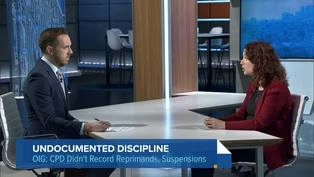
CPD Failed to Document Suspensions and Reprimands, Inspector General Finds
Video has Closed Captions
Clip: 12/22/2025 | 2m 40s | An audit found the Chicago Police Department lacking in keeping records around officer misconduct. (2m 40s)
Providing Support for PBS.org
Learn Moreabout PBS online sponsorship
- News and Public Affairs

Top journalists deliver compelling original analysis of the hour's headlines.

- News and Public Affairs

FRONTLINE is investigative journalism that questions, explains and changes our world.








WHYY Series
Support for PBS provided by:
Chicago Tonight is a local public television program presented by WTTW
WTTW video streaming support provided by members and sponsors.