
January 20, 2026 - PBS News Hour full episode
1/20/2026 | 57m 46sVideo has Closed Captions
January 20, 2026 - PBS News Hour full episode
Tuesday on the News Hour, President Trump intensifies his threats to take over Greenland as Europe weighs retaliatory tariffs. In Gaza, families dig through rubble with bare hands as the search for loved ones goes on. Plus, the expansion of family detention by immigration authorities raises fresh questions about the Trump administration's policies.
Problems playing video? | Closed Captioning Feedback
Problems playing video? | Closed Captioning Feedback
Major corporate funding for the PBS News Hour is provided by BDO, BNSF, Consumer Cellular, American Cruise Lines, and Raymond James. Funding for the PBS NewsHour Weekend is provided by...
January 20, 2026 - PBS News Hour full episode
1/20/2026 | 57m 46sVideo has Closed Captions
Tuesday on the News Hour, President Trump intensifies his threats to take over Greenland as Europe weighs retaliatory tariffs. In Gaza, families dig through rubble with bare hands as the search for loved ones goes on. Plus, the expansion of family detention by immigration authorities raises fresh questions about the Trump administration's policies.
Problems playing video? | Closed Captioning Feedback
How to Watch PBS News Hour
PBS News Hour is available to stream on pbs.org and the free PBS App, available on iPhone, Apple TV, Android TV, Android smartphones, Amazon Fire TV, Amazon Fire Tablet, Roku, Samsung Smart TV, and Vizio.
Providing Support for PBS.org
Learn Moreabout PBS online sponsorshipAMNA NAWAZ: Good evening.
I'm Amna Nawaz.
GEOFF BENNETT: And I'm Geoff Bennett.
On the "News Hour" tonight: President Trump intensifies his threats to take over Greenland, as Europe weighs retaliatory tariffs.
AMNA NAWAZ: In Gaza, families dig through rubble with bare hands, as the search for loved ones goes on.
GEOFF BENNETT: And the major expansion of family detention by immigration authorities raises fresh questions about Trump administration policies.
BECKY WOLOZIN, Senior Attorney, National Center for Youth Law: We see a lot of problems with just basic health, basic access to basic needs.
(BREAK) GEOFF BENNETT: Welcome to the "News Hour."
President Trump today sent mixed signals on his threats to take over Greenland ahead of meetings with European allies in Davos later this week.
After inflammatory messages posted online overnight and this morning, President Trump, while speaking to reporters at the White House this afternoon, seemed to signal a deal could be reached.
AMNA NAWAZ: Meanwhile, European leaders already gathering at the World Economic Forum are forcefully pushing back against the president's new tariff threats and his insistence that U.S.
control of Greenland is a national security imperative.
The president departs tonight for Switzerland and some high-stakes meetings at an uncertain moment for the transatlantic alliance.
In Zurich, Switzerland, protesters set the U.S.
flag ablaze before President Trump arrives in Davos for the World Economic Forum, where leaders of American allies today pushed back on Trump's new tariff threats if Europe refuses to back his Greenland takeover.
From Canada: MARK CARNEY, Canadian Prime Minister: We stand firmly with Greenland and Denmark and fully support their unique right to determine Greenland's future.
AMNA NAWAZ: To the European Union: URSULA VON DER LEYEN, President, European Commission: First principle, full solidarity with Greenland and the kingdom of Denmark.
The sovereignty and integrity of that territory is nonnegotiable.
AMNA NAWAZ: French President Emmanuel Macron confirmed French troops would be sent to Greenland and warned against giving in to Trump.
EMMANUEL MACRON, French President (through translator): We must not give in to the law of the strongest or to intimidation tactics.
We must move forward.
We must not yield to the dictates of the strongest.
We must defend our interests, but also our principles.
AMNA NAWAZ: And Greenland's Prime Minister Jens-Frederik Nielsen worried about the impact of U.S.
military action.
JENS-FREDERIK NIELSEN, Prime Minister of Greenland (through translator): This leader from the other side has made it very clear that it is not ruled out.
And, therefore, we must, of course, be prepared for everything.
But we must emphasize that Greenland is part of the Western alliance, NATO.
And if there is further escalation, it will also have consequences for the entire outside world.
SCOTT BESSENT, U.S.
Treasury Secretary: He believes that Greenland is essential.
AMNA NAWAZ: Already in Davos, U.S.
Treasury Secretary Scott Bessent urged European leaders to - - quote -- "have an open mind."
SCOTT BESSENT: I tell everyone, sit back, take a deep breath, do not retaliate, do not retaliate.
The president will be here tomorrow and he will get his message across.
AMNA NAWAZ: But a slew of overnight messages from Trump shared on TRUTH Social have already set the tone for his visit, posting just after midnight: "Greenland is imperative for national and world security.
There can be no going back."
At 1:38 a.m.
: "Denmark and its European allies have to do the right thing."
And today: "If I didn't come along, there would be no NATO right now."
Trump also posted screenshots of private Signal messages from French President Macron and NATO Secretary-General Mark Rutte and this A.I.-generated image of himself and world leaders in the White House with a map showing the U.S.
flag covering not just Greenland, but Venezuela and Canada as well.
DONALD TRUMP, President of the United States: These are accomplishments.
AMNA NAWAZ: For allies trying to anticipate Trump's plans, the president in today's White House briefing had few details to share.
QUESTION: How far are you willing to go to acquire Greenland?
DONALD TRUMP: You will find out.
AMNA NAWAZ: But signaled a possible deal ahead in Davos.
DONALD TRUMP: So I think something's going to happen that's going to be very good for everybody.
I think that we will work something out, where NATO is going to be very happy and where we're going to be very happy.
But we need it for security purposes.
We need it for national security and even world security.
It's very important.
AMNA NAWAZ: For a perspective now on how President Trump's rhetoric could fundamentally change the NATO alliance, we turn to Robin Niblett, a distinguished fellow and former director at Chatham House.
That's a global policy think tank.
Robin, welcome back to the "News Hour."
Thanks for joining us.
We should note you are already in Davos.
The president, of course, will arrive there tomorrow.
Tell us about what it's like there on the ground.
And do you believe that President Trump and European leaders can have productive dialogue on the issue of Greenland?
ROBIN NIBLETT, Chatham House: Well, it's made it, Davos, more febrile than usual.
It's always a febrile week, a lot going on, a lot of competing debates.
But with most of the U.S.
Cabinet descending and some of them already participating in dinners this evening, and, I mean, this remarkable buildup to this Davos was, as you noted in your lead-in here, the tweets and the comments about European leaders, people are literally just punch-drunk at the moment.
I think they're punch-drunk.
But to your second part of your question, there is a sort of we have got our backs to the wall and we're not going any further type of feeling to the European leaders that I saw speaking today and that you reported on as well.
I think we will see whether President Trump can sense this or not.
He has a kind of animal instinct of how far he can push people.
But for most of these European governments, the idea of compromising on Greenland's sovereignty and the sovereignty of the Greenlandic people in return for a sort of 19th, early 20th century return to great power hemispheric politics is nonnegotiable.
So there might be a deal out there, but Donald Trump would have to climb back somewhat from where he's gone to.
AMNA NAWAZ: So what do you see happening from here?
I mean, we saw President Trump threatening new tariffs, right, if Greenland -- or, rather, if European allies stand in the way of him acquiring Greenland.
We are now seeing some European leaders say they could retaliate as well.
Are European leaders aligned on that approach?
ROBIN NIBLETT: I think there's a great nervousness about retaliating with trade measures.
Treasury Secretary Scott Bessent kind of warned European leaders today here in Davos, don't do it.
It was a slightly plaintive cry, please don't do it.
He will be here soon.
You can talk to him.
He's got a plan.
So I think instinctively there's a desire not to do it.
When the trade -- reciprocal trade battle came to a head in July of last year, a deal was done with the United States, which basically gave European nations a 15 percent tariff rate, which was amongst the best globally.
And Europe in return offered to take some zero tariff rates for some American products.
We didn't match them at all, the view being we need America at our side for the war in Ukraine still to this point.
There's nothing to be gained by escalating with Trump.
So where we're at right now is, I think they may decide to push off approving the deal.
The Europeans had not yet ratified the deal.
The European Parliament, the E.U.
's Parliament, has to do that to come into law.
They have not yet done it, despite it being sort of agreed back in July last year.
So I suspect what they will do is not approve it while Greenland remains in doubt, but at the same time not have retaliatory tariffs that they were planning last year.
They're going to try and find a holding pattern and wait and see, as Scott Bessent recommended, what President Trump is going to bring to Davos.
AMNA NAWAZ: So, Robin, you have got sort of a rising U.S.
threat of military action in Greenland.
You have got rising tensions over a potential trade war with E.U.
allies here.
What does all this mean for the NATO alliance?
I mean, can NATO excommunicate one of its members?
(LAUGHTER) ROBIN NIBLETT: Well, can it?
Actually, I don't even know the legal answer to that.
I know there is a legal answer to it, but I think the idea of excommunicating the top leader -- I don't want to take the religious analogy too far, but like the disciples excommunicating Jesus, I mean, would be a hell of a step.
So, no, I mean, that isn't going to happen.
I think European leaders are trying to look to the long term.
What they don't want to do is to allow a sudden or extended collapse of the relationship with the Trump administration to define the future of a NATO alliance that they believe is going to be critical for their security against a very revanchist Russia well into the future, well beyond the time of this Trump administration.
So, on the one hand, they're trying to sort of buy time, but not just by sitting back and hoping the past will return.
They're buying time by investing in defense, including investing in Arctic defense, buying American defense equipment, raising their defense spending levels, taking security seriously, looking after Ukraine themselves, which they have been doing this past calendar year, and hoping that by demonstrating to this Mr.
Trump or to a post-Trump president, that the alliance could actually be stronger in the future than it is right now.
So they're trying to turn this moment of emergency into something that could be more positive for the future.
AMNA NAWAZ: So, in the minute or so we have left, I want to ask you -- I know we're focused on Greenland right now, but we should also note the president has previously threatened retaking control of the Panama Canal, for example.
He's now also threatening Canada being acquired by the U.S.
as well.
As we mark year one of his second presidency, what do you take away from where the president's words actually meet his actions?
ROBIN NIBLETT: Well, that's a very difficult question.
I still sense there are more words.
Look, you can't deny what happened in Venezuela, although, again, the end result of Venezuela is yet to be seen.
You can't deny what has happened with the tariffs, even though I think Europe can live with 15 percent.
A lot of the peace deals have ended up being temporary at best.
Cambodia, Thailand, the Democratic Republic of Congo, they're not yet resolved.
Gaza, we're still not out of phase one.
I think people are wondering in Europe, does he have staying power?
He's definitely started his second presidency looking for a legacy.
Our worry in Europe is that he sees Greenland as his legacy.
It's real estate.
It's big.
It could have minerals.
And we're worried that the hemispheric part of his ambition is going to affect our security, because, if Greenland falls in some way, if he really applies pressure to it, it's a terrible example to Russia, to China and to others.
So we're worried, but we're hopeful that, a bit like in the first administration, he won't go all the way.
AMNA NAWAZ: Robin Niblett, former director at Chatham House, joining us tonight from Davos.
Robin, thank you for your time.
It's good to speak with you.
ROBIN NIBLETT: Thanks, Amna.
GEOFF BENNETT: We start the day's other headlines in Minnesota, where federal prosecutors have issued subpoenas to at least five officials amid a federal immigration crackdown in that state.
The DOJ is seeking documents from Governor Tim Walz, Minneapolis Mayor Jacob Frey, St.
Paul Mayor Kaohly Her, state Attorney General Keith Ellison, and Hennepin County Attorney Mary Moriarty.
All are Democrats.
The subpoenas mark an escalation of a federal inquiry into how Minnesota's leaders have responded to federal enforcement efforts, especially in Minneapolis.
In a statement, Attorney General Ellison called the subpoena highly irregular, adding that Trump is "weaponizing the justice system against any leader who dares stand up to him."
The scope of President Trump's Board of Peace is looking broader than first expected, with invitations going out to dozens of nations.
The group is meant to oversee the next phase of the Gaza cease-fire.
Among those invited, China, as confirmed today by a Foreign Ministry spokesperson, and Ukraine, according to President Volodymyr Zelenskyy.
That's in addition to Russia being offered a spot.
None of those leaders have said whether they will join, but, notably, Norway has declined the invitation for now, saying it undermines the principles of the United Nations.
Belarus, Bahrain, and the United Arab Emirates have all formally accepted invitations.
Ukraine's President Zelenskyy says one million households remain without power in the capital, Kyiv, following the latest Russian attacks.
(SIRENS BLARING) GEOFF BENNETT: Air raid sirens rang out last night as Russian forces launched more than 300 drones and missiles.
Kyiv's mayor says the attack knocked out heating for nearly 6,000 apartment buildings, even as the country endures one of its worst winters in years.
After the strikes, Zelenskyy said he won't travel to the World Economic Forum in Davos as planned, that is, unless the U.S.
has documents ready to sign on security guarantees for Ukraine.
In Australia, lawmakers there passed a new hate speech law today, plus gun control measures just over a month after a mass shooting at a Hanukkah celebration killed 15 people.
WOMAN: Order.
There being 38 ayes and 26 no's, the matter is resolved in the affirmative.
I call the clock.
GEOFF BENNETT: The laws create new restrictions on gun ownership and broaden hate speech restrictions to allow certain extremist groups to be outlawed.
Authorities say the father-and-son gunmen were inspired by the Islamic State group.
Australia's home affairs minister told lawmakers that, under the new restrictions, neither would have been allowed to possess firearms.
TONY BURKE, Australia Home Affairs Minister: The tragic events at Bondi demand a comprehensive response from government.
The fewer legal firearms in the community, the less opportunity there is for them to fall into the wrong hands, including potential violent extremists and serious organized criminals.
GEOFF BENNETT: Australia's conservative opposition argued that the new legislation could infringe on free speech and criticized the way it was rushed through Parliament.
Lawmakers returned two weeks earlier than planned to address the massacre, which was the country's deadliest shooting in nearly three decades.
Vice President J.D.
Vance and second lady Usha Vance are expecting their fourth child.
They made the announcement on social media today, saying their baby, a boy, is due in late July.
They said the second lady and baby are doing well.
Usha Vance is the first sitting second lady to be pregnant while in her role.
The couple's three children have often joined them for official appearances and trips.
Netflix is revising its $72 billion offer for Warner Bros.
Discovery, in a bid to fend off a hostile takeover effort from Paramount Skydance.
Netflix is now offering all cash for the company's streaming and studios businesses.
The two companies said today that their revised deal simplifies the offer, providing more certainty for Warner Bros.'
stockholders.
Warner Bros.
shares ended about 1 percent lower today.
As for the broader market, Wall Street sank today amid concerns over President Trump's tariff threats over Greenland.
The Dow Jones industrial average dropped nearly 900 points.
The Nasdaq fell more than 550 points on the day.
The S&P 500 posted its biggest decline since October.
Meantime, the Indiana Hoosiers are basking in the glow of victory today after beating Miami 27-21 to win the school's first ever national football title.
Jubilant fans lined the streets of Bloomington, Indiana, after the team capped off an undefeated season under head coach Curt Cignetti.
He orchestrated one of the most remarkable turnarounds in sports, turning a team with more losses than any other major program in history into national champions.
At a press conference today in Florida, Indiana's first Heisman winner, quarterback Fernando Mendoza, said he's proud of the support he's seen back in Bloomington.
FERNANDO MENDOZA, Indiana Hoosiers Quarterback: That just epitomizes the Hoosiers spirit and foreshadows the many long celebrations that there are going to be.
Bloomington's been a predominantly basketball town and basketball city for the longest time, and I think it's a great honor and great privilege to be a part of the team that brings its first football national championship.
GEOFF BENNETT: The Hoosiers will hold a championship celebration on Saturday, though no details have been announced just yet.
Still to come on the "News Hour": the U.S.
Supreme Court hears a challenge to a Hawaii gun law that could have national implications; a conservative legal scholar weighs in on the constitutionality of President Trump's actions one year since he returned to the White House; and a new book examines a college admissions scandal that exposed racial inequalities in U.S.
education.
Food contaminated with worms and mold, limited access to clean drinking water, inadequate medical care, these are a few of the allegations made by migrant families in recent court documents about their children's conditions while in ICE custody.
As part of this administration's crackdown on immigration, President Trump has restored the practice of family detention, with more than 1,700 children in custody since family detention centers reopened this past spring.
Becky Wolozin is a senior lawyer with the National Center for Youth Law and joins us now.
Thanks for being here.
BECKY WOLOZIN, Senior Attorney, National Center for Youth Law: Thanks so much for having me.
GEOFF BENNETT: President Trump says the border is effectively closed.
If that's the case, how are these children and families still ending up in custody?
Who are they?
BECKY WOLOZIN: So we have seen a lot of different trends happen since they first opened - - reopened family detention in April.
But now a lot of families are being arrested from the interior of the United States.
So these are your neighbors, your friends, your kids' friends who are being picked up in a lot of different ways, really from across the country.
GEOFF BENNETT: And you have been inside the South Texas Family Residential Center in Dilley, where families are being held.
Your organization has sued the federal government, alleging inadequate food, medical care, education and safety.
What are the most striking examples you witnessed that illustrate those failures?
BECKY WOLOZIN: Well, there are really profound problems with basic needs, like food and water.
So we have seen and heard a lot of things about children not getting child-friendly food, not being able to eat what's offered.
As you mentioned, people reported vegetables that were moldy or had worms in them.
People have gotten sick following meals.
And there's really not food that's appropriate for small children.
So, for example, one mother told us that in order to try and get her child to eat anything, she had to suck the sauce off each piece of pasta to try and get him to just eat some kind of plain meal that's not the Teddy Grahams and juice that's available.
GEOFF BENNETT: For our viewers who might be unfamiliar, what are the minimum legal standards required when the government detains children and families?
BECKY WOLOZIN: So, under the Flores Settlement Agreement, there are some basic requirements for detaining children.
And those are based on the settlement when it was created in the '90s.
And so children have a right to safe and sanitary conditions, and they have a right to be treated with a particular attention to their unique vulnerabilities as minors.
That's the Flores Settlement Agreement.
There are, of course, other requirements and constitutional requirements in terms of detaining anybody, including children.
But Flores sets a very basic floor on the conditions.
GEOFF BENNETT: And how do the current conditions compare with previous administrations?
Is this a longstanding problem, or is this specific to the Trump administration?
BECKY WOLOZIN: Family detention was not being used for many years before it began again in April.
And so, in previous iterations, there were very similar conditions, issues.
And one of the biggest problems is that, in 1997, the standards were what the consensus was around child welfare at that time.
And now we understand and know so much more.
And we know that the detention of children of any kind is really harmful.
And so what we see is that, as kids are in these prolonged, restrictive settings, they really begin to deteriorate.
They have regressions in behavior.
One mother explained that her previously happy toddler was starting to hit her and hit himself in the face because he was so distraught over the conditions in which they were living.
We have just seen otherwise really well adjusted kids really devolve into concerning just constant sadness, nightmares, crying every night.
One teenage boy described to me -- I mean, a big kid, he was maybe 16 or 17 -- that he cries every night when he goes to sleep in the detention center where he's held with his father.
I would say one other deeply, deeply concerning thing that we have seen in this iteration are -- is really concerning medical conditions.
So children are not getting the care that -- the medical care they need.
A lot of people are coming in with dangerous chronic medical issues that are not treated or are incorrectly treated.
For example, one child -- regular childhood illnesses become very dangerous in detention.
So one child had an earache that turned into such a severe infection that she experienced hearing loss, and she really wasn't treated for a long period of time.
And then, when she finally was treated, the antibiotics they gave her were extremely strong and caused her a lot of distress.
And so we see a lot of problems with just basic health, basic access to basic needs.
GEOFF BENNETT: And, on average, how long are these children and these families held in these conditions?
BECKY WOLOZIN: We have seen families being held for longer and longer periods of time.
And so, most recently, according to the data that we get, we have seen several, I would say dozens of families and children that were held for more than 80 days.
And so these kids are spending months in detention in these horrible conditions.
GEOFF BENNETT: Well, the Department of Homeland Security did not respond to the "News Hour"s multiple requests for a response to the allegations about the conditions at Dilley.
But in court documents filed last month, the administration wrote -- quote -- "ICE's actions exemplify a model of regulatory compliance and humane care."
How do you respond to that claim?
BECKY WOLOZIN: It's just not true.
They are not complying with the Flores Settlement Agreement.
They're holding children for extensive periods of time.
The conditions are not meeting those basic requirements, as mentioned, not just because of the food.
The water is problematic.
Often, the water containers have mold or algae in them around the facility.
The lights are on all night.
Children can't sleep.
There are constant interruptions.
They don't have access to school, which they admitted in their most recent filing.
And, in fact, there's so little to do there that it makes it all the more difficult for children to even cope with the situation in which they're being held.
GEOFF BENNETT: To what degree is this by design to get migrants to self-deport?
BECKY WOLOZIN: I think it's very evident that none of this is necessary to carry out immigration laws and policies, regardless of what they are.
Many of these families were arrested while complying with various different forms of immigration requirements.
And I think that makes it very clear that the goal is cruelty and the goal is to make people who came to the United States often seeking safety and security to flee the United States for the countries where they felt so endangered that they had to leave.
And I think we're seeing that many families really cannot tolerate the level of harm that is being imposed on them by the government and are in fact leaving.
GEOFF BENNETT: Becky Wolozin with the National Center for Youth Law, thanks for being here.
BECKY WOLOZIN: Thank you so much for having me.
GEOFF BENNETT: Today, Israeli authorities took an unprecedented step and began to bulldoze the United Nations' main office for Palestinian refugees.
Israel had banned it from the country, accusing it of being complicit in Hamas' terrorism and governance in Gaza.
President Trump today said the Board of Peace that is designed to run Gaza might replace the U.N., though he said the U.N.
needed to continue its work.
But if the U.S.
is hoping to give Palestinians a better future, in Gaza, it feels a long way off.
Nick Schifrin and our Gaza producer Shams Odeh have this look at one man's desperate search for his deceased family.
And a warning: Images in this story are disturbing.
NICK SCHIFRIN: Today in Gaza, Palestinians often don't go home to live.
They go home to find the dead, not with cranes or bulldozers, which aren't available, just shovels and bare hands and an unbearable weight of grief.
Mahmoud Hammad walks down to where he used to live, where he lost everything.
He survived what he says was the Israeli strike that destroyed his house and stole his world.
MAHMOUD HAMMAD, Lost Entire Family (through translator): I am standing outside of this house to say that what happened to me has happened to every Gazan.
My house, like the whole area, was targeted by a huge fire belt.
NICK SCHIFRIN: He moves slowly, digging debris carefully, because he is looking for all of his children, his wife, Samar, and the unborn baby he will never meet.
MAHMOUD HAMMAD (through translator): She was pregnant.
When we were in school, she was in her seventh or eighth month of pregnancy.
I graduated with her from the university and she graduated top of the class with distinction.
We promised to complete a master's degree and doctorate and stay together, but she passed away.
May God honor her.
NICK SCHIFRIN: His screen cracked, but his memory crystal clear, his kids, Mohamed, Ghaith, Jannah, Judy, Ismail.
And so goes the story of Gaza, once one of the most densely populated parts of the planet, today, much of it a moonscape, with thousands buried underneath.
Palestinian health officials say more than 70,000 were killed, including more than 450 even after the October cease-fire.
Today, 3-month-old Shaza Abu Jara died of hypothermia, the ninth child this winter who Palestinian health officials say was killed by severe cold.
And the U.N.
says more than 80 percent of Gaza's buildings are destroyed in the war launched after Hamas' October 7 terrorist attacks, the deadliest single day in Israeli history.
Israel blames the damage on Hamas' use of civilian infrastructure.
Since the cease-fire, half of Gaza has no Israeli troops, but also no reconstruction.
Gazans like Hamada Sleem walk freely.
He too is looking for his buried family by hand.
All he finds, children's blankets and clothes.
HAMADA SLEEM, Lost Family (through translator): We try and try, hoping that God will help me get any of them out, so they can be buried.
I don't know how to describe the feeling of having my whole family under the house and being unable to get them out.
I have appealed to the whole world, hoping that this new Board of Peace will stand with us and look after us.
DONALD TRUMP, President of the United States: We just created the Board of Peace, which I think is going to be amazing.
I wish the United Nations could do more.
NICK SCHIFRIN: The Security Council-endorsed Board of Peace will be chaired indefinitely by Donald Trump and is designed to oversee Gaza's future and make decisions that will lead to reconstruction and new governance.
But, today, that better life is just a promise.
There is first trying to provide dignity in death.
Mahmoud Hammad sifts through the sand.
It turns out there are no bodies to find, only human bones among the rocks.
He will keep going, but he knows he's found the remains of his pregnant wife.
MAHMOUD HAMMAD (through translator): How did I know that she was my wife?
The first thing was the room, and the second were the bones of the baby.
The baby was fully formed and was in the same place.
NICK SCHIFRIN: In this place today, there was no dignity recovered and peace is still something imagined.
For the "PBS News Hour," I'm Nick Schifrin.
AMNA NAWAZ: Today, the Supreme Court heard the latest case that's testing the limits of the constitutional right to carry a gun in America.
As William Brangham reports, today's argument centered on one strict state law aimed at preventing gun violence.
WILLIAM BRANGHAM: Today's argument centered around a political clash over a Hawaii gun law.
In that state, gun owners are prohibited from carrying firearms on private property that's open to the public, such as hotels, beaches, or stores, unless the property owner explicitly permits it, otherwise, no guns allowed.
Three gun-owning residents challenged that law, saying it goes farther than the legal limits about where the government can bar firearms.
So, for more on today's arguments, I am joined now by Chip Brownlee.
He's a reporter with The Trace, which is a nonprofit news organization that covers gun violence.
Chip, thanks so much for being here.
Let's talk about this Hawaii law.
Let's say I'm a concealed-carry permit owner in Hawaii.
I want to go to the beach or a mall.
The law says what?
CHIP BROWNLEE, The Trace: The law says that you would have to get permission from the owner of that property to bring your concealed-carry gun with you there.
And what that would look like in practice is the probably the owner of such establishment would have to post a sign saying we allow guns, or you would have to get the verbal consent from the owner, the provider or a representative to bring your gun there.
So you could imagine it being a restaurant that has a sign that says "We allow guns."
And this is kind of opposed to what is typical in the rest of the country.
In most of the country, it's the opposite.
For a restaurant to exclude guns, they have to post a sign that says "No guns allowed."
Or if you're going to an arena, they have to have signs posted to say "No guns here."
That's in the majority of the country.
But in Hawaii and four other states, they have flipped this default to require the owner to give express permission.
WILLIAM BRANGHAM: I see.
So is that why this has become such a significant Second Amendment case?
CHIP BROWNLEE: This really goes back to 2022 when the Supreme Court issued a landmark decision expanding gun rights across the country in a case called Bruen.
And in direct response to that case, states passed these laws like what Hawaii has trying to effectively limit the number of public spaces that -- where guns are allowed.
And they did this by changing the default on these -- private property.
Now, this case is specifically about private property that's open to the public, so, again, like a business.
This is not about government property.
This is not really about your private home or inside of your home or fenced-off land.
This is about private property that you can - - actually are invited to come to.
WILLIAM BRANGHAM: I see.
And, today, the justices, they took two very different approaches to this.
I want to play a little bit of sound.
First, this is Justice Samuel Alito, who was questioning the very need for the law itself.
SAMUEL ALITO, U.S.
Supreme Court Associate Justice: So what then is the big deal about this statute?
Why does it matter if store owners and owners of private property that are generally open to the public don't like guns?
Why is it a big deal to say they want people carrying guns to stay out, just put up a sign?
Why does Hawaii have to have this law?
WILLIAM BRANGHAM: But then the court's liberal justices, including Sonia Sotomayor, focused more on the rights of property owners.
Here's what she said.
SONIA SOTOMAYOR, U.S.
Supreme Court Associate Justice: Is there a constitutional right to enter private property with a gun without an owner's express or implicit consent?
The answer has to be simply no.
You can't own -- enter an owner's property without their consent, correct, express or implicit.
WILLIAM BRANGHAM: I know it's always a bad idea to try to handicap what's going to happen by listening to the arguments, but did you get a sense today how this might go down?
CHIP BROWNLEE: You know, if I had to guess, I would say that it's going to split down party lines.
I mean, you heard from those questions from Justice Alito and from the other justices that the conservatives are really -- seem like they're going to strike down the Hawaii law.
And the liberals, perhaps unsurprisingly, seem like they're going to uphold the law.
But I think one thing that this really gets at is, this case could have implications for the whole country, but particularly like in a place in Hawaii, where they have not had guns really for most of their history, until 2022, when the Supreme Court changed this law, and are bringing a whole new set of guns and expectations into a state that hasn't really had guns.
That's why I think this matters to people in Hawaii.
But this could have implications for the rest of the country too, because if the Supreme Court issues a broad decision that changes the gun law test again, they could have -- spell trouble for other types of gun laws that are not just this particular case about private property open to the public.
WILLIAM BRANGHAM: And this isn't the only major gun case that the Supreme Court is going to hear this term.
Justices are going to soon hear arguments in a case involving the federal statute that prohibits the possession of firearms by a person who is -- quote -- "in an unlawful" -- "is an unlawful user or addicted to any controlled substance."
It seems that the court now is eager to start taking up gun rights cases again.
CHIP BROWNLEE: I think one thing that's really important to remember is that, for most of its several-hundred-year history, the Supreme Court never really weighed in on the Second Amendment or Second Amendment rights.
It wasn't until 2008 in a case called Heller that the Supreme Court really started weighing in on the Second Amendment.
And then it went into another decade, essentially, without really changing that precedent that it laid out in Heller.
And then, in 2022, we start getting this wave of Second Amendment cases.
We got Bruen, which expanded the right to carry guns in public, Rahimi, which walked that back a little bit.
And now we have two cases this term.
So this really is a Supreme Court that seems more engaged on the issue of the Second Amendment than ever, really.
WILLIAM BRANGHAM: All right, that is Chip Brownlee of The Trace.
Thank you so much for being here.
CHIP BROWNLEE: Thank you so much for having me.
Today marks one year since President Trump took the oath of office for the second time.
Over the past 12 months, the president has pushed the boundaries of executive power, challenged the Constitution, and reshaped the federal government.
He's imposed unilateral tariffs, asserted control over independent agencies.
The Department of Justice has launched investigations into his political opponents.
He's deployed the National Guard and active duty troops to American cities over the objections of local officials.
He's launched military operations in Venezuela and Iran, while threatening action in Greenland.
And he's followed through on his pledge to carry out a nationwide mass deportation campaign.
To help make sense of all these moves, we're returning this week to guests from our On Democracy series, which explores the laws, institutions, and norms that have shaped this country and the different pressures they face today.
Our first conversation is with Ilya Shapiro, a senior fellow at the conservative Manhattan Institute.
Welcome back to the program.
ILYA SHAPIRO, Manhattan Institute: Good to be back with you.
GEOFF BENNETT: I know, in speaking with you, that you believe that presidents deserve wide latitude to execute their agendas.
But at what point does expansive use of presidential power cross a line into abuse of power?
ILYA SHAPIRO: Well, I don't think that presidents get wide deference just by sake of being presidents.
There are constitutional limits.
There are separation of powers.
And what we have seen in the last year, just in terms of court cases, especially what we have seen from the Supreme Court, is that the president does get a lot of leeway in reorganizing the executive branch.
He's the head of the executive branch.
We will see.
I think the Supreme Court is going to rule that he gets to remove the heads of executive branch agencies.
On the other hand, when the president tries to make his own laws or change the laws in some way, he runs into trouble.
And we have seen that as well, when, for example, using laws in a new way to use the National Guard in cities that the Supreme Court has paused, or with the tariff, which I think the Supreme Court is likely going to rule against him on that, although Secretary of Treasury Scott Bessent has said there are other ways of putting other kinds of tariffs more narrowly.
Wish they had a thought of that at the beginning.
GEOFF BENNETT: Well, yes, I know you ground your thinking in originalism.
So where in the Constitution do you see the authority for a president to treat independent agencies as if they are extensions of the West Wing?
ILYA SHAPIRO: Well, we have in the Constitution three branches, the executive, the legislative, and the judicial.
There's no fourth branch or fifth branch for agencies that are unaccountable to anyone else.
So the question is, is an agency kind of some quasi-legislative body, or is it executive?
Because if it's part of the executive branch, then the president, as the head of the executive, should be able to control it.
And that is ultimately why I think the Supreme Court is going to allow him to remove these agency heads.
The Fed is different.
And, as we're speaking, tomorrow, the Supreme Court is poised to take up a case about the removal of a governor of the Fed.
The Fed's a little different because it's quasi-legislative, quasi-executive.
It's its own sort of thing.
And the president isn't even inserting the power to remove a governor for any reason.
He says he has cause to remove Governor Cook.
GEOFF BENNETT: A question about the politics of all this, because many of the same conservatives who used to warn against the imperial presidency now support President Trump's actions.
What accounts for that?
Is it just tribal politics?
Or is there something else at play?
ILYA SHAPIRO: Well, people change where they stand based on where they sit all the time.
There are hypocrites on the left and the right.
I like to think that I'm being consistent in believing that the president does have power over the executive branch, but wanting limited government overall.
And so I have certain quibbles with the Trump administration in terms of policy, in terms of the scope and the growth of even taking bits of private companies for the U.S.
government to own.
But the nature of what we're seeing is just a difference of degree, not kind.
We have presidents of both parties going back decades and even over a century that keep growing this what's come to be known as the imperial presidency.
It's unfortunate, but it's not just the president acting badly.
It's also Congress being satisfied with passing the buck to the president so it doesn't have to bear the consequences of those policy decisions.
GEOFF BENNETT: What about the DOJ investigations, the Justice Department opening inquiries and investigations into President Trump's perceived political rivals?
I know you have criticized politicized prosecutions in the past.
Why shouldn't Americans see this as exactly the kind of abuse of prosecutorial power that conservatives once warned about?
ILYA SHAPIRO: When President Trump was campaigning for his second term, he said, citing the lawfare against him, that he would be different, that he was going to put a stop to this politicization.
And I think he's succumbed to a bit of the temptation to get involved in that with the tit-for-tat politicization sometimes, with James Comey, for example, going after the governor of the Fed, the chairman of the Fed, Jerome Powell.
So I think there are excesses there.
But certain investigations that the Justice Department has been criticized for as being politicized are actually going after real wrongdoing.
GEOFF BENNETT: The military strikes in Venezuela that were launched without explicit congressional authorization, has Congress become irrelevant to decisions of war and peace?
ILYA SHAPIRO: I think it has when we're talking about something other than a major war.
What's a major war?
Well, Iraq or Afghanistan, something that's certainly longer than just getting in, getting out, the Maduro operation in Venezuela, or even the drone strikes on the fishing boats.
We have this War Powers Act that's over 50 years old.
Most presidents have paid lip service to it while maintaining that it's unconstitutional.
It was passed over President Nixon's veto.
President Clinton had a longer-than-90-day excursion into Kosovo, into the Balkans without congressional approval, and nothing happened.
I think this was -- what President Trump is using in terms of the use of force is more minor than what a lot of his predecessors were doing.
GEOFF BENNETT: Really?
ILYA SHAPIRO: Certainly.
President Obama had kinetic military action in Libya over several days.
I mean, this is greater than what Trump has done in Venezuela, in Iran, or anywhere.
He hasn't done anything in Iran yet.
He just gave the green light to Israel to do it, and with some assistance there.
So, yes, I think a lot of people have short memories.
And Clinton probably is the biggest example.
GEOFF BENNETT: James Madison, as you will know, warned that the accumulation of legislative, executive, and judicial power in the same hands is the very definition of tyranny.
Are we closer to that danger today?
ILYA SHAPIRO: If we are, it's not because of President Trump.
It's because of this dynamic of Congress ceding its power to the presidency.
Again, Congress is controlled by both parties.
The president is controlled by both parties.
There's this dynamic that I think Madison missed of the incentive to pass the political buck, so that your constituents who are upset, the congressmen can then say, no, don't blame me.
It's the deputy undersecretary of such and such that promulgated that regulation that is hurting you.
So, yes, there are definitely problems with the way our system is functioning.
And I'm seeing good things out of the Supreme Court, for example, overturning judicial deference to agencies taking -- executive agencies, taking expansive power, and to presidents, for that matter, checking President Obama, President Biden, President Bush, and President Trump.
So we will see.
There's this give-and-take that's certainly playing out.
GEOFF BENNETT: So is there any concrete action the president has taken so far that, in your view, you would say this crosses a constitutional line, full stop?
ILYA SHAPIRO: I think, for me, the worst thing he's done legally is the continued postponement of the law requiring divestment of TikTok by ByteDance.
This was a law passed with a supermajority in Congress, that never happens anymore, approved by unanimous vote of the Supreme Court.
And yet the president has three or four times, four times now, I think, said, we will give a 90-day pause, which the law does provide for if all that's left in a deal for divestiture is the lawyers to paper it over, which hasn't happened.
So this doesn't satisfy anybody's narrative, but I point to TikTok as the biggest violation by President Trump.
GEOFF BENNETT: Ilya Shapiro of the Manhattan Institute, always enjoy speaking with you.
Thanks for being here.
ILYA SHAPIRO: Thank you.
A few years ago, a small private school in an underprivileged Black community in Louisiana, the T.M.
Landry College Preparatory Academy, made national headlines for propelling student after student into elite universities like Harvard and Yale.
But as New York Times journalists Katie Benner and Erica Green report in their new book, "Miracle Children," the school's success was built on lies and threats.
I spoke with Benner and Green and began by asking what led them to look into this school.
KATIE BENNER, Co-Author, "Miracle Children: Race, Education, and a True Story of False Promises": It was very unusual because I was covering the Justice Department at the time, but Erica and I had both seen the viral videos when they were on all over social media.
And like everybody else in the country, we were so excited about these students getting into Harvard and Princeton and Stanford, Yale, et cetera.
And part of the reason we were excited about it is because they were Black students just achieving the highest heights.
So when I got a call from a source, actually a former DOJ source who said that she'd heard that something else was happening at the school, that there was misconduct, that there might be an abusive situation, and that the students themselves were being manipulated by their teachers to lie about their lives in order to get into these elite schools, I called Erica immediately.
She was our education policy reporter.
And I said:"I think this is a real story.
You would know better though.
You cover education, but this feels like it's the kind of story that tells us a lot about race in America."
AMNA NAWAZ: Erica, I'd imagine with so many people invested in the school and invested in selling that story, it might be hard to get people to talk to you about it, was it?
ERICA L. GREEN, Co-Author: Believe it or not, this was a rare case in my career where we had droves of people ready to talk about it.
And that is why it gave us this sense of urgency.
There were families who had collected stories about what was transpiring in the school over a few months.
They were prying out of their children that was very disturbing.
And they reached out for help in their own communities, got none, and they banded together and decided that they wanted to talk to The Times.
AMNA NAWAZ: There's so many compelling stories in here.
I want to get into a more detail.
But, Katie, for anyone unfamiliar, just briefly, what was the fraud being perpetrated here by the school founders, the couple that ran the school?
That's Mike and Tracey Landry.
KATIE BENNER: Right.
So, first, I think we need to say that Mike and Tracey Landry, the founder of the school, have denied all wrongdoing.
So all of our reporting in the book and the original New York Times story is based on legal documents, court records, police records, and the interviews with students that corroborate one another.
But what the students had been forced to do was to lie about their lives and to lean into really negative stereotypes about Black America on their college applications, to say that they had been homeless, that their parents had been addicted to drugs, and all sorts of other really terrible things, because Mike and Tracey told them that that's what white admissions officers wanted from Black people.
They also suffered a lot of psychological, emotional, and physical violence at that school to keep them in line.
For Mike and Tracey, they were Making Money.
They were charging tuition, and they had a lot of admissions offices at some of the most elite colleges in the country adoring them.
And one of the things they did to keep the students in line was say, if you expose us, if you tell anybody, we will make sure you do not get into your dream school.
You're not going to get into MIT.
You won't get into Yale.
We will rescind your application.
AMNA NAWAZ: Erica, take us inside the mind-set of some of these families, obviously, the ones you have met with who wanted to speak out about this, who were in some sense ostracized because they wanted to speak out, but the many families that some folks may look at and say, why did they let their kids continue to participate in this?
ERICA L. GREEN: For them, they brokered a deal with Mike.
He said, give me your children.
Give me your most precious commodity.
And I'm going to take them further than you ever could.
He very much preyed and seized on this deficit model that has existed for decades.
But he seized on their fears and their vulnerabilities, whether it was that they had not gone to college themselves or they couldn't afford to send their kids to college or they couldn't even guide them through the process.
So he really did just hit every vulnerability that they had as working-class, predominantly Black families in a very-low-income part of one of the poor states in the country.
At the end of the day, they were seeing results.
They saw the viral videos that were being eaten up by celebrities, by the first lady of the United States.
So it's not like it was just a gamble.
It was an equation.
AMNA NAWAZ: I mean, it was your article for The New York Times that blew it all up, that called attention to this.
But, Katie, the book really grounds it not just in what happened and in more storytelling and in more perspectives, but in the historical context.
Why is that necessary here?
KATIE BENNER: I think that we have to understand that the country has fought oftentimes in schoolhouses about whether or not it wants to have a racial hierarchy or not.
Education is one of the most powerful tools to allow us to widen the circle of who gets to be an American or to close it off.
And so understanding that history helps us understand why the students were making some of the choices they were making, why they felt cut off from educational opportunity, and even why we were cheering so hard for these Black students to get into Stanford or Yale and not questioning what that says about our expectations of Black Americans writ large.
One of the lawyers who worked with the students said, would we have been cheering like this, would these videos have gone viral if the students in the videos had been white and getting into Stanford or if they had been Black and been getting into a state school?
What is that telling us about who we are?
AMNA NAWAZ: Erica, what do you want people to take away from this book?
ERICA L. GREEN: I think what we really hope is that people really self-reflect about their own expectations of Black children.
I think we have to question what we demand of them to just achieve opportunities and the kinds of American dreams that are handed to other groups of children on a silver platter.
And, also, we have to just recognize that this is -- opportunity has become transactional.
And for a certain subset of Americans, that means you can pay to get your way into an Ivy League or an elite college.
And for Black children, they're paying with their dignity.
Their price has become higher.
And we all have to ask ourselves why.
And the big takeaway for me is that Black children do not have to be damaged to be valuable.
AMNA NAWAZ: The book is "Miracle Children: Race, Education, and a True Story of False Promises."
The authors are Erica Green and Katie Benner.
Thank you so much.
ERICA L. GREEN: Thank you.
KATIE BENNER: Thank you.
GEOFF BENNETT: As always, there's a lot more online, including a look at the increasing prevalence of A.I.
on social media in breaking news situations and how to navigate all of it.
That's on our YouTube page.
AMNA NAWAZ: And that is the "News Hour" for tonight.
I'm Amna Nawaz.
GEOFF BENNETT: And I'm Geoff Bennett.
For all of us here at the "News Hour, thanks for spending part of your evening with us.

Book explores admissions scandal that exposed inequalities
Video has Closed Captions
Clip: 1/20/2026 | 7m 8s | 'Miracle Children' explores admissions scandal that exposed inequalities in education (7m 8s)
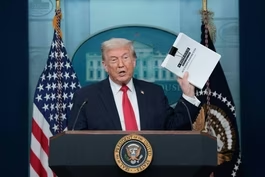
Conservative legal scholar discusses Trump's first year
Video has Closed Captions
Clip: 1/20/2026 | 8m 58s | Conservative legal scholar on constitutionality of Trump's first year (8m 58s)
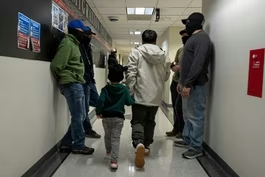
Families say children held by ICE face unsanitary conditions
Video has Closed Captions
Clip: 1/20/2026 | 8m | Migrant families allege children held by ICE face unsafe and unsanitary conditions (8m)
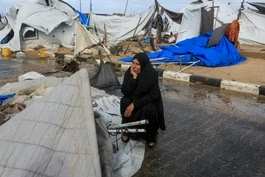
Gaza families dig through rubble for loved ones’ remains
Video has Closed Captions
Clip: 1/20/2026 | 4m 35s | Gaza families dig through rubble searching for loved ones’ remains (4m 35s)
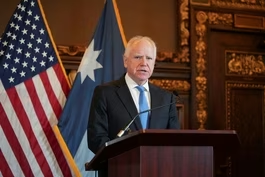
News Wrap: Federal prosecutors subpoena Minnesota officials
Video has Closed Captions
Clip: 1/20/2026 | 5m 55s | News Wrap: Federal prosecutors subpoena Minnesota officials (5m 55s)
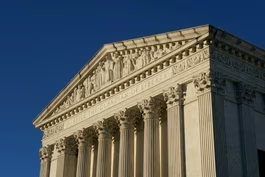
Supreme Court weighs private property gun restrictions
Video has Closed Captions
Clip: 1/20/2026 | 6m 42s | Supreme Court weighs private property gun restrictions in major case (6m 42s)

Trump's Greenland threats rattle NATO allies
Video has Closed Captions
Clip: 1/20/2026 | 11m 10s | 'Something's going to happen,' Trump says as Greenland threats rattle NATO allies (11m 10s)
Providing Support for PBS.org
Learn Moreabout PBS online sponsorship
- News and Public Affairs

FRONTLINE is investigative journalism that questions, explains and changes our world.

- News and Public Affairs

Amanpour and Company features conversations with leaders and decision makers.












Support for PBS provided by:
Major corporate funding for the PBS News Hour is provided by BDO, BNSF, Consumer Cellular, American Cruise Lines, and Raymond James. Funding for the PBS NewsHour Weekend is provided by...