
June 13, 2023 - PBS NewsHour full episode
6/13/2023 | 57m 46sVideo has Closed Captions
June 13, 2023 - PBS NewsHour full episode
June 13, 2023 - PBS NewsHour full episode
Problems playing video? | Closed Captioning Feedback
Problems playing video? | Closed Captioning Feedback
Major corporate funding for the PBS News Hour is provided by BDO, BNSF, Consumer Cellular, American Cruise Lines, and Raymond James. Funding for the PBS NewsHour Weekend is provided by...
Support provided by:

June 13, 2023 - PBS NewsHour full episode
6/13/2023 | 57m 46sVideo has Closed Captions
June 13, 2023 - PBS NewsHour full episode
Problems playing video? | Closed Captioning Feedback
How to Watch PBS News Hour
PBS News Hour is available to stream on pbs.org and the free PBS App, available on iPhone, Apple TV, Android TV, Android smartphones, Amazon Fire TV, Amazon Fire Tablet, Roku, Samsung Smart TV, and Vizio.
Providing Support for PBS.org
Learn Moreabout PBS online sponsorshipGEOFF BENNETT: Good evening.
I'm Geoff Bennett.
AMNA NAWAZ: And I'm Amna Nawaz.
On the "NewsHour" tonight: Former President Trump pleads not guilty in federal court on dozens of charges, accused of illegally retaining and withholding classified documents.
GEOFF BENNETT: As Ukraine continues its counteroffensive, Russia intensifies it's assault, with missile strikes targeting the hometown of Ukraine's president.
IRINA KUDRAVTSEVA, Kryvyi Rih Resident (through translator): We were asleep.
All the windows were shattered.
I am still confused how it all happened.
At first, there was a loud bang, the cars caught on fire, and the window here was blown out.
AMNA NAWAZ: And far right House Republicans demand more control over major issues, potentially ensnaring any legislative movement in the chamber.
(BREAK) AMNA NAWAZ: Good evening, and welcome to the "NewsHour."
Former President Donald Trump today pleaded not guilty to 37 felony counts related to his alleged mishandling of classified information after leaving the White House, launching the next phase of the federal criminal case against him.
GEOFF BENNETT: The former president arrived at the Miami courthouse this afternoon to respond to the Justice Departments historic indictment, alleging he -- alleging he illegally retained secret documents, obstructed the governments efforts to retrieve them, and made false statements on the matter.
Today's arraignment was Donald Trump's second this year, but his first on federal charges.
William Brangham was in the courthouse today for the proceedings.
And he joins us now.
So, William, you were in the courtroom today, one of about 30 journalists with that kind of access.
No cameras, no photographs were allowed.
Take us inside the room.
How did the proceedings unfold?
WILLIAM BRANGHAM: I mean, Geoff, it was -- for such an extraordinary day with what is -- could be the beginning of what is possibly the most consequential federal criminal trial in American history, the day unfolded in a rather routine fashion.
As you reported, the former president came.
He entered the courthouse through an underground garage this morning.
He was booked.
He was fingerprinted.
They didn't need a photograph of him because the federal marshals said they have got plenty of photographs of the former president already.
And then he went up into the courtroom, where the charges were read against him.
His not guilty plea was read.
And his lawyer said he pleads not guilty to all of them.
And, for the most part, the former president sat stoically still, staring straight ahead, arms crossed.
He did not look over at the special counsel, Jack Smith, who was probably 20, 25 feet to his left.
And so the not guilty plea was read.
There was some discussion about what witnesses could and couldn't be spoken to.
But, overall, it was a relatively calm proceeding for this truly remarkable day.
Jack Smith, on his way out, clapped one of his colleagues on the shoulder, put out a small smile, and they left the courtroom.
GEOFF BENNETT: William, Miami officials, as you know, they have been assuring the public for days now that they had extensive plans to prepare for potentially massive crowds.
What was the scene outside the courthouse today?
WILLIAM BRANGHAM: That's right.
That was the fear of going into this.
And there certainly was a large police presence out here today.
We got here very early this morning.
And there was a smattering of Trump supporters with their usual "Election was stolen" signs supporting President Trump.
And the numbers continued to grow as the course of the day went on.
Most supporters here that we spoke to of the former president came to argue that this is an unfair prosecution being run by a Justice Department that they see as hopelessly biased.
But, as far as we saw, there was no sign of violence whatsoever.
There was one actual Biden supporter who apparently lunged in front of the former president's motorcade as he was trying to leave today.
But, again, that was the only sign of real disruption.
We did see a lot of people here who also came to support the government's position, who argued that the allegations in this indictment are very severe and they pertain to some of the most core issues of national security and military affairs.
And so they were here to support the prosecution side.
There were also some people who came simply because this is a moment in history, a remarkable one.
And they simply wanted to witness that.
Here's a smattering of some of the voices that we heard today.
BOB KUNST, Florida: The public understands it's all politics.
And the public is really upset.
So, my argument is, I wanted to let the president know there's a lot of people out here supporting him, coming by the cars, walking by, that are not the press, and that he has a lot of great support here.
JACK KAPLAN, Florida: These are serious felonies that he's been charged with.
So, if you or I had been charged, we'd already be in jail.
And he shouldn't be any different.
RAJ ABHYANKER, Florida: I chose to come here today because it's an interesting, historic day.
I haven't been in Miami for a decade, and it just so happens that the president of the United States is being indicted for crimes, federal crimes.
It's not a usual occurrence.
So, I thought it would be great to just go to this historic day and participate in it.
GEOFF BENNETT: So, William, a magistrate oversaw today's arraignment, the procedural part of this case, but he's not overseeing the entirety of the case.
What happens next, as this federal case proceeds?
WILLIAM BRANGHAM: That's right, Geoff.
Judge Aileen Cannon is the judge who has been assigned this case.
And barring a plea deal, what we will enter now is the is the pretrial phase of maneuvering from both sides, the prosecution and the defense, what the witnesses will be, what the evidence is, what they get to hear, as far as the jury goes.
One issue that is coming up is this potential recusal of Judge Aileen Cannon.
You may remember, she was appointed at the tail end of the Trump administration.
And she ruled early on in this classified documents case, and she appointed -- agreed to appoint a special master to oversee the surveillance of those documents.
That hindered the prosecution's case.
And a subsequent federal appeals court, the 11th Circuit, really slapped down the judge for her ruling in that case, and implied that she was being overly deferential to the former president.
And so the question becomes, now that she's overseeing his actual trial, should she recuse herself?
There is no evidence, there's nobody that I have spoken to who believes that she will actually recuse.
And so it is up to her.
If she chooses not to, then special counsel Jack Smith and the Department of Justice could choose, if they wanted to, to ask for her recusal, and another court would have to rule on that.
That doesn't happen very often, and it's often an unsuccessful appeal.
The question also is, if you ask to have a judge removed from a case and they are not removed, then you are sitting through a lengthy trial with a judge that you have publicly accused of being unable to be impartial in this case.
And so it's certainly a fraught issue, as far as that issue.
What we know as far as happens tonight, the president -- the former president is heading back to New Jersey to his golf club at Bedminster.
He's having a prescheduled fund-raiser there.
He will again rally the troops and again make the allegation that he is the victim of an unfair prosecution.
GEOFF BENNETT: William Brangham in Miami tonight reporting on Donald Trump's arraignment on federal charges.
William, thank you.
AMNA NAWAZ: And for legal analysis of today's events, I'm joined now by former federal prosecutor Renato Mariotti.
Renato, welcome, and thanks for joining us.
We watched an unprecedented moment today, a former president facing criminal charges by the same government he wants led.
From a legal standpoint, as you watched today's proceedings unfold, what struck you?
RENATO MARIOTTI, Former Federal Prosecutor: Well, I think one thing that was very interesting, as we just heard a moment ago, there was some discussion about witnesses speak -- being spoken to, and actually the two defendants in this case and what they could talk about.
After all, Walt Nauta was there.
He did -- wasn't actually arraigned today, because he did not have an attorney who was licensed in Florida there to represent him.
But, nonetheless, he was present, and the former president was warned not to speak with him about this matter.
I thought that was interesting.
And I think it's also fair to say that there's a certain gravity to this moment.
We heard from one of the passersby in the street a moment ago about how this was a moment in history.
And I think it was a moment in history and a moment where you saw a former president of the United States treated the same way that so many other people in this country are every year, thousands of people who are charged federally and ultimately have to see their day in court in front of a federal judge.
AMNA NAWAZ: Renato, tell me about Mr. Trump's defense team on this case led by Todd Blanche, who recently took on that lead role, also by Chris Kise, who's an attorney with very deep Florida ties.
What do we know about them?
And what are they likely to take as next steps after today's arraignment?
RENATO MARIOTTI: So, Mr. Blanche is a very well-known criminal defense attorney.
He is a New York attorney, not an attorney from Florida.
So this is -- he's a bit out of his out of his lane there, but, nonetheless, a very well regarded white-collar criminal defense attorney.
He does not have national security experience.
So that is one thing that I wouldn't be surprised if Trump tried to add in the future, is somebody who has experience dealing with the very unique statute that governs discovery in national security cases.
Mr. Kise very experienced in the state of Florida.
What they will be doing next, first of all, there's going to be discussions with the government regarding discovery.
There's a protective order that will be entered in this case that's unique to national security cases, very special order that makes sure that national security secrets are kept secret.
There are also security clearances that would be obtained for the defense team.
And then there's going to be discussions about timing and scheduling regarding this case.
We heard Jack Smith talk about a speedy trial.
But the criminal justice system in the United States, particularly in national security cases, is anything but speedy.
And there will certainly be a lot of discussions about discovery, about deadlines, and then also ultimately about a potential of motions that could be filed by the defense.
AMNA NAWAZ: You heard William's reporting there about the questions and some of the concerns around the judge appointed in this case, Judge Aileen Cannon.
Tell us a little bit about her.
And in a case like this, how much influence would Judge Cannon have in that timeline, as you expect it to play out, in what seen and what's not seen?
RENATO MARIOTTI: An enormous amount of influence.
The trial judge in a case has an incredible amount of influence over the timeline.
They are allowed to manage their own dockets.
And the Courts of Appeals rarely overturn their decisions regarding scheduling.
In addition, they have evidentiary control over the evidence that comes into trial.
They make those initial rulings.
The Court of Appeals has a very deferential standard when reviewing those evidentiary rulings.
She also would have the opportunity to decide which jurors can get seated.
Ultimately, she could decide whether or not a juror can be too biased to sit on the jury or not.
She ultimately could make a decision to toss out the entire case once the jury is impaneled, which would not be subject to a Court of Appeals review.
So that would be very serious stuff.
So she has enormous power.
And I think there was a great and accurate summary a moment ago of the challenging situation the government is in, given that recusal is far from a guarantee and fraught with some significant challenges.
AMNA NAWAZ: What about potential jurors in this case?
I mean, this is in Florida, where Mr. Trump does have broad support.
It's also in Miami-Dade County, which Republicans won back in the 2022 midterms.
It's impossible to separate the politics from all of this.
So how are both sides viewing potential jurors in this case?
RENATO MARIOTTI: That's a great question.
I think if an ordinary person, someone like you were I, were on trial facing this indictment, I would think that there's not much of a defense.
It would be very challenging.
The best defense might be to delay the case as long as possible.
But with the former president, it bears noting that the jury has to be unanimous in order to convict the president on any count.
And just one juror who feels strongly about and can really flip that script and ultimately create a hung jury that forces the government to either retry the case or give up.
So, that -- and that has happened before, by the way.
Rod Blagojevich in his first -- his first trial had a hung jury on all but one count because a single juror held out.
So it's definitely possible for a popular politician like Donald Trump to potentially sway a juror.
And that, I think, is a real wild card when it comes to the trial as well.
AMNA NAWAZ: Renato, I have got like 30 seconds left, but I have to ask you because Mr. Trump will speak publicly tonight.
Could what he says in public now impact this case?
RENATO MARIOTTI: One hundred percent.
And you see in the indictment his words quoted, used against him, his words on the campaign trail and from the presidency.
There's no question that Jack Smith and his team are watching closely, record -- video recorders in hand, ready to snap an evidence sticker on that recording and use it at trial.
AMNA NAWAZ: That is former federal prosecutor Renato Mariotti joining us tonight.
Thank you for your time.
RENATO MARIOTTI: Thank you.
AMNA NAWAZ: Now to today's other top headlines.
American consumers got a bit more of a break on inflation in May.
The Labor Department reports retail prices were up 4 percent from a year ago, but that was the smallest increase in two years.
It was also well below April's increase of 4.9 percent from a year earlier.
At the same time, the so-called core rate, not counting food and fuel, climbed four-tenths of a percent from April, remaining stubbornly high.
Police in Denver say a drug deal gone bad apparently triggered a mass shooting last night, as the city celebrated the Denver Nuggets' first NBA championship.
Nine people were wounded in a dispute involving several people.
It happened about a mile from the basketball arena.
The suspect was among the wounded and was arrested.
Tens of thousands of people across Western India and Pakistan began evacuating the region today ahead of a powerful cyclone.
It's expected to blow out of the Arabian Sea on Thursday, striking India's Gujarat state with winds topping 110 miles an hour.
Some coastal villages have already cleared out.
And officials in Pakistan said they intend to evacuate 80,000 people before the storm hits.
KARAM ALI, Pakistani Fisherman (through translator): The storm is coming.
Water will enter our house, so we're moving to higher ground.
I'm taking my belongings and children.
We will come back when the water recedes.
AMNA NAWAZ: The cyclone is expected to pass through some of the same Pakistani districts that were inundated by devastating floods last summer.
The U.S. military reports 22 American troops in Syria were injured Sunday in a helicopter crash.
It happened near the town of Shaddadi in the northeast.
U.S. officials said there's no indication that hostile fire was involved.
At least 900 U.S. troops are in Syria at any given time, assisting Kurdish led forces against the Islamic State group.
An autopsy has determined that U.S. Olympic champion sprinter Tori Bowie died from childbirth complications, including respiratory distress and eclampsia.
The medical examiner said the 32-year-old was eight months pregnant and in labor when she died in her home in Orlando.
She was found days later.
Bowie won three medals at the 2016 Olympics and the 100-meter race at the 2017 World Championships.
Meanwhile, Wall Street advanced today waiting for the Federal Reserve's next move on interest rates tomorrow.
The Dow Jones industrial average gained 106 points to close at 34172.
The Nasdaq rose 87 points.
The S&P 500 added 24.
And a passing of note.
Actor Treat Williams died Monday in a motorcycle accident in Vermont.
His career covered nearly 50 years and 120 film and TV roles, including in the musical "Hair" and the TV series "Everwood."
Treat Williams was 71 years old.
Still to come on the "NewsHour": thousands of Reddit users go dark to protest the Web site's new pricing plan; we examine the differences in the many high-profile classified documents cases; actress Poorna Jagannathan talks about her role in "Never Have I Ever"; plus much more.
GEOFF BENNETT: Ukraine is in the early stages of a long-planned counteroffensive to win back roughly a fifth of its homeland from Russian occupiers.
But, today, as Kyiv intensified its ground attacks, Moscow struck back with air assaults, which devastated a residential area in Central Ukraine.
Russian missiles raining down on the hometown of Ukrainian President Volodymyr Zelenskyy early today, leaving behind apocalyptic scenes.
Rescue workers battled the blazes through the morning at a five-story residential building.
The strikes killed at least 11 people, the highest toll from any single Russian attack since April.
Those who survived described the horrors of the nighttime assault.
IRINA KUDRAVTSEVA, Kryvyi Rih Resident (through translator): We were asleep.
All the windows were shattered.
I am still confused how it all happened.
At first, there was a loud bang, the cars caught on fire, and the window here was blown out.
It was bad, seriously.
GEOFF BENNETT: It came as Ukraine continues its counteroffensive, broadcasting footage of what appeared to be early phases of its long-planned military action.
Today, Kyiv's deputy defense minister outlined four focal points of his armies counteroffensive in the south and the east.
Military analysts say Ukraine is striking it fortified Russian positions along hundreds of miles of trenches, bunkers and minefields.
LT. GEN. BEN HODGES (RET.
), U.S. Army: These defensive fortifications are only as good as the soldiers in them.
GEOFF BENNETT: We asked former U.S. Army Europe Commander Ben Hodges about whether the Russian lines will hold.
LT. GEN. BEN HODGES: I'm waiting to see, are the Russian troops better at defense than they were in the attack?
If they don't do any better than they did in the attack, then it won't matter how many trenches there are.
But I also see, on the trenches, none of them have overhead cover.
So people that are in those trenches, when the artillery starts on them, they're all going to be killed.
GEOFF BENNETT: Today, independent video confirmed early signs of Ukrainian breakthroughs in the southeast.
Footage showed military vehicles driving dusty roads near retaken villages, while a Ukrainian flag fluttered over the remains of a grocery store in another captured town.
ARTEM, Territorial Defense Forces Fighter (through translator): Three days ago, the Russian forces were still here.
We chased them out.
Glory to Ukraine.
This village was under Russian occupation for a year-and-a-half.
But these are Ukrainian lands.
GEOFF BENNETT: Meantime, Moscow claimed its own rewards, releasing video showing of what appeared to be a captured German-made Leopard 2 tank and a U.S.-made Bradley Fighting Vehicle.
LT. GEN. BEN HODGES: There's a difference between the beginning of the offensive, which clearly has started, and the beginning of the main attack.
When we see two or three armored brigades, I mean, that's between 500 and 700 armored vehicles of all types.
When we see that, then I will think, OK, that's - - that looks like main attack.
But, even then, it could be a feint to draw Russian attention away from where the real main attack is.
GEOFF BENNETT: In Washington today, NATO Secretary-General Jens Stoltenberg met with President Biden and said Ukraine's counteroffensive would send a strong message to Russia.
JENS STOLTENBERG, NATO Secretary-General: It's still early days, but what we do know is that the more land Ukrainians are able to liberate, the stronger hand they will have at the negotiating table, and also the more likely it will be that President Putin at some stage will understand that he will never win this war of aggression.
GEOFF BENNETT: But earlier today, in Moscow, Vladimir Putin reiterated that,after 15 months of war, none of his objectives have changed.
VLADIMIR PUTIN, Russian President (through translator): All in all, there are no significant changes in terms of the goals we set for ourselves at the beginning of the operation.
Nothing has changed today.
GEOFF BENNETT: And, as fighting rages across a 600-mile front, a humanitarian disaster still unfolds in Kherson.
Soldiers picked apart buildings as they continued to rescue trapped residents one week after a disastrous dam collapse flooded the southern region.
AMNA NAWAZ: Speaker Kevin McCarthy struck a deal to quell internal rebellion in the House Republican Conference this week, the result of a handful of hard-line members' dissatisfaction with the debt ceiling compromise.
Lisa Desjardins brings us up to speed now on what happened and what it means for the House GOP.
Lisa, good to see you.
LISA DESJARDINS: Hi.
AMNA NAWAZ: So, help us understand.
How has this small group of hard-liners gained enough power to control the workflow of the entire House of Representatives?
LISA DESJARDINS: This would be like me taking over the show right now when I'm not even the anchor.
But this comes down to the margins in the House of Representatives.
Let's take a look at where things stand.
In the House right now, 218 votes is what you need for a majority.
Republicans have 222.
So they have got that majority.
But let's talk about these 11 members who figured out -- let's see -- if you -- so, look at those 11 members.
Then they have the power to control the majority.
There they are.
And these members have a few things in common.
Some are members of the House Freedom Caucus, but one thread that runs through them, Amna, when you talk about how they voted for Kevin McCarthy on those first speaker votes, most of them voted no.
And that is a significant threat here.
When you look at these names, this is a group that does not have a name of its own.
It's not the Freedom Caucus.
But these are the names I watch when I look at the voting board, and so does Kevin McCarthy.
AMNA NAWAZ: So what about the timing?
Why is this group taking this stand now?
LISA DESJARDINS: This was coming out of the debt ceiling deal, as you said.
And this, they say, happened to spontaneously on the floor.
Those frustrations bubbled up.
They realized they did not have the votes to oust McCarthy.
They did have the votes to freeze the entire House floor for a week.
So that's what they did.
How has House leadership responding to this?
Well, today, the House majority whip who counts the votes tried to put a good face on it, Tom Emmer.
REP. TOM EMMER (R-MN): As with every team, the Republican House majority has had to learn how to work together to build that success.
And, as with every team, you win some games and you lose some every now and then too.
But you always come out stronger.
And that's exactly what we have done.
LISA DESJARDINS: House Democrats say they think the Republicans are in shambles.
AMNA NAWAZ: This is not just about internal party politics, obviously.
There are real-world implications.
What do we need to understand about why this matters?
LISA DESJARDINS: This is why I think it's important we're talking about this tonight.
To get the House moving again, which happened just in the past few hours, Kevin McCarthy struck a deal with these 11 members.
And I want to go through some of the elements of that deal.
This is a handshake.
First of all, he agreed to a vote to reverse a gun restriction.
That's significant for conservatives.
But, ultimately, we don't think that vote will change law because of the Biden White House.
But he also agreed to a $100 billion worth of additional spending cuts on top of that debt ceiling deal.
What could that mean?
Well, if Republicans do it the way they want, that would mean about 30 percent cuts for everything except for defense and veterans.
Now, this isn't just an idea right now.
The House Appropriations Committee, as we speak, are moving all of their appropriations and spending bills, and they are cutting it down to that lower level, lower than the deal with President Biden.
What we think will happen is, these cuts will be passed by the House in some form, potentially, and then the Senate will pass a very different deal.
And then we could have, yes, another fiscal standoff in September over government funding.
This is heading to another significant fiscal cliff.
AMNA NAWAZ: What does all this mean for what's ahead for Congress, outside of just the potential fiscal cliff there?
LISA DESJARDINS: We're in for a roller coaster ride.
Speaking to some of these members -- I spoke to one today, Ralph Norman of South Carolina - - I said: "Is this case-by-case?
You have a deal for months now with the speaker?"
He said: "No, this is case-by-case.
We could come back next week and say we don't like something that Speaker McCarthy is doing.
And we could block another rules vote just like this."
So the House floor will be very dramatic.
And it could be hard to predict.
Also, Speaker McCarthy does not have, let's say, job security right now.
And he has to walk a very careful line.
And he's going to have very difficult decisions to make when it comes to that potential government shutdown debate that we could have at the end of -- or the beginning of the fall.
AMNA NAWAZ: You have also been covering, of course, how Republicans are responding to the historic indictment and today's arraignment of former President Trump.
It's not just what they're saying, but what they're doing, right?
Tell us about some of the actions you have seen.
LISA DESJARDINS: This was significant today.
At the top of the list, I want to talk about Senator J.D.
Vance of Ohio.
He has made a threat and I'm trying to find out if he's actually put this in process yet.
He's about to, to block every Biden administration nominee to the Department of Justice while this trial is ongoing, it seems to be his implication.
Now, right now, there are two nominees on the Senate calendar.
One is a U.S. attorney, the chief prosecutor for a district in Mississippi.
The other is a woman who's nominated to head the office that oversees basically domestic violence, Violence Against Women Act.
Both of those nominations could be in complete limbo, as could any other prosecutors that the president wants to nominate.
That's just one thing.
In addition to that, we know that some House Republicans want to vote to defund the special prosecutor, make sure he can't actually go ahead with his prosecution.
That's unlikely to pass through Congress.
But they are taking moves to censure people who've been involved in past investigations, like Adam Schiff.
There could be a House vote against him, even though he's not involved in this.
Essentially, Amna,they have few powers to really stop this prosecution.
But members of Congress, fired-up Republicans are just throwing a lot of any weapon they can at the board right now.
And we have to watch it carefully.
AMNA NAWAZ: And they're all rallying behind former President Trump.
(CROSSTALK) LISA DESJARDINS: Those ones are, yes.
AMNA NAWAZ: They are.
Lisa Desjardins, covering it all, thank you so much.
LISA DESJARDINS: You're welcome.
GEOFF BENNETT: More than 6,000 communities on the popular social networking forum Reddit have gone dark, as moderators protest the company's decision to charge some third-party apps for the use of Reddit data.
The move is controversial, with many of the apps having to shut down as a result.
But the CEO of Reddit doesn't appear to be backing down anytime soon.
Reddit often refers to itself as the front page of the Internet, and is also one of the most visited Web sites on the web.
Bobby Allyn covers business and technology for NPR.
And he joins us now.
Bobby, it's great to have you here.
BOBBY ALLYN, Business and Technology Reporter, NPR: Hey, Geoff.
GEOFF BENNETT: And I feel like we should start with a glossary of terms for our viewers who aren't as familiar with this stuff as we are.
So, Reddit is the discussion forum.
And subreddits, we should say, are the discussion threads.
And there are subreddits on everything from gaming to gardening, from sports to science.
OK, so help us understand how this protest started, and what these moderators are trying to get from it.
BOBBY ALLYN: Sure.
So Reddit has been around for almost 20 years.
And it's been one of the most popular online forums on the Web, as you mentioned.
And for the longest time, Reddit didn't have its own official mobile app.
So that meant lots of third-party app developers introduced apps where people can browse Reddit on their phones.
And the only way they can do that is if Reddit allowed access to that data from these third-party apps.
That's how it's worked for years and years.
But, recently, Reddit said, you know what?
We should start charging those third-party app developers for access to our data.
And the bills can be as much as $20 million a year.
And these are small, scrappy app developers.
I talked to one guy who runs an app called Apollo.
And he's based in Nova Scotia.
And he's the only person who runs this app.
He can't afford $20 million a year.
And so, in response to this, thousands and thousands of subreddits, so these discussion groups, decided to go dark, meaning, if you try to access one of these forums today, you can't.
You just can't access it.
And this affects people who don't use Reddit.
So, for instance, if you Google something about a baseball game, something about your favorite movie, something about skateboarding, you're not going to get results from Reddit.
And Reddit is a wealth and wealth of information and conversations about practically everything.
So, by having this many discussion groups go dark, it's really affecting large swathes of the entire Internet.
GEOFF BENNETT: Well, on that point, I mean, companies that are developing artificial intelligence technology are using data from Reddit to basically teach A.I.
how to talk and how to have human interactions.
What better way to do that than to use data from a discussion forum?
But is Reddit not getting paid by the likes of OpenAI and Microsoft when they use their data?
BOBBY ALLYN: Yes, so Steve Huffman, who is the CEO of Reddit, has justified the new charges this way.
He has said, popular tools like ChatGPT scrape Reddit for its wealth of conversations, for its wealth of data in order to train its A.I.
models, as you just mentioned.
And Steve Huffman says: Look, I run Reddit.
This company has been around for almost 20 years.
It has never been profitable.
He is trying to take the company public later this year.
So he has an eye toward trying to make investors feel good about potentially investing in Reddit.
One way to do this, come up with another revenue stream.
And he says these big companies that are running these large language models, like OpenAI, like Google, like Microsoft, they should be paying for all of the -- all of the data they're accessing from Reddit.
So that's how Huffman has justified these new charges.
That said, small developers of third-party Reddit apps say, hey, how about us?
Because we can't afford a $20 million bill a year.
And if you charge us that, we're going to go out of business.
GEOFF BENNETT: Twenty million dollars a year is real money.
So, how is this going to be resolved?
Because the people who love Reddit love it, because it hasn't been profit-driven.
It wasn't really seen as a commercial entity.
But now the CEO, as you say, is trying to change course here.
BOBBY ALLYN: It's hard to know how this is going to shake out in the end.
We do know that Reddit has said they aren't really interested in coming to the negotiating table about these new charges.
The blackout protests or the boycott is only going to last 48 hours.
We will see if they try to extend it a little longer to try to get more leverage to bring Reddit to the negotiating table.
But, assuming they don't, I think we're going to see large parts of Reddit move to other online forums.
And that is going to be a real hit to this company, because I think, last time I checked, it's the 20th most popular Web site on the Web.
It's a real powerhouse.
So, to really sort of drive a stake into the heart of one of the most popular forums on the Web is a really big deal.
And, like I said, this doesn't just affect people who use Reddit.
It affects people who Google anything they want to Google every day and stumble upon something on a Reddit forum that actually was enlightening or actually was pretty interesting.
If you're going to have many parts of this community move to other Web sites, it's really going to divide up the Internet in a way that's going to affect all of us.
GEOFF BENNETT: Bobby Allyn covers business and technology for NPR.
Bobby, thanks so much for being with us.
BOBBY ALLYN: Thanks, Geoff.
GEOFF BENNETT: With Donald Trump and in Miami courtroom today, the first ex-president ever indicted on federal criminal charges, the chorus of his Republican supporters asking the question "But what about the Democrats?"
has grown even louder.
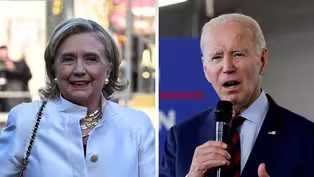
Laura Barron-Lopez reports on why the DOJ charged Mr. Trump for his handling of classified material, but not others, like Hillary Clinton, Joe Biden, and Mike Pence.
REP. JIM JORDAN (R-OH): This is the most political thing I have ever seen.
LAURA BARRON-LOPEZ: In response to the unprecedented federal indictment of Donald Trump... GOV.
RON DESANTIS (R-FL), Presidential Candidate: Is there a different standard for a Democrat secretary of state versus a former Republican president?
I think there needs to be one standard of justice in this country.
LAURA BARRON-LOPEZ: Republicans, including the former president, are attacking the justice system.
DONALD TRUMP, Former President of the United States: The ridiculous and baseless indictment of me by the Biden administration's weaponized department of injustice will go down as among the most horrific abuses of power in the history of our country.
JACK SMITH, Special Counsel: An indictment was unsealed.
LAURA BARRON-LOPEZ: The Justice Department charged Trump with 37 felonies, including 31 counts under the Espionage Act, for knowingly retaining national defense documents after repeatedly being asked to hand them over.
REP. NANCY MACE (R-SC): Joe Biden has classified documents.
He mishandled them as vice president.
LAURA BARRON-LOPEZ: Republicans are crying hypocrisy, and GOP primary voters agree.
Three-quarters say the prosecution is politically motivated, according to a recent CBS News poll.
MAN: It's a witch-hunt.
WOMAN: I think it's a complete waste of time.
DONALD TRUMP: They did absolutely nothing in Hillary's case.
LAURA BARRON-LOPEZ: Trump and his allies are pointing to other cases where classified material was found in the possession of former government officials, but not prosecuted, in particular, Trump's 2016 rival, Hillary Clinton.
HILLARY RODHAM CLINTON, Former U.S. Secretary of State: I did not send nor receive classified material.
LAURA BARRON-LOPEZ: Some 30,000 e-mails from Clinton's years as secretary of state, including some deemed classified, were found in a personal e-mail server in her New York home during the 2016 campaign.
Clinton cooperated with an FBI investigation, which recommended no criminal charges.
JAMES COMEY, Former FBI Director: Although we did not find clear evidence that Secretary Clinton or her colleagues intended to violate laws governing the handling of classified information, there is evidence that they were extremely careless.
MARK ZAID, National Security Attorney: Hillary Clinton's case is completely different.
LAURA BARRON-LOPEZ: Mark Zaid is an attorney who focuses on national security issues.
He says Trump and Clinton were investigated under two different Espionage Act provisions.
And Clinton was dealing with e-mails, not marked classified document.
MARK ZAID: But most of the information that was deemed to be classified was actually deemed based on the content after people reviewed it, so that those who saw it wouldn't necessarily have suspected there was anything classified in it.
LAURA BARRON-LOPEZ: As for the investigations into President Biden and Trump's own vice president, Mike Pence, there are key differences.
In Trump's case, the DOJ charged him for holding onto classified materials for more than a year after leaving office, documents he stored in places like a bathroom and ballroom.
Both Biden and Pence found classified material from their time as V.P.
in their homes.
But, unlike Trump, both turn them over immediately, and invited the FBI to search for others.
DAVID KELLEY, Former U.S. Attorney, Southern District of New York: When you talk about President Biden and former Vice President Pence, what you're talking about is complete transparency.
LAURA BARRON-LOPEZ: David Kelley is a former U.S. attorney of the Southern District of New York.
DAVID KELLEY: You screwed up.
You weren't supposed to take these documents.
Then you gave them back.
We're good.
But when you go ahead and you're told that you have got documents you're not supposed to have, and then you conceal that, and then you lie about it, that's a criminal problem, because that shows knowledge and intent to violate the law.
LAURA BARRON-LOPEZ: The DOJ recently cleared Pence, and a special counsel investigation of Biden is ongoing.
The Trump indictment alleges that he conspired to hide documents from the government, returning them only after a subpoena and a later FBI search.
Dozens of other classified documents he had taken to Florida, but turned over to the National Archives earlier, were not included in the charges.
DAVID KELLEY: The compounding factor in the Trump indictment is the obstruction of justice.
He was told he had documents.
He kept them anyway and then took steps to keep them from the National Archives.
LAURA BARRON-LOPEZ: While Trump had hundreds of classified documents stored in Florida, the special counsel narrowed its case to just 31 pages.
That includes 21 with -- quote -- "top secret markings" from the CIA, NSA, the Pentagon and Department of Energy,among others.
According to the indictment, the documents contain secrets about U.S. nuclear and military capabilities and defense capabilities of foreign countries.
MARK ZAID: Some have said the Goldilocks documents.
LAURA BARRON-LOPEZ: Mark Zaid says these 31 documents were chosen carefully by the special counsel.
MARK ZAID: It's not too secret, and it's not too challengeable, meaning these are documents that probably anyone who looks at them would understand, as a layperson, that the information is incredibly sensitive.
LAURA BARRON-LOPEZ: It will soon be up to a Florida jury to decide if Trump will face criminal consequences.
For the "PBS NewsHour," I'm Laura Barron-Lopez.
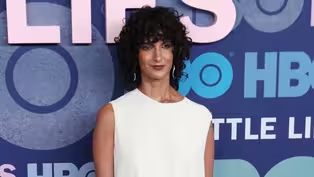
AMNA NAWAZ: The fourth and final season of Netflix's wildly popular series "Never Have I Ever" is leading the platform's streaming charts across the world.
I recently spoke with one of the series' lead actors, Poorna Jagannathan, about the show's success and how it's paving the way for more diversity in Hollywood, as part of our arts and culture series, Canvas.
Poorna Jagannathan, welcome back to the "NewsHour."
It's good to see you again. '
POORNA JAGANNATHAN, Actor: Such a pleasure.
I remember we did the release of season one.
And it is such a pleasure to come full circle and be with you for season four.
AMNA NAWAZ: So, we are talking four seasons later now.
The world is now watching the final episodes of what has become a multicultural phenomenon on television, "Never Have I Ever."
How are you feeling about it coming to an end?
POORNA JAGANNATHAN: Well, as you're talking, it is really occurring to me it has gone from extraordinary thing in season one to an ordinary thing in season four, meaning, like, we -- the diversity was so unheard of, and now we're seeing so much more representation in streaming platforms, in the scripts I'm getting, in just everything.
So the beauty of it going from a complete one-off and complete explosion to being much more ordinary is actually the journey that we wanted always.
AMNA NAWAZ: Did the reaction over the last four seasons surprise you?
I mean, show creator Mindy Kaling shared recently this screen grab that seemed to show all of the number one shows across Netflix around the world.
"Never Have I Ever" was number one across country after country after country.
Did that surprise you?
POORNA JAGANNATHAN: It really was very surprising for season one.
We didn't expect -- we didn't know what we were making.
We just knew we were having an unbelievably intimate experience while making it.
But we didn't know who would watch it, why people would watch it.
It just -- it felt so radically diverse, and it felt like such a big risk.
And even then, it was number one.
We didn't expect that at all.
We thought it'd be very niche.
AMNA NAWAZ: When we first spoke, you also talked about the connection you felt to this role.
You play an immigrant mom, right, Nalini Vishwakumar.
You, yourself, as you said, are an immigrant mom.
Does that in any way make it harder to say goodbye to this role right now because of that connection you felt?
POORNA JAGANNATHAN: Well, the funny thing is, as the seasons progressed, it became closer and closer to who I am.
When I got this role, she was really funny.
She parents in a different way from how I parent.
She's super strict, no boundaries.
(LAUGHTER) POORNA JAGANNATHAN: But, for example, Pati getting married, that was my life.
My mother got remarried at 64.
Or Devi getting ready for college, that happened this year.
And my son's getting ready for college.
So, for all of us, the show has really (INAUDIBLE) lives.
And it's become very meta and therefore very weird and hard to let go of.
I do believe this is the role of a lifetime for me.
AMNA NAWAZ: There are -- something I wanted to ask you about, because there are so many detailed, culturally specific moments throughout the show, whether it comes to traditions or celebrations or even the terms of endearment that you use to refer to other people.
I wonder, did you and the writer say, OK, we have to explain this in some way to our audience?
Or did you just think, we're going to do it and they will catch up?
POORNA JAGANNATHAN: What I love about this show is that there are no footnotes.
There's no you saying something and then someone translating.
There's an element of cultural specificity that is never explained.
And I think that's what makes it so beautiful and so authentic.
For example, the wedding jewelry that I wear is literally what I wear in my real life.
It's not a character thing.
It's what I wear.
I'm South Indian.
Or there was a scene where we said goodbye to Sendhil's mom, and it was just written in as, we hug her.
But Sendhil and I both, when we greet our parents and our grandparents, we do the namaskar.
And we -- it's the bow.
The props person would call me the day before and say, OK, we have a dinner scene.
What are you thinking to eat?
What do you want to eat?
And we would discuss, oh, (INAUDIBLE) today or (INAUDIBLE) today.
And so it's one of the only sets I have been on where there's so much cultural specificity, that everyone wanted an authenticity.
And they look to the actors to provide that.
AMNA NAWAZ: We have seen a number of both television shows, but also movies, animated film, even, in which Asian American characters and Asian American stories are not on the fringes.
They are the centerpiece.
They are the focus.
We saw that with "Everything Everywhere All at Once."
We saw that on TV with "Ms. Marvel" and "Beef," even with animated films like "Turning Red."
Why do you think we're seeing that now?
POORNA JAGANNATHAN: I actually think it started from "Never Have I Ever."
I mean, I absolutely believe that what we are seeing now is because of shows that Mindy has created and Shonda has created, where people of color are the center of those stories.
And they are doing so well.
I mean, Netflix used "Never Have I Ever" as a -- as kind of a lighthouse example of what a show can do in terms of story, in terms of diversity of storylines, diversity of casting.
But I think once something's been green-lit and does well, floodgates open.
And I believe "Never Have I Ever" was there because of "Crazy Rich Asians."
I think it's a domino effect.
And the dominoes have just grown.
And it's so high-risk when you do something like this.
And people are now willing to take the risk.
And there's an audience.
I think audiences are demanding now to be seen.
They're demanding to be reflected.
And streaming services like Netflix are rising to meet them.
AMNA NAWAZ: You have got some more work coming up where you play very different characters in.
You're going to play a bad guy in your upcoming Netflix film called "The Out-Laws."
POORNA JAGANNATHAN: Yes.
AMNA NAWAZ: The scope of your career has been so fun and interesting to watch, because you have played all different kinds of characters.
And in an industry where women of color aren't necessarily granted all that kind of agency to make decisions about the roles they play, the older women get, you're not necessarily given that many roles, and here you are, a 50-year-old brown woman, setting new peaks.
How do you do that?
POORNA JAGANNATHAN: It's the industry.
I have said this a million times.
I'm not a creator.
I'm a performer.
And I come to scripts.
I don't create them.
But there are women before me who are continuing to do the work.
Men are dying to put a full stop on women's narratives in life.
They're just, like, dying to write us out.
But there's women like Reese Witherspoon and Nicole Kidman, Mindy Kaling, and Shonda who are like, but that's not going to happen.
That (INAUDIBLE) is not going to go there.
It's a comma, and the narrative continues.
And so I am walking in the shadows of these women.
I fully know that my career and the trajectory I have is because of these women just opening doors with all their might right before I got there.
And I am waltzing through those doors now.
AMNA NAWAZ: That is Poorna Jagannathan, one of the stars of "Never Have I Ever," which is ending now after four seasons.
Congratulations.
We will be watching what you do next.
POORNA JAGANNATHAN: Thank you for always supporting me and the show, and it's a pleasure to be back on with you.
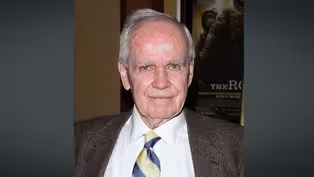
GEOFF BENNETT: Pulitzer Prize-winning novelist Cormac McCarthy died today at his home in Santa Fe, New Mexico.
His books often focused on loss and bloodshed, set everywhere from the American West, to the South, to a post-apocalyptic world.
Throughout his long career, he wrote novels that could be bleak and violent, but that were also hailed for his beautiful prose.
They were often suffused with moral ambiguity.
That included some of his best-known works, such as "No Country For Old Men," "All the Pretty Horses," and "The Road."
Critics likened him to Faulkner, Hemingway, and Melville.
Joining us now is writer Walter Kirn, the author of many novels, including up in the air, and he's also a literary critic himself.
Thank you for being with us.
Cormac McCarthy, as we said, was one of our greatest writers, known for his violent and bleak depictions, his sort of dark view of the human condition.
But in his own way, he never really wrote an uninteresting sentence.
What informed his approach to writing?
WALTER KIRN, Novelist and Critic: Well, Cormac McCarthy was kind of a hybrid of the great American novelists of the last 150 years.
For some reason, he channeled in an authentic way, not as though he were copying others, everybody, like you say, from Melville on, really.
He was a very masculine novel, I think -- novelist.
I think that needs to be noted, though his last novel was narrated by a female character, something he'd been preparing for, for 50 years.
So he was very settled in his tradition.
He had absorbed all the great writing.
And, somehow, he managed to channel it in a new way, as though it came from his deepest self.
It was as though he was a river that all the other rivers flowed into.
GEOFF BENNETT: He was relatively obscure for much of his career.
And when fame and acclaim eventually found him, he really abhorred talking about his books.
He didn't do very many interviews.
Is it fair to say that he was the most, I guess, celebrated, reclusive writer since J.D.
Salinger?
I mean, what accounted for it?
WALTER KIRN: Well, we have got a few celebrated, reclusive writers, like Thomas Pynchon, in this country.
But McCarthy, who did get around -- he just lived a very private life.
It wasn't as though he was completely hiding out or he didn't want his photograph taken.
But he was hard to meet.
You had to go to Santa Fe.
You had to sort of seek him out.
But he wasn't pushing America away.
He just wanted to do his business.
And his business was the page.
And that was where he focused himself.
GEOFF BENNETT: You, as I understand it, reviewed all of his books.
What lines or passages stuck with you, resonated with you?
WALTER KIRN: Oh, no, I can't claim to have reviewed all of them.
But I have reviewed quite a few of them.
McCarthy wrote every genre.
He wrote a great suspense novel in "No Country For Old Men."
He wrote a great sort of historical, almost horror novel in "Blood Meridian," and he wrote a dystopian science fiction novel in "The Road."
And I think "The Road" is probably the novel that I think of most these days, because it dealt with war and an uncertain future and perhaps an apocalypse on the horizon for a country much like the United States.
So it's a very haunting book.
And the very end of it, I think, where he looks back at the American landscape through a clear trout stream back into the primeval pre-civilization of this content -- continent, really sticks with me now.
GEOFF BENNETT: How do you think McCarthy in his body of work, how will it be remembered?
WALTER KIRN: It's going to be remembered with extreme fondness, respect, and, I think, affection.
He was a popular novelist.
Once he got going with "All the Pretty Horses" in the early '90s, he became a bestselling American novelist, whose movies -- I mean, whose books were made into movies and whose work became familiar.
And when he died today, it wasn't just literary people who started texting me and saying, oh, my gosh, can you believe it?
It was people of all kinds, the general reader.
We don't think that the general reader maybe exists in the United States anymore.
But she does, he does, and they do.
And Cormac wrote for all of them.
GEOFF BENNETT: How then does his imprint, does his influence show up in contemporary writing?
WALTER KIRN: Well, in some ways, he was a writer of ancient prose.
He sounded at times like the Bible.
He sounded at times like ancient philosophical texts.
He really combined knowledge of the past and present in a way few do here.
And I think he will be remembered as a kind of gold standard for a very laconic, strong, minimalist American prose, though his early books were anything but minimalist.
I mean, if you look at "Blood Meridian," it was a book that might have been written by a mad prophet of the desert in the year zero.
(LAUGHTER) GEOFF BENNETT: Walter Kirn, thanks so much for joining us, as we acknowledge and pay tribute to the many contributions of Cormac McCarthy.
7 WALTER KIRN: Thank you.
AMNA NAWAZ: And don't forget, there is more online, including an effort to collect oral histories and mementos from LGBTQ+ residents of Missouri to preserve queer history in the state.
You can see that online at PBS.org/NewsHour.
GEOFF BENNETT: And join us again here tomorrow night as we look at how Republican voters in one early voting state are reacting to the federal charges against former President Donald Trump.
And that is the "NewsHour" for tonight.
I'm Geoff Bennett.
AMNA NAWAZ: And I'm Amna Nawaz.
On behalf of the entire "NewsHour" team, thank you for joining us.
Far-right Republicans demand more control in the House
Video has Closed Captions
Far-right House Republicans demand more control over major issues in the chamber (5m 53s)

Former federal prosecutor analyzes case against Trump
Video has Closed Captions
Former federal prosecutor analyzes case against Trump (6m 22s)
How Trump classified material case is different from others
Video has Closed Captions
How Trump's classified material case is different from Clinton's and Biden's (5m 27s)
The legacy of Pulitzer-winning novelist Cormac McCarthy
Video has Closed Captions
The legacy of Pulitzer-winning novelist Cormac McCarthy (5m 34s)
Poorna Jagannathan on her role in "Never Have I Ever"
Video has Closed Captions
Poorna Jagannathan on her role in "Never Have I Ever" and diversity in Hollywood (7m 18s)

Reddit users protest policy that harms third-party apps
Video has Closed Captions
Reddit users go dark in protest of policy that could shut out third-party apps (5m 20s)
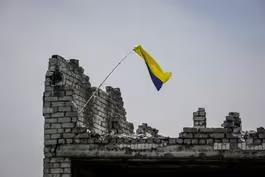
Russia targets Zelenskyy's hometown with missile strikes
Video has Closed Captions
Russia targets Zelenskyy's hometown with missiles as Ukraine continues counteroffensive (4m 21s)
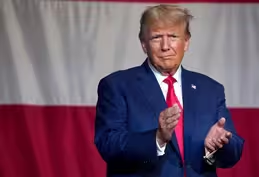
Trump pleads not guilty in classified documents case
Video has Closed Captions
Trump pleads not guilty on federal charges of mishandling classified documents (6m 32s)
Providing Support for PBS.org
Learn Moreabout PBS online sponsorship
- News and Public Affairs

FRONTLINE is investigative journalism that questions, explains and changes our world.

- News and Public Affairs

Amanpour and Company features conversations with leaders and decision makers.












Support for PBS provided by:
Major corporate funding for the PBS News Hour is provided by BDO, BNSF, Consumer Cellular, American Cruise Lines, and Raymond James. Funding for the PBS NewsHour Weekend is provided by...