
March 2, 2026 - Full Show
3/2/2026 | 26m 48sVideo has Closed Captions
Watch the March 2, 2026, full episode of "Chicago Tonight."
Trump fans the flames of war in Iran — what we know and where we’re going. And could more nuclear reactors be coming to Illinois?
Problems playing video? | Closed Captioning Feedback
Problems playing video? | Closed Captioning Feedback
Chicago Tonight is a local public television program presented by WTTW
WTTW video streaming support provided by members and sponsors.
March 2, 2026 - Full Show
3/2/2026 | 26m 48sVideo has Closed Captions
Trump fans the flames of war in Iran — what we know and where we’re going. And could more nuclear reactors be coming to Illinois?
Problems playing video? | Closed Captioning Feedback
How to Watch Chicago Tonight
Chicago Tonight is available to stream on pbs.org and the free PBS App, available on iPhone, Apple TV, Android TV, Android smartphones, Amazon Fire TV, Amazon Fire Tablet, Roku, Samsung Smart TV, and Vizio.

WTTW News Explains
In this Emmy Award-winning series, WTTW News tackles your questions — big and small — about life in the Chicago area. Our video animations guide you through local government, city history, public utilities and everything in between.Providing Support for PBS.org
Learn Moreabout PBS online sponsorshipfor joining us on Chicago tonight.
I'm Nick Blumberg.
Brandis Friedman is on assignment.
Here's what we're looking at.
>> We projected 4 to 5 weeks.
We have.
Capability to go far longer than that.
>> President Trump says a war with Iran could last 4 to 5 weeks.
What a local congressman has to say about that.
>> The economic opportunity of building power is enormous.
And what Governor Pritzker's nuclear ambitions mean for Illinois residents.
>> First off tonight, a new push to investigate Jeffrey Epstein related crimes at the state level.
Lawmakers and advocates for abuse victims gathered today to announce a new bill creating the Illinois Epstein Files Investigation Commission which would have the power to issue subpoenas and refer allegations to Illinois Attorney general backers of the measure say Epstein's network extended into the state and that the U.S.
Department of Justice is failing to act.
>> Accountability applies to everyone.
No one should be prematurely exonerated and no one should be presumed guilty without evidence.
Let the investigations follow wherever the facts lead.
Avoid political filtering.
>> The measure also calls for a focus on assault survivors, including trauma, informed care and access to counseling.
>> Residents Chicago Fire Stadium come with the community benefits agreement.
>> Local organizations from neighborhoods around the area south of the loop, known as the 78 and around the city gathered this morning in the CBA ahead of tomorrow's scheduled groundbreaking for the new stadium and entertainment District.
They want guarantees in key areas including jobs, transportation and housing.
We continue to hear about affordable housing, this coming around.
>> Out of surrounding communities.
But if house and does not include the incomes of people who live a fixed income then is not affordable for us.
If that house and does not include the incomes of people who are working every day and on just receive minimal ways in come then is not affordable for us.
>> Members of the CBA coalition say they haven't been invited to participate in tomorrow's event.
With the Illinois primary just 2 weeks from tomorrow.
Election officials are urging voters to cast their ballots early.
Early voting expanded to all 50 wards in Chicago today as well as the downtown super site where anyone can cast a ballot regardless of where they live and where residents can register.
Same day or update their address.
They're also 55 early voting sites now open in suburban Cook County.
You never know >> how the weather will be in the beginning of March or what circumstances may come your way preventing you from voting as you originally planned.
So we are urging Chicago voters to vote early and enjoy the peace of mind that comes with getting your civic duty out of the way.
>> And if you're still not sure who you're casting a ballot for or where you can vote, be sure to check out our Web site at Wt Tw dot com slash voter guide.
The death toll in Iran and the surrounding region rises to over 500 as U.S.
Secretary of state Marco Rubio warns the quote, hardest hits are still to come.
Those comments after the U.S.
and Israel struck Iran on Saturday killing Iranian Supreme Leader Ayatollah Ali come raising concerns over the long-term ramifications for the region and the United States's involvement.
President Donald Trump today says the strikes on Iran could take 4 to 5 weeks or far longer.
>> Our objectives are clear.
First were.
Destroying Iran's missile capabilities.
And you see that happening on an hourly basis.
Second, we're and Nia letting their neighbor.
We've knocked out already 10 ships.
3rd, we're ensuring that the world's number one sponsor of Tara can ever obtaining a nuclear weapon.
And finally, we're ensuring that the Iranian regime cannot continue to arm fund and direct terrorist armies outside of their borders.
>> But some members of Congress are pushing back on Trump's actions calling for a vote on the president's use of military power.
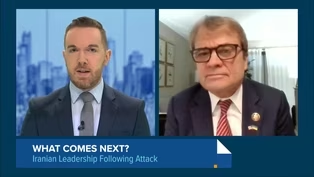
Joining us is Congressman Mike Quigley, a member of the U.S.
House Intelligence Committee.
His district covers parts of Chicago and some western suburbs.
We also invited Illinois Republican Darin LaHood.
Also a member of the Intelligence Committee.
But he did not respond to our invitation.
Congressman, quickly, welcome back to the program.
Thank you for being here.
Thank you.
Glad to be back.
So it's been reported the Trump administration alerted just a handful of top congressional leaders before the attack on Iran.
What if anything as yet?
Have you been briefed on?
>> I think administration lying about that.
I know, you know, Democratic members that were told specifically that said this attack would take place there were some briefings that took place today.
They'll be more tomorrow and Wednesday terms of foreknowledge that simply didn't happen.
>> This strike, you know, was launched without Congress declaring war.
You know, there is a bipartisan push set for a vote this week aimed at limiting the operation.
What's your expectation as to how that vote might go?
>> Yeah, I mean, look, fact that this vote got to the floor took some Republicans what we call a discharge petition to get to the floor.
So the question is, will those Republicans stick with?
I think what will be every Democrat supporting this measure?
The bottom line is Constitution clearly rest ability to declare war with Congress.
And the president has obviously forsaking more than one occasion during this first her first year in the second term.
So what voting probably Thursday afternoon isn't a measure to restrict that.
I think as a pet, a chance to pass the House.
I have less optimistic about the Senate.
Of course, the president would never sign this.
This is the president again who it said no new words he has called this action, war.
Indeed, it is.
>> And based on what you know, was there concern within the intelligence community about an imminent attack from Iran patients?
I can only speak for myself that there was We do know this.
No briefing about it an attack, imminent threat to the United States.
>> So we were left with wonder was the exact question?
rationale here?
Clearly the regime in Iran.
>> He's a horrible entity killed thousands of its own people.
to see regime change, but what we've learned and what >> Syria.
I rack.
Maybe a Afghanistan that simply a change in leadership does not lead to democracy.
What's most likely hears that, you though, later was planning because of his age and know-how for a change in leadership probably toward his But clearly some one of the Revolutionary Guard.
This is going to be an extreme later that takes its place.
If anyone thinks regime change will take place without full-fledged war, they're mistaken in the facts.
>> Yeah.
I mean, what is the view?
You know, either from from folks who speak within the military and the intelligence community about, you are there, for example, opposition leaders poised to lead after regime change, for example, or is this going to pass, as you say to who's already within the power structure?
>> far more likely to be within the existing power structure.
This isn't regime that has the capabilities that too an exact as they have recently, just brutal repression and the fact that, you know, we're striking them now will reduce their capabilities, but it it won't reduce their capabilities and repressing their own people.
The real concern I have for our country the fact of matter is when the jcpl way trained they have with around was in place.
They were in compliance that we're not moving forward with a weapon.
This is the country now ready to exact revenge on the U.S.
and its allies and then as the president said, quite capable of terrorism.
I'm concerned with the renewed enhanced terrorist threat right here in the United States.
>> We've got just about 30 seconds left.
But as we mentioned, the president says this could take 4 to 5 weeks or perhaps far longer.
What's your assessment in terms of the timeline that we're looking at?
>> Yeah, history doesn't bow.
Wow.
All right.
The wise man said if you break it, you own it.
Now that we're in the situation is going to be very difficult to extract ourselves.
The president sought to palace with the deaths were already had a service members.
Unfortunately, we're going to see far more.
>> All right.
Congressman Mike Quigley, thank you very much for your time.
We appreciate it.
And up next, a look at the future of nuclear power in Illinois.
>> Chicago tonight is made possible in part why the Alexander and John Nichols family.
The Pope Brothers Foundation.
And the support of these donors.
>> Illinois gets a majority of its energy from nuclear power.
Despite a decades long moratorium on building new nuclear power plants.
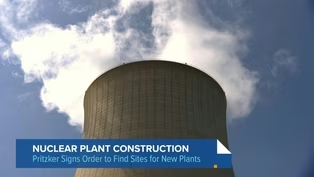
With that moratorium lifted earlier this year, Governor JB Pritzker signed an executive order directing state agencies to start planning for nuclear power plant construction.
That could begin by 2033, here's a bit of what Pritzker had to say.
>> We can take years off of the development and launch of new base load energy production.
It sets a new nuclear energy framework for Illinois.
One that prioritizes affordability, safety and reliability.
Our state agencies have been ordered to immediately begin working together and reaching out to local governments to identify sites for new reactors.
It will also advance the development of a state regulatory framework with rigorous safety and citing standards.
>> Joining us to talk about the future of nuclear energy in Illinois are Tom Fanning a nuclear engineer at Argonne National Laboratory.
Mark Pruitt, former chair of the Illinois Power Agency and now an independent consultant at the Power Bureau and Madison, Hilly managing director at Radiant Energy Group, a nuclear energy consultancy.
also reached out to a number of groups with concerns about nuclear power and were able to join us.
We have some statements to share and a moment, but thank to 3 of you for being here.
happy to have Thank you.
Thank So, you know, Tom Fanning, a lot of folks are may be familiar with the concept of nuclear reactors, but not exactly how they work.
So that briefly, how do they generate electricity?
>> So nuclear power plants generate electricity via fission, which is the splitting of typically a heavy elements like uranium.
This is a technology that was here in Chicago back in the 1940's, the first chain reaction was in 1942.
In the city actually.
And then that eventually moved on to the suburbs.
And in 1946, Argonne National Laboratory was was established.
And we've been developing that technology since them.
so the idea, of course, is to generate heat to make either a very high temperature gas for steam to turn a turbine, turns a generator project to produce electricity.
>> Alright, simple enough.
But I would have been able to say it as well medicine.
You know, looking at the current state of nuclear power in Illinois.
How much are we producing?
>> Yeah, so we're actually leading the nation in nuclear energy production are 6 nuclear plants generate over half of Illinois's electricity.
And yeah, it's part of what keeps our Northern Illinois is electricity mix.
Some of the most affordable and cleanest in the nation.
And what's the sort of maintenance that's required for the current fleet of reactors that we have here in the state?
>> Honestly, the boring answer is just.
>> Proper maintenance, in part replacement mean that these nuclear plants can Ryan in pristine condition for decades.
So we actually have reactors in Illinois that have licenses to run for 80 years.
And there's no reason that they couldn't possibly run beyond that.
The NRC is actually investigating life extensions out to 100 years as we speak.
Interesting.
So if that sort of, you know, the regular upkeep is maintain, they may actually be able to go longer than initially thought.
Oh, yeah, exactly.
Our existing fleet could continue to provide electricity for Illinois for decades to come.
My crew, we just heard a bit of a Governor Pritzker announcing his order.
What was your reaction that measure?
thought it was good for the first time in 30 maybe more years.
>> great in Illinois in our neighboring states has actually started to show signs of low growth, which is more demand for electricity, which quite quite different kind of the managed decline that we've been noticing over the past, especially 10 to 20 years.
So no, the game has to change from deciding which plants close to.
How do we meet the new demand?
Well, not leaving the existing consumers behind.
So there's there's cost issues.
There's reliability issues.
you know, the sooner they start thinking about how to bring these types of resources.
To the market, the better the result is going to Yeah.
I mean, with that increased demand.
How important of a role do you see nuclear playing?
You know, obviously the state has a lot of has passed legislation to.
>> You know, encourage the development of clean energy, wind, solar, things like that that has nuclear fit into that mix.
>> Well, you I don't know that there's any.
One better than the other there.
They're just different when we're looking at the demands for electricity from some of the new industries to, of course, the data centers, but also the battery manufacturers.
The electric vehicle manufacturers, and then, you know, electrification of buildings moving away from.
More traditional forms of energy.
What you really need is several layers and different types of energy because in the end, we're wanting to spread our bets across a broader portfolio of resources so that we're always a sure that the grid can deliver when the demand greatest.
And I think that that nuclear and solar and wind, they all have a role to play.
But the bottom line is we need more of >> So after the governor's executive order, the nuclear energy Information Service industry watchdog, they raised some concerns.
Those include a lack of language in the order around waste management and post closure plans for reactor communities.
Concerns about staffing cuts at the federal level that could affect oversight as well as concerns about the high costs of reactors.
Madison, hilly, what do you make of some of those concerns?
>> I mean, I think this is sort of a last ditch effort to scare communities from what is going to be a really powerful economic engine and investment for the future nuclear in America has an impeccable safety record.
It doesn't get better 0 deaths over more than 70 years of commercial operation.
In terms of the waste.
The nuclear waste is great.
It's easily contained.
It's currently getting safer day by day.
It can be recycled.
Very few people know that it can actually be fuel for this next generation of nuclear reactors.
We're looking to invest in.
So I think.
Like clearly momentum is for new clear for growth for new economic prosperity in the state.
And I'm glad to hear that.
You know, Tom Fanning, when you look at that next generation of nuclear reactors, you know, designs have come a long way since they were last built an in Illinois many decades ago.
>> What might this next generation of of local reactors look like?
>> as I mentioned, are gonna started a long time ago working on nuclear technology in the focus has always been on secure, safe and sustainable energy production worldwide.
Really?
so what developed in the early days was light water reactor technologies.
And I think that will continue for the foreseeable future.
But there are also companies and are gonna has partnered with some of those companies to develop what we called the advanced reactors or Gen for technologies that look at different cooling options, different fuel types.
But ultimately our focus has always been on safe and sustainable operations of that power supply.
>> You medicine who just mentioned haven't built nuclear plants in Illinois and many decades.
Does the state have the necessary workforce and expertise to build the next generation of reactors?
Absolutely.
If anything, Illinois should be the frontrunner in this competition for new nuclear investment.
>> We have the most nuclear energy production of any state.
We have an existing workforce with deep expertise.
We have wonderful institutions, including National labs.
So it really was ours to lose.
But while we were coasting on our existing nuclear fleet, other states were actively competing for new nuclear investment.
We can catch up, but we do have to catch up.
>> My Pruitt, you know, the governor's office says Illinois will not impose facilities on communities.
That participation is voluntary be dilip driven by local interest.
What sorts of things should communities be thinking through as they try to decide whether nuclear is right for them.
Well, I think like every type of large industrial development, there's going to be an analysis of the tradeoffs, right?
There's there's desire for jobs and for property tax revenue and all the plus sides.
But >> I think that the communities have some additional due diligence to, of course, there's going to be concerned about safety and operations.
And what does this really mean?
Long term?
Is this 20 year, a 50 year, 400 year.
>> type of institution that that's going to exist or community.
I can say that a number of the existing communities that are hosting nuclear facilities Illinois are very closely associated with those facilities firing Clinton, etc.
>> And I think that they have a very close working relationship with the nuclear operator.
Things could get a little scary sometimes if a, if there's word that the nuclear plant is going to close, we saw that not that long ago in Illinois.
we're state intervention was necessary to keep the plants operating.
And I think that those communities during that experience really had start thinking about, okay, we have this great economic driver.
What else do we need to be doing?
You know, it's not just a one and done or filing forget they they need to continue to manage their position.
And I think that the communities are up for it.
There are patterns and experience that other communities you know, patterns already been cut.
I think that they can.
They can learn a lot from those other communities, income to a good conclusion by themselves.
you know, medicine.
You mentioned the excellent safety record of new clear.
But, you know, a lot of folks may have things that stick in their mind.
Things like 3 Mile Island What are the sorts of safety concerns you hear from folks when you talk with them about nuclear?
>> I mean, I do really think it's sort of the their worst case scenario.
They think about China Syndrome, 3 Mile Island.
Where's, you know, 3 Mile Island is actually nuclear safety.
Sort of that.
It's best where?
An accident happens.
And plant just shuts down on itself.
No serious environmental releases.
No, you know, harm or public health issues to any of the workers or to the public.
You know, that same thing can be said of similar energy accidents and other industries.
So it's just it's hard to argue with the historical track record of new clear in the U.S.
and, you know, I you talk to the people in these communities and they're very defensive about their plan.
They know that it's safe because it's the members of their community that they go to church with, that they go to lunch with that.
They have book club with Keep that plant safe.
So I have no concerns that Illinois couldn't lead on this while maintaining its excellent safety record.
You know, Tom Fanning Argonne does a lot of You know, how did the technology's >> go from sort of research in a lab toward actual commercial uses in these reactors.
What's that pathway like?
So so that that is the big challenge, right?
Getting from the R and d space into the commercial environment the industry does a lot of innovation on its own where the National Labs come in and come partner with industry is when there are new materials are new components or or even new designs that they would like help, you know, from a national lab to to kind of get through that gap right from the R and D space to to the commercial space.
Madison mentioned earlier about fuel, the potential for it to be recycled that's that's a big political challenge.
But there's also a G that needs to be developed to support that.
And that's one of the big areas that are going does research in.
And without that support them, it's going to be even harder for industry to try to take the next step.
Yeah.
So looking ahead, you as Illinois's anticipating trying to get more plants online, that some think there's the potential there for for Oregon to partner with with government with no industry.
Yeah.
And and the the the executive order specifically mention the University of Illinois.
So I want to give them a shout out there they have a great program down there as well.
I don't remember them and mentioning are gone, but certainly our gun would overjoyed to help the only in in our own backyard in our communities.
The people that work at Argonne work all around live all around the Chicago suburban area.
So the group any I s that we referenced earlier, they also brought up concerns about.
>> Cost effectiveness, saying that it is, quote, utterly incomprehensible.
Why the governor and legislature would promote the most expensive slowest to deploy at least cost-effective greenhouse gas, displacing most of dangerous.
And in the case of small modular nuclear reactors, nonexistent method to deal with it, you know, weighing that sort of the multi-billion dollar cost of new nuclear against falling prices of renewables like wind or solar or proof.
You know, how do you square that circle?
>> Again, this goes back to, you know, are are some energy sources better than others, The issue with the new clear is I think that, you know, sometimes things are more expensive because they the higher value being able to have power plant that can operate at close to 100% capacity for 2 years with then a very short-term fueling turnaround time.
That's a very valuable asset.
And really it's that type of of generating profile that placed Illinois initially as just more or less that the energy.
Of the Midwest over the 60 70's and 80's.
again, that's not to take anything away from the wind and solar which can deploy quicker.
But those aren't 80 your These are just different.
They have a different cost structure.
But when we look at the normalized or level cost of the volume of electricity that's generated, I think it's probably a little bit different cost comparison and what the group indicates.
All right.
Well, there is a lot of interest in this topic.
I'm sure we'll be talking about it much more to come.
>> That's all the time we have for this evening.
Tom Fanning marked Parade and Madison Haley, thank you for joining us.
Thank you for having us.
And that's our show for this Monday night.
You can stream Chicago tonight on our W T Tw YouTube channel every evening and catch up on any programs you may have missed.
Join us tomorrow night at 5, 30 10, 30.
The Democrats running for Cook County Board.
President join us to share their visions for the office and why they want your vote now for all of us here in Chicago tonight, I'm Nick Blumberg.
Thank you for watching.
Stay healthy and safe and have a good night.
>> Closed captioning is made possible by Robert a cliff and Clifford law Chicago, personal injury and wrongful death with
 New
NewAre More Nuclear Reactors Coming to Illinois? Here's What to Know
Video has Closed Captions
Clip: 3/2/2026 | 14m 49s | Illinois gets a majority of its energy from nuclear power. (14m 49s)
 New
NewUS Rep. Mike Quigley on War With Iran
Video has Closed Captions
Clip: 3/2/2026 | 6m 15s | President Donald Trump today says the strikes on Iran could take four to five weeks. (6m 15s)
Providing Support for PBS.org
Learn Moreabout PBS online sponsorship
- News and Public Affairs

Top journalists deliver compelling original analysis of the hour's headlines.

- News and Public Affairs

FRONTLINE is investigative journalism that questions, explains and changes our world.











Out Of The Dark: Teens Talk Mental Health
Support for PBS provided by:
Chicago Tonight is a local public television program presented by WTTW
WTTW video streaming support provided by members and sponsors.