
Mars: The Red Planet Revealed
Special | 5m 12sVideo has Closed Captions
Find out more about Mars.
Mars is one of our closest neighbors in the solar system. Find out more about the Red Planet in this Science Trek video short.
Problems playing video? | Closed Captioning Feedback
Problems playing video? | Closed Captioning Feedback
Science Trek is a local public television program presented by IdahoPTV
Major funding for Science Trek is made possible by the Laura Moore Cunningham Foundation, with additional funding provided by the Idaho National Laboratory, and by contributions to the Friends of Idaho Public Television from viewers like you, thank you.
Mars: The Red Planet Revealed
Special | 5m 12sVideo has Closed Captions
Mars is one of our closest neighbors in the solar system. Find out more about the Red Planet in this Science Trek video short.
Problems playing video? | Closed Captioning Feedback
Where to Watch Science Trek
Science Trek is available to stream on pbs.org and the PBS app.
Science Trek
Science Trek is a place where parents, kids, and educators can watch short, educational videos on a variety of science topics. Every Monday Science Trek releases a new video that introduces children to math, science, technology, engineering, and math (STEM) career potentials in a fun, informative way.More from This Collection
Ever since human first looked up in the night sky and wondered what was out there, we have been trying learn more about outer space. Explore the planets. Study asteroids and comets and find out what it is like to train to be an astronaut.
Video has Closed Captions
Where in the galaxy do we live? Find out. (7m 28s)
Video has Closed Captions
Asteroids and comets can teach us about the beginnings of the universe. (6m 20s)

Exoplanets: Finding Life With the JWST
Video has Closed Captions
Will biosignatures help us find life on exoplanets? (5m 26s)
Video has Closed Captions
Learn what astronomers learned through the ages. (5m 52s)
Video has Closed Captions
The James Webb Space Telescope could bring amazing discoveries. (6m 53s)
Satellites: The Story of Satellites
Video has Closed Captions
What is a satellite and how do human-made satellites study the Earth and the Universe. (5m 32s)
Satellites: Using Satellites to Find Treasure
Video has Closed Captions
GPS satellites help us navigate around the world and can help us find treasure. Learn how. (6m 22s)
Planets: What Exactly is a Planet?
Video has Closed Captions
How do you decide what a planet actually is? (5m 29s)
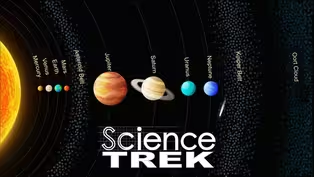
Planets: Tour the Solar Neighborhood
Video has Closed Captions
Take a tour of our Solar System and learn about planets and much more. (6m 3s)
Video has Closed Captions
Learn more about the Earth's only natural satellite. (5m 15s)
The Moon: Can You Visit the Moon in Idaho?
Video has Closed Captions
Why did the Apollo astronauts train in Idaho? (6m 7s)
Providing Support for PBS.org
Learn Moreabout PBS online sponsorshipJoan Cartan-Hansen, Host: Scientists are learning all they can about Mars with the hope that someday soon we can send people there.
So, what do you want to know about Mars?
Find out as the red planet is revealed on Science Trek.
[MUSIC] Mars is the fourth planet from the Sun.
Of all the planets in the solar system, Mars is the most like Earth.
Mars spins on its axis with a tilt similar to Earth's.
A Martian day is about 24 hours and 40 minutes.
It has distinct seasons.
And there are ice caps on its north and south poles.
But unlike Earth, Mars has a thin atmosphere mostly made up of carbon dioxide.
Mars is about half as wide as the Earth, and because its mass is lower, it has far less gravity.
If you weighed 50 pounds on Earth, you would weigh only 19 pounds on Mars.
And because Mars is much further from the Sun than the Earth is, Mars takes longer to orbit the Sun.
A Mars year takes 687 Earth days.
Its average surface temperature is about 80 degrees below zero.
Summer days can get much warmer, but because Mars has so little atmosphere, the nights are very cold.
Mars has two moons: Phobos and Deimos.
They are small and shaped kind of like potatoes.
Deimos is the smaller and its orbit is farther from Mars than Phobos.
Phobos can orbit Mars three times in a single Martian day.
Mars was named after the roman God of war and is known as the red planet.
It's red because iron in the dirt on Mars gives it its rusty red color.
Mars has giant volcanoes and deep canyons.
The highest volcano in the whole solar system is Olympus Mons and it's on Mars.
Olympus mons is about 374 miles wide and 16 miles high.
That's three times taller than Mt.
Everest, Earth's highest point and about as wide as the state of Arizona.
There are lots of craters on Mars caused by asteroids.
And Mars' surface is solid like Earth's and made up of mostly of rock and dirt.
Giant dust storms can blanket much of the planet and leaves the Mars sky a pink or tan color.
In 1877, Giovanni Schiaparelli first identified lines on the surface of Mars.
He called them "canali", which was mistranslated into English as "canals."
Astronomers of the time thought the canals had been dug by some sort of alien life form.
That started the talk about little green creatures from Mars.
>>> "At last the secret was mine.
And now, to get proof of my discovery, smuggled past the border guards.
In spite of my infinite precaution, one of them became suspicious and gave the alarm.
[woman screams] >> Come back for the (indescernable) did ya?
Get 'em pa!
>> And so with a fond farewell to the natives ringing in my ears, I took off once again for Mars."
Cartan-Hansen: Well, there were no little green Martians when Mariner IV took these first real close-up pictures of the surface of Mars in 1965.
Viking I landed on the surface of Mars in July of 1976 and provided the first panoramic photos of the planet's surface.
And rovers like "Spirit," "Opportunity," and "Curiosity" have allowed scientists to learn a great deal more about the red planet.
[MUSIC] We know water once ran in streams on the planet and that there were once lakes.
We're studying the elements that make up the rocks and soils on Mars.
And we're searching for the building blocks of life.
And who knows?
Maybe you'll be the first astronaut to walk on Mars and discover even more about the red planet.
If you want to learn more, check out the Science Trek website.
You'll find it at ScienceTrek.org [MUSIC] Announcer: Major funding for Science Trek is made possible by the Laura Moore Cunningham Foundation, helping Idahoans reach new heights for generations; additional funding provided by the Idaho National Laboratory, mentoring talent and finding solutions for energy and security challenges; and by contributions to the Friends of Idaho Public Television from viewers like you, thank you.
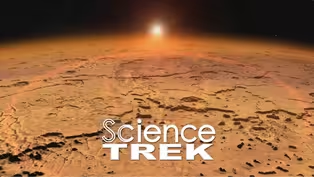
Video has Closed Captions
Clip: Special | 1m 4s | Was Mars once a wet, warm place? (1m 4s)
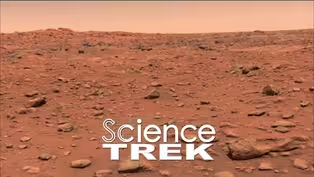
Mars: What does it sound like on Mars?
Video has Closed Captions
Clip: Special | 1m 4s | What could you hear on Mars? (1m 4s)
Providing Support for PBS.org
Learn Moreabout PBS online sponsorship New Episode
- Science and Nature

Explore scientific discoveries on television's most acclaimed science documentary series.


 New Season
 New Season






Support for PBS provided by:
Science Trek is a local public television program presented by IdahoPTV
Major funding for Science Trek is made possible by the Laura Moore Cunningham Foundation, with additional funding provided by the Idaho National Laboratory, and by contributions to the Friends of Idaho Public Television from viewers like you, thank you.