
Mayor Brandon Johnson on the 2026 Chicago Budget
Clip: 12/23/2025 | 16m 18sVideo has Closed Captions
The mayor said he would allow the $16.6 billion budget to take effect Jan. 1 over his objections.
The mayor’s decision not to veto the budget he called “morally bankrupt” immediately averts what could have been the city's most severe fiscal crisis in more than 40 years.
Problems playing video? | Closed Captioning Feedback
Problems playing video? | Closed Captioning Feedback
Chicago Tonight is a local public television program presented by WTTW
WTTW video streaming support provided by members and sponsors.
Mayor Brandon Johnson on the 2026 Chicago Budget
Clip: 12/23/2025 | 16m 18sVideo has Closed Captions
The mayor’s decision not to veto the budget he called “morally bankrupt” immediately averts what could have been the city's most severe fiscal crisis in more than 40 years.
Problems playing video? | Closed Captioning Feedback
How to Watch Chicago Tonight
Chicago Tonight is available to stream on pbs.org and the free PBS App, available on iPhone, Apple TV, Android TV, Android smartphones, Amazon Fire TV, Amazon Fire Tablet, Roku, Samsung Smart TV, and Vizio.

WTTW News Explains
In this Emmy Award-winning series, WTTW News tackles your questions — big and small — about life in the Chicago area. Our video animations guide you through local government, city history, public utilities and everything in between.Providing Support for PBS.org
Learn Moreabout PBS online sponsorship>> No veto.
That's the decision for Mayor Brandon Johnson about the rival budget passed over his objections by City Council.
But the mayor also did not sign the budget so it will automatically go into effect January.
First, averting a Chicago government shutdown.
What went into the mayor's decision?
Well, he's here to tackle that question and look back at an eventful 2020 to 5 in Chicago.
Mayor Brandon Johnson joins us now.
Welcome back to the program.
Thanks for having me and happy holidays.
Happy holidays.
So you announced today, as we said, you would neither vetoed North, signed the budget plan allowing it to automatically become law.
How did you reach that decision?
>> Well, pretty straight forward.
There are critical investments in this budget that were important to me and to the people of this city.
One, making sure that we're addressing in our young people, which we've done that we've maintained it investing in mental or behavior, health care services that's in this budget.
We were able to maintain that.
Also ensuring that we're creating economic opportunities for small businesses and building more affordable homes.
We've maintained that we also had some pretty straight for red lines in the and the budget as well.
No increase in property taxes, no collection of grocery taxes.
And of course, no to raising garbage fees.
So to maintain that.
However, though, there are some important investments in this budget.
There's one aspect of it that I believe this is is quite frankly, is immoral, is that there are a group of alders that were dead set on attempting to balance this budget off the backs of working people in poor people by selling off debt and what we've seen is historically that that has incredibly harassing and undignified away of collecting debt people who quite frankly are in economic peril at the results of what's coming from the federal government.
>> Well into that, and you also signed 2 executive orders aimed at knocking down a couple of the elements he found objectionable preventing the sale, specifically medical debt to collectors as well as an effort to rein in Chicago Police Department overtime spending.
Are you confident those executive orders have full force of law behind them?
Well, that's what they're designed to do is really to protect all of Chicago.
And so what we've seen historically police overtime has, you know, placed our budget in in peril.
While also we've seen how medical debt in particularly have led to many working people landing in poverty.
Right?
And so that was important.
Now, there are some key elements of this budget that I do know will help strengthen our our our city over time where we've put forth cost savings.
But really this moment is about challenging big corporations in the ultra rich to pay their fair share in taxes.
The best way to balance a budget is to ensure that there's some shared sacrifice and what was presented before mean why I didn't sign it was because we had an opportunity to challenge the wealthy most lucrative corporations in the city of Chicago to put more skin in the game or we could go in the direction in which at least 30 Alders decided to go which was a sense of the balance, his budget the backs of poor people.
So this plan doubles the CPD overtime budget from 100 million dollars to 200 million dollars.
What do feel?
It's necessary as well to put more guardrails in place on police OT.
As you've done with this executive order?
Well, the first thing that we had to do was make sure that we have a realistic overtime budget, right.
But we also had to put safeguards in place because, you know, look, our police officers are working hard every single day and just for their own mental health.
And they're there's stability we had to put some measures in place so that their well-being as also being considered.
So it was twofold.
Getting the police department on par with other city departments as it relates to overtime while also ensuring that the health and the well-being of our police officers, it's also being considered putting and we're putting that front and center and all of our decisions this budget.
Also legalizes slot machines and video poker in every Chicago bar and restaurant with a liquor license.
Now some critics say that could harm low-income and working class voters.
That's been a concern of yours.
Was that a provision that you tried to negotiate out of the budget?
We certainly attempted to negotiate first of all, a balanced budget.
There still some severe concerns about the way the revenues that have been proposed are not quite lining up with our expenses, right?
So there's still some efforts on the part of my administration while also working with City Council to ensure that moving forward, that this budget is stabilize.
Now, there obviously some concerns about how they are, how the attempted to balance its budget that I'm concerned about long-term, where potential loss to services as well as layoffs could could could be in the future of our city.
So but the most important thing was it's you know, we remain vigilant.
You know, as an administration to since we speak to what working people have called for, which is the ultra rich in these big corporations to put more skin in the game.
Obviously, that work is not done.
We're going to continue to do our part to ensure that budgets not just for now, but in the future reflect what the people Chicago desire need.
Let's talk about some of those concerns that you raise because you and you know, some of your top school officials say this budget will result in a deficit of more than 163 million dollars.
How soon do you expect to know whether that forecast is accurate when that deficit will rise?
Well, that work is being done now.
My team has not stopped working to make sure all of the amendments that have been put forward that they're actually in the line items.
But even as they do that work, it's becoming clear that the budget is it's it's not balanced.
And so that's why we put some protective measures in place moving forward.
But make no mistake about it.
I'm incredibly concerned about the approach that a number of alders have taken that have placed a great deal consternation and instability in this moment.
However, our work is never done and we're going to continue to ensure that we do everything in our power to protect the working people of this city.
Well, in some of those alters we saw just last week, pretty openly disagreeing with of the city's budget director and CFO kind of in favor of their own calculations.
How tough is it to negotiate when the 2 sides aren't even agreeing on kind of the basic facts?
That issue?
What what makes it difficult is that you had a group of alderman who were not listening to what working people wanted.
In fact, 80% of the people of Chicago resoundingly said that we need to challenge corporations to put more skin in the game.
Now there is a social media tax that's going to help us generate revenue for for mental and behavioral health care services see the PPL T which is a tax corporations.
We did raise that.
That was the right thing to do.
They essentially took 98.4% of my overall budget.
The key element where there was disagreement was essentially over less than 2% of the overall budget.
The problem is the impact of that's going to have on working people.
There is real serious concern there.
What made it increasingly difficult was that we had the interests of corporations, millionaires and billionaires put incredible pressure on alders in some Alders decided to stand with corporations and the interest of the ultra-rich instead of sending with working people.
Now the fight continues because we know there's much more work to be done.
And that includes working in Springfield to work with the General Assembly to challenge, you know, the ultra-rich to put more skin in the game, whether it's to a digital ad tags openly supported whether that's through a millionaire's tax, the work that we have to do as a as a city as the state to protect working people that that work certainly continues.
Yeah.
Are there specific asks that you'll be going to to Springfield within the coming session because, you know, the previous session there seem to be perhaps a bit of a contentious relationship there.
Well, look, I mean, I think whenever leave leading in a transformational way, you know, folks will, you know, feel that pressure that doesn't intimidate me.
You know, the people of Chicago elected me to stand up for everyday people.
And that's essentially what I'm doing.
So we've been through 2 fairly contentious budget cycles the last couple years.
There's also the possibility as well.
A further budget hearing is necessary if the deficit that you predict merges, you know, after that, how would you evaluate your relationship with City Council right now?
Well, look, my door has always remain open to every single member of City Council.
My door will always remain open, in fact.
And so what we have to center our work around, we have to center that work around people.
That's the most important thing.
I was elected to stand up for.
Working people were on pace as we continue to work to build the safest most affordable, big city in America.
We've seen historic declines in violence, including homicides.
We haven't seen these levels of declined since the 1960's right?
And so what I was charged to do was to make sure we put forth a budget that was balanced that ultimately protect working people.
As long as we're center in our work around working people of this city, we can never go I mean, I know we're just through the end of this process.
But as you reflect on what we've been through in recent weeks, is there anything that you do have done differently?
Anything you're thinking about for next time around?
Well, we're still going to continue to organize and galvanize people around the city.
We hosted multiple town halls, visited many of leaders within the faith community.
Also the business community.
We're going to continue that work.
Look what the other group of Alders decided to do was to take 98.4% of the budget that I put forth.
They kept intact.
Now want to they try to take away you summer jobs.
They try to double the garbage fees, be pushed back down on that.
This small element that still left.
It's going to have profound impact on working people was the fact that Alters decided to sell off dead to of working people.
We've seen before.
Whenever there's been attempt to sell something off in this city that is never bowled well for us.
And so again, I'm deeply concerned that what was presented in past could leave right back at the table again, halfway through the If these numbers continue to do what we speculate that they'll do, which could lead to cuts to services and laying people off.
But again, I'm going to continue to work hard to make sure that we're protecting all Chicago.
certainly the budget has been taking up.
A significant portion of your plate is not the only thing on their plate, So after demanding the CTA come up with this big comprehensive safety plan.
>> The Federal Transit administration is now threatening to withhold millions of dollars from CTA calling framework materially deficient.
What's your response to Look, as I've said from the beginning, community safety is my top priority and always be my top priority.
>> And of course, that includes safety on our public transportation system with the investments that are coming from Springfield.
places us in a much stronger position to ensure that the full force of government can show for our riders ridership is up.
That's a good thing.
More and more people are using our public transportation system.
However, we have to utilize every single aspect to keep people safe, whether that's law enforcement security, but its also preventative services, social workers and counselors, people who can Hendel individuals who are suffering from mental illness.
So that full force of government approach is still are our priority.
And now we have funding from Springfield that will enable us to be able to carry out that vision into talent.
Well, you know, this all comes in the wake of the brutal random attack on the blue line where 26 year-old Bethany McGee was set on fire.
The man accused with the crime does have a lengthy record was out on electronic monitoring.
We've heard from the Cook County State's attorney and chief judge that they think electronic monitoring should perhaps be reexamined in the wake of that attack.
Where do you stand on I think in this particular instance is very clear that there is a breakdown in all of our institutions right?
And so I think it's important is to play.
Frankly, it's imperative that we always review our practices, especially as you know, these laws begin to set in if there are areas of vulnerability, we should do everything that's necessary to strengthen where there are some gaps.
But again, it's going to require full force of government approach.
It's law enforcement, but its also the critical investments to make sure that the people who need the most help and support that that help and support is there.
So, you know, despite the claims that we hear from folks, including the president and his administration, crime in Chicago is down sharply.
You know, the city is on track for the Hewitt, fewest homicides in decades.
What do you think?
It's sometimes hard to communicate the message to folks the, you know, the reality of the violent crime numbers versus the perception that some folks have of of high crime.
You look at the 1970's, you know, they're next in 73 74.
There were 970 homicides.
1995.
Ugly.
There were 778 in 2016.
There were about 805, 828.
And in 2021, there were 105.
And so we've cut that in half.
There's more work to be done.
But you know, the point, is that >> law enforcement by itself cannot solve all of our societal issues.
And so what I've done is put forth a comprehensive, holistic approach to ensure that were driving violence town.
It's going to take people a bit more time to get that full field of field from our investments.
But the good news is that so far there are 175 or so less individuals who've lost their lives to gun violence.
We've worked hard to get illegal weapons off the streets of Chicago as they get trafficked in from states that voted for Donald Trump.
It's going to take all of us to continue to drive on Stone.
The city of Chicago.
And though we are heading the right direction, we're not putting ourselves in the back.
This is why these at this is why this budget in these investments were so critical as we work to build safe and affordable communities across our beloved city.
>> Yeah.
And you think that's a message that's perhaps starting to resonate with older men who in the past may have had a more law enforcement judicial system focused approach that things like youth jobs, for example, can be an anti-violence you know, measures is that message breaking through alders?
I believe it is including our cvi workers, a community violence intervention workers, you know, law enforcement working with individuals who are just as involved.
They've turned their lives around another contributing to the transformation of our communities.
That also includes building more affordable homes, invest in our public education system.
In my budget, released the largest surplus in the history of Chicago.
We're going to send a half a billion dollars over to our public schools, but we're also, in fact, invest in our parks and our libraries.
All of this is critical to build safe and affordable communities.
And now there's far more buy-in around investing in the full force of government, not just law enforcement but law enforcement and affordable housing law enforcement and public education, law enforcement and youth employment.
And that's why we're seeing the results that we're seeing so far before we run run out of time.
I want to mention a story that broke late today that the U.S.
Supreme Court ruled President Trump did not have the authority to deploy federalized National Guard troops in Chicago over the objections of Governor Pritzker.
Does this showed you that Chicago and Illinois can fight.
The president can fight the administration and have some success there?
Well, absolutely.
Every law, suit that we put up against the Trump administration.
We prevailed and everything that they brought against us.
We were also to be back.
I said from the very beginning that was going to use every single tool available to me to protect all Chicago, whether that's executive orders with which we've done legislation, which we've done, including taking it to the to the court.
And so we've said from the very beginning that this president was working outside the bounds of his executive authority.
He has trampled on this constitution, working with our law department, including the state of Illinois, is proof positive that we stand firm in our values.
The people who are united around those values will always prevail.
All right.
Always much more to discuss, but that's where
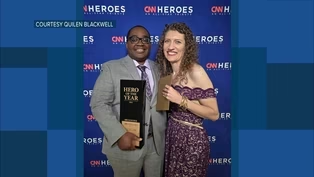
Southside Blooms Co-Founder Named CNN’s Hero of the Year
Video has Closed Captions
Clip: 12/23/2025 | 6m 55s | What started on vacant lots on Chicago's South Side is now getting national attention. (6m 55s)
Providing Support for PBS.org
Learn Moreabout PBS online sponsorship
- News and Public Affairs

Top journalists deliver compelling original analysis of the hour's headlines.

- News and Public Affairs

FRONTLINE is investigative journalism that questions, explains and changes our world.








WHYY Series
Support for PBS provided by:
Chicago Tonight is a local public television program presented by WTTW
WTTW video streaming support provided by members and sponsors.