
September 8, 2026 - PBS News Hour full episode
9/8/2026 | 57m 46sVideo has Closed Captions
September 8, 2026 - PBS News Hour full episode
September 8, 2026 - PBS News Hour full episode
Problems playing video? | Closed Captioning Feedback
Problems playing video? | Closed Captioning Feedback
Major corporate funding for the PBS News Hour is provided by BDO, BNSF, Consumer Cellular, American Cruise Lines, and Raymond James. Funding for the PBS NewsHour Weekend is provided by...
September 8, 2026 - PBS News Hour full episode
9/8/2026 | 57m 46sVideo has Closed Captions
September 8, 2026 - PBS News Hour full episode
Problems playing video? | Closed Captioning Feedback
Where to Watch PBS News Hour
PBS News Hour is available to stream on pbs.org and the PBS app.
Providing Support for PBS.org
Learn Moreabout PBS online sponsorshipAMNA NAWAZ: Good evening.
I'm Amna Nawaz.
GEOFF BENNETT: And I'm Geoff Bennett.
On the "News Hour" tonight: New Canadian tariffs on U.S.
goods take effect in the latest escalation of trade tensions.
A look at how the dispute is affecting daily life on both sides of the border.
AMNA NAWAZ: The head of the Smithsonian, Lonnie Bunch, announces his retirement.
We sit down to discuss his yearslong work preserving the nation's history and how he's navigated political pressure facing the institution today.
LONNIE BUNCH, Smithsonian Institution Secretary: Because the Smithsonian tells a fuller, more complicated story, that makes it hard for some people to understand what we do.
GEOFF BENNETT: And 25 years after September 11, a fighter pilot recounts the day she was ordered to do something she never imagined, take down the civilian airliner Flight 93.
HEATHER PENNEY, Former Pilot, D.C.
Air National Guard: We knew that if any other terrorist had taken control of an airliner and was headed towards D.C., the capital of the free world was in danger.
And we needed to do whatever we could to protect that.
(BREAK) GEOFF BENNETT: Welcome to the "News Hour."
Canadian Prime Minister Mark Carney says Canada will move quickly to reduce its economic reliance on the U.S., as retaliatory tariffs take effect on roughly $20 billion worth of American goods.
AMNA NAWAZ: The tariffs, some as high as 50 percent, match duties President Donald Trump imposed on Canadian imports earlier this year.
The latest escalation follows months of strained relations and unsuccessful trade negotiations between the two countries.
And, for Canada, today's confrontation marks a turning point with its much larger neighbor.
MARK CARNEY, Canadian Prime Minister: They were asking far too much and offering far too little.
AMNA NAWAZ: Just after midnight last night, one of America's closest allies struck back.
MARK CARNEY: Since a fair deal wasn't on the table, we made the right choice to walk away from a bad one.
AMNA NAWAZ: Canada imposing new tariffs on roughly $20 billion worth of U.S.
goods, targeting hundreds of products from steel and aluminum to clothing and cheese.
These retaliatory tariffs come after months of building pressure by the U.S.
KAROLINE LEAVITT, Former White House Press Secretary: The tariffs are incoming tomorrow on Canada.
AMNA NAWAZ: In February of last year, President Trump announced sweeping 25 percent tariffs on many Canadian goods.
DONALD TRUMP, President of the United States: They need us to survive.
AMNA NAWAZ: In July, he announced new 50 percent tariffs targeting roughly $20 billion in Canadian products, including wine, dairy, clothing and hockey equipment.
Those went into effect in late August.
The latest escalation from Canada follows failed trade talks, months of private negotiations between the neighboring countries, and an ongoing public pressure campaign by President Trump, from renaming Lake Ontario Lake America... DONALD TRUMP: And all it takes is a good pen and some intelligence.
AMNA NAWAZ: ... to repeatedly suggesting Canada should become the 51st U.S.
state.
Over the weekend, the president posted this A.I.-generated cartoon depicting him looming over Carney with a hockey stick and calling the prime minister governor.
Just yesterday, Trump threatened to block Canadian plane maker Bombardier from selling jets in the U.S.
unless it moves production to American soil.
"That era is over," the president wrote.
"If they want our market, they must build here and stop treating America like a piggy bank."
While the tariffs only affect about 5 to 6 percent of total goods each country imports from the other, larger uncertainties in this new era of U.S.-Canada relations remain.
For more on the impact of the tariffs on the United States and Canada, we're joined now by Matthew Shoemaker.
He is the mayor of Sault Ste.
Marie, Ontario.
That's a Canadian city just across the border from its sister city, Sault Ste.
Marie, Michigan.
Mayor Shoemaker, welcome to the "News Hour."
Thanks for joining us.
MATTHEW SHOEMAKER, Mayor of Sault Ste.
Marie, Ontario, Canada: Thanks for having me.
AMNA NAWAZ: So, your city, Sault, Ontario, as it's called, is separated by just a bridge from Sault, Michigan.
It's the ninth busiest border crossing between the U.S.
and Canada.
For anyone who hasn't been there, before all of these tariffs went into place, just how closely have your two communities been tied?
MATTHEW SHOEMAKER: Yes, well, I mean, for generations, the twin Saults have been a place where it really is, we call it one nation -- one city across two nations.
And it is a place where shopping on either side of the border is common, whether you're American or Canadian, doing recreational activities on the Canadian side of the border is common.
So it really is an extension of our own community and something that is part of the way of life here in the Twin Saults.
AMNA NAWAZ: So not unusual to find Red Wings or Lions fans in Sault, Ontario, either?
MATTHEW SHOEMAKER: Not at all.
Lots of Tigers fans this time of year.
The Tigers and the Jays are in a hard battle for playoff spots, but I know that there's lots of people in the Sault cheering for the Tigers.
AMNA NAWAZ: So we should also note your city, Sault, Ontario, is a steel town.
What kind of impact have the steel tariff that President Trump put in place had on your community?
MATTHEW SHOEMAKER: Yes, they have had a really significant impact.
And our community has, to some extent, been here before.
During the first Trump presidency, there were the 25 percent steel tariffs that affected Algoma Steel.
At the time, they said they were losing a million dollars a day as a result of 25 percent tariffs.
And then, throughout this term, the tariffs, the tariff rate was at 25 percent from the beginning of the Trump presidency essentially to last summer, when it increased to 50 percent.
And it looked like there was going to be some relief over the past several weeks as the negotiations were ongoing on reducing sectoral tariffs broadly, but, of course, those negotiations fell apart, and we continue to feel real economic impact in terms of job losses, in terms of losses at Algoma Steel itself from the 50 percent steel tariffs, which is the main driver in our local economy.
AMNA NAWAZ: And because your two communities are so closely aligned, if your community is hurting economically, what does that mean for Sault, Michigan, across the border?
MATTHEW SHOEMAKER: Yes, we have got the unique distinction of being one of the very few Canadian cities that is larger than its American counterpart.
Typically, you have got Windsor and Detroit, where Detroit's larger, you have got Niagara Falls and Buffalo, where Buffalo's larger.
Here in the Sault, we're both -- in Twin Saults, the Canadian side is about five times larger than the American city.
So the retail, the restaurants, the coffee shops on the American side rely on Canadians going across and spending the dollars that they earn or derive from the steel plant.
So it really does have a significant economic impact in Sault, Michigan, when Sault, Ontario, is not doing well.
And, right now, Sault, Ontario, is hurting as a result of decisions being made in Washington.
AMNA NAWAZ: So did your constituents want to see these retaliatory tariffs go into place?
I mean, what's the mood on the ground when it comes to pushing back against U.S.
policy right now?
MATTHEW SHOEMAKER: Yes, I think there's a real desire to see a pushback on the American policy for quite some time.
The steel plant has been under the -- facing the impacts, I would say, of the 50 percent steel tariffs.
And we have tried to negotiate our way out of those.
We have tried to create Canadian supply chains and Canadian markets for Canadian steel, but the reality is, without retaliatory tariffs, it felt like it was a fight we were fighting with a one arm tied behind our backs.
So when those negotiations did fall apart, I think one of the only real options left was retaliatory tariffs.
It is the type of thing that, to protect a domestic steel economy, if we want to have steel plants in the future, we're going to have to invest in and protect our Canadian steelmaking.
Otherwise, we will lose the capacity to do it whatsoever.
AMNA NAWAZ: We have seen some really fiery rhetoric from the premier of Ontario, Doug Ford.
I mean, you don't quite hit that level of fiery rhetoric here, but does he capture sort of the anger on your side of the border right now?
MATTHEW SHOEMAKER: Absolutely.
I think that the insults that we have had coming towards our prime minister and towards our premier have been unwarranted.
They have been unwelcome.
And people are -- have had it with those types of insults, and I think that's the mood that you saw our premier express and the frustration that was flowing from him resulted in that type of that type of language back.
And it's unfortunate because we're coming up, on several days from now, the anniversary of September 11, when Canadians opened their airports, their homes to Americans who had to land in Canadian airspace or land in Canadian airports at the time.
We fought alongside the American military in Afghanistan as a result of that -- those terrorism attacks.
And you have seen residents answering with their wallets.
Bridge traffic is down 30 percent from its standard numbers.
The number of people canceling vacations, at least what we hear anecdotally, locally is significant.
Nobody is going across the Sault, Michigan, to golf anymore in the summer.
And so there is a real economic impact that people are voting with their wallets, so to speak, on how they feel about these tariffs.
AMNA NAWAZ: All right, that is Matthew Shoemaker.
He's mayor of Sault Ste.
Marie, Ontario, in Canada.
Mr.
Mayor, thank you so much for your time.
MATTHEW SHOEMAKER: Thanks for having me.
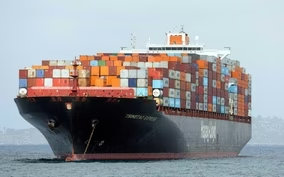
GEOFF BENNETT: Let's turn now to how President Trump's tariff policies are shaping key races for control of Congress this fall.
For that, we turn to our congressional correspondent, Lisa Desjardins.
Lisa, it's always great to see you.
So let's start with a state that we just touched on, Michigan.
It's a key battleground.
Help us understand why.
LISA DESJARDINS: Wolverine State has some big paws and has important races in both the House and the Senate.
Let's start with the House, though.
There, you see four House races that are critical to control of the House.
And there you see in yellow the Canadian border.
So one of those House races even borders Canada.
Now, the state also has a key Senate race between Republican there, Mike Rogers, and Democrat Abdul El-Sayed.
Just two weeks ago, Mike Rogers came out with a key ad campaign in which he said, I will fight for manufacturing in this state.
But President Trump's record on manufacturing has not been as great as he would like.
In fact, let's take a look at where things stand there in Michigan.
After Trump had his liberation day last year announcing global tariffs, Michigan has lost 8,300 manufacturing jobs on net.
The state is facing the third largest tariff cost of any state, and that's about 15 billion in tariffs for the auto industry alone.
This is a situation where Republicans are actually very happy with the candidates they have in this state.
They have known how important it is, but the economic effects cannot be ignored anymore, and voters are really catching on.
One Republican national campaign source I have said they think Michigan is the state where tariffs could impact the election the most.
GEOFF BENNETT: And there's another state in the crosshairs of Canadian tariffs, and that's Pennsylvania.
Take us there.
LISA DESJARDINS: Right.
This is fascinating.
There are several important races in the House in Pennsylvania, but there's one in particular I want us to look at that's center stage, and it's because of the tariffs specifically Canada put in place against motorcycles.
This is Pennsylvania's 10th Congressional District on the southern border of Pennsylvania, and there in York County sits the Harley-Davidson assembly plant.
Canada has just announced today 50 percent tariffs on American-made motorcycles, most of them like Harley-Davidsons, that on assembly plant in York County.
Harley-Davidson earlier this summer said they were going to try and expand it.
They had had layoffs, but they were recovering.
And, as is obvious, that's not what any business wants is a big freeze before you're expanding.
This is a problem for one member of Congress.
That's Scott Perry, who represents the 10th Congressional District.
He is in a very close race to try and keep his seat.
This does not help him.
He did put out a statement saying that he thinks that these tariffs are disappointing, that they're detrimental, but the fact is, it does make him more vulnerable.
We reached out to Harley-Davidson, and they said just in a sentence they will decline to comment.
GEOFF BENNETT: There's also a potential impact on a Senate race that many saw as a long shot for Democrats, but it's getting fresh attention.
What's up with that?
LISA DESJARDINS: Right.
All politics is local.
We're talking about Kansas.
This is a long shot race for Democrats, but it's getting more within reach when we talk about the U.S.
Senate.
President Trump yesterday put out on TRUTH Social a statement about a jet company in Canada called Bombardier.
He wrote: "No more selling Bombardier in the United States."
Now, that is a Canadian company, it's true, but their U.S.
headquarters are in Wichita, Kansas, where they employ some 1,200 Americans.
That is a problem in the Senate race potentially for Republicans.
There's Roger Marshall, who is the incumbent senator, facing Democratic Pastor Adam Hamilton.
Marshall really shouldn't be vulnerable.
He's a longtime incumbent that's well-known.
However, he is increasingly so.
And he's seeing headlines in newspapers and on TV stations around the state like this one connecting Trump to job losses.
Marshall has put out a statement today saying that he has reached out to Trump and he's trying to fight for jobs.
GEOFF BENNETT: And big picture, what is the overall effect of President Trump's trade policies on these key midterm races?
LISA DESJARDINS: We focused on a few, but let's look at the states in play, Republican seats in the Senate.
There's a number of them.
You see Alaska and Maine, big-time trading with Canada.
Same with Texas.
There's also issues for farmers over his tariff policies with beef.
Overall, what we're seeing right now is the winds continue to blow in Democratic directions, and some Republicans think Trump is helping them right now with tariff policy.
GEOFF BENNETT: Lisa Desjardins, thanks, as always, for that reporting.
LISA DESJARDINS: You're welcome.
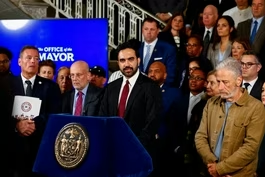
GEOFF BENNETT: In the day's other headlines: New York City officials released thousands of documents today that raise new concerns about air quality following the September 11 attacks.
More than 170,000 documents from across government agencies were made public via an online portal.
They suggest that authorities were aware of the health risks at the time, despite public assurances about the air being safe to breathe.
At a news conference, New York Mayor Zohran Mamdani said that families, survivors, and first responders deserve transparency.
ZOHRAN MAMDANI (D), Mayor of New York City: As the years pass and the human toll grows, we reckon with the cost of September 11 whenever another New Yorker is stolen from us too soon.
People got sick because the leaders they trusted lied and told them they were safe to breathe in toxic air.
GEOFF BENNETT: The 9/11 Memorial and Museum says at least 49,000 first responders and survivors have been diagnosed with cancer as a result of the attacks.
Miami-Dade authorities say all five people killed by an Amazon cargo plane crash this past weekend were in a van used for cleaning crews that service airplanes.
At a news conference this morning, officials shared the names of the deceased, who ranged from 47 to 75 years old and expressed sympathy for the lives lost.
ROSIE CORDERO-STUTZ, Miami-Dade County, Florida, Sheriff: One leaves their House to go to work, to visit family, to do what we normally do, and without ever thinking that this is even a possibility, what occurred.
For those families, they are going to be living with this for the rest of their lives as well.
GEOFF BENNETT: Five other people were injured Sunday when the Amazon jet arriving at Miami International Airport overran the runway.
City officials say the plane's two pilots have been released from the hospital.
Two other people remain in critical condition, while a third is stable.
In the U.K., more than 600 flights were canceled today due to a technical problem with the country's air traffic control system.
At London's Heathrow Airport, crowds waited for updates as canceled signs appeared on information boards.
Flights were also grounded at Gatwick and Stansted airports, among others.
Britain's National Air Traffic Services cited a problem with its flight processing system.
The agency says the problem is now resolved and officials are working to clear the backlog of flights.
The British government says it's banning trade with Israeli settlements in the occupied West Bank, accusing what officials called settler terrorists of carrying out ethnic cleansing of Palestinians.
Speaking in the House of Commons today, the U.K.
's foreign secretary said the ban would include all imported goods, along with services ranging from construction to advertising.
ED MILIBAND, British Foreign Secretary: The government believes the unlawfulness of the occupation should be reflected in the economic relationships we choose to have with the occupied territories.
GEOFF BENNETT: France and Canada were among the nations joining the U.K.
's ban, which will likely have a limited economic impact, given the small volume of the West Bank's exports.
But Israeli officials were quick to condemn the move, calling it morally distorted and announcing the closure of the British Consulate in East Jerusalem.
GIDEON SA'AR, Israeli Foreign Minister: Unfortunately, a hostile Labor government is in office, systematically acting against the state of Israel.
And it has left us with no choice but to finally respond to its hostile actions.
GEOFF BENNETT: The Israeli government also barred Britain from participating in U.S.-led Gaza peace efforts based in Israel and banned a dozen British lawmakers from entering the country.
A U.S.
official confirms to the "News Hour" that the U.S.
carried out strikes on Iranian tankers near Kharg Island in the Persian Gulf today, as well as in the Gulf of Oman.
It's in response to the latest Iranian attacks on U.S.
warships.
Separately, Saudi Arabia vowed to retaliate against Yemen's Houthi rebels after the militia group struck oil facilities and other sites inside the kingdom.
Saudi authorities say more than 70 people were injured, including women and children.
Houthi military officials say the strikes were in retaliation for recent Saudi attacks, including one on a prison that killed at least seven people.
It marks a major escalation in fighting between the Saudis, an important U.S.
ally in the region, and the Iranian-backed rebels in Yemen.
The Kremlin says that Russian President Vladimir Putin reassured President Trump today that Moscow has no aggressive plans toward Europe.
A senior Kremlin official says the two leaders spoke by phone for about an hour, during which Mr.
Trump told Putin he wants a swift end to the war in Ukraine and for U.S.-Russia ties to be restored.
That follows a weekend visit from U.S.
envoys Steve Witkoff and Jared Kushner to both Kyiv and Moscow, during which the fighting briefly paused.
But, in Kyiv last night, Russia's air assault resumed.
Ukrainian officials say the strikes killed at least seven people in the capital and the surrounding region.
On Wall Street today, stocks ended lower following the long holiday weekend.
The Dow Jones industrial average dropped more than 600 points.
The Nasdaq fell about a third-of-1-percent.
The S&P 500 also closed in negative territory.
Still to come on the "News Hour": the retiring head of the Smithsonian reflects on his legacy and political pressures; millions of people across Southeast Asia brace for the extreme weather from the Super El Nino; and how youth sports has become a moneymaking business and created high stress for both parents and athletes.
Smithsonian Secretary Lonnie Bunch announced today that he is stepping down as the institution he leads faces an escalating battle with the Trump administration over how it tells the American story.
Bunch, the first African American to lead the Smithsonian, plans to retire at the end of the year, capping a career that transformed the institution.
He was the founding director of the National Museum of African American History and Culture, which marks its 10th anniversary this month.
I spoke with Bunch last week, before he announced his retirement, about the political pressure, what's at stake for the Smithsonian, and how he sees his legacy.
It's part of our series Art in Action, exploring the intersection of art and democracy, part of our Canvas coverage.
LONNIE BUNCH, Smithsonian Institution Secretary: I had hoped that this museum, as part of the Smithsonian, would be important to America.
It's become even more important than I could ever imagine.
GEOFF BENNETT: The National Museum of African American History and Culture was Lonnie Bunch's great undertaking, an institution he spent more than a decade bringing to life.
When it opened on the National Mall in 2016, the museum offered something unprecedented, bringing together the sweep of Black history and culture and its central place in the American story.
LONNIE BUNCH: When I think about the 10 years and I walk through the building now, I'm almost so proud to be an American, that this is something you could build in America, that you could ask these difficult questions.
GEOFF BENNETT: When we spoke a decade ago, upon the opening, you described this museum as a kind of a reservoir, a place where people can find understanding and resilience and laughter and hope.
Ten years in, has it become what you hoped it would be?
LONNIE BUNCH: Even more so, because, in a way, I see people who are really using it as that reservoir.
I watch people come in here and they sort of learn new stories.
I watch people understand that slavery is something that's not just a story for African Americans, but a kind of quintessential American story.
And I find people around the country saying to me, I came to the museum and I was made better.
And that really just makes me feel so good about what the Smithsonian can do.
GEOFF BENNETT: Building the museum also meant finding the artifacts that could tell those stories, sometimes by going straight to the source.
How did you acquire this Cadillac?
LONNIE BUNCH: I called Chuck Berry and said, "I want..." GEOFF BENNETT: You called up Chuck Berry?
(LAUGHTER) LONNIE BUNCH: Yes.
"I want one of the guitars that you wrote "Maybellene" on.
And he said: "OK, but if you want a guitar, you got to take my car."
And I was like: "I don't care about a car, and I didn't want it.
And so I was like, fine."
And -- but we have gifted staff who basically knew that this was so important to Chuck Berry to sort of middle-class respectability, all of that.
And so they collected it and convinced me that it should be on display.
And I remember thinking, this is not the story I want to tell.
It's become the number one photographed item in our museum.
But I loved that picture of him.
It meant so much to Chuck Berry.
And if it got me the guitar... (LAUGHTER) GEOFF BENNETT: Though the museum is now one of the most visited in Washington, Secretary Bunch has found himself defending what he built against a presidential administration determined to reshape how the Smithsonian tells the American story.
DONALD TRUMP, President of the United States: We want the museums to treat our country fairly.
We want the museums to talk about the history of our country in a fair manner, not in a woke manner or in a racist manner.
GEOFF BENNETT: In March of last year, President Trump signed an executive order called Restoring Truth and Sanity to American History.
It accused the Smithsonian of promoting what the order called a "distorted narrative driven by ideology, rather than truth," singling out exhibits that examine race and slavery as examples of what it deemed improper ideology.
By August of 2025, the White House had sent Bunch's office a formal letter ordering a content review of Smithsonian Museums ahead of the nation's 250th anniversary.
And just last week, the administration threatened to withhold federal support.
President Trump has accused the institution of presenting American history through a distorted ideological lens.
What does he fundamentally misunderstand about the work the Smithsonian does?
LONNIE BUNCH: I think the Smithsonian, first and foremost, does what it's done for 180 years, use scholarship, use good public servants, use research to help America understand itself, to help America find hope and healing.
And I think that, because the Smithsonian tells a fuller, more complicated story, that makes it hard for some people to understand what we do.
But I think the most important thing to remember is that the Smithsonian is not a place driven by left-wing crazy people.
It's really a place driven by people who love a nation and who basically believe, like I do, that the great strength of a nation is that it's aspirational, and that, for me, Thomas Jefferson's Declaration of Independence is so powerful because it challenges us to live up to certain ideals.
And what you see through history, what you see through African American history are people for hundreds of years protesting, demonstrating, voting, dying in order to make concrete those words.
And there's nothing more powerful, it seems to me, than a nation that aspires to - - for that more perfect union.
GEOFF BENNETT: Right, because there is this larger debate that telling the difficult parts of our history amounts to denigrating the country.
LONNIE BUNCH: Right.
GEOFF BENNETT: What do we lose as a country when we're only focused on telling the parts of our story that make us feel good?
LONNIE BUNCH: Well, we don't understand how we have arrived at where we have arrived.
It's almost like saying your doctor gave you a physical and you only want half of what he or she found out, right?
So, for me, my notion is, knowledge is power, and that if you understand the complexity of your nation, then you're doing better.
GEOFF BENNETT: How do you distinguish between legitimate scrutiny of a publicly funded institution and interference, bad faith interference?
LONNIE BUNCH: I mean, I'm not sure I can distinguish them both.
What I can distinguish is, I think the Smithsonian always wants to be better, wants to be a learning institution.
So, when anybody raises issues, be it president of the United States or another historian, I think we want to grapple with it.
We want to try to understand, is there ways that we can be better?
But I think what's important is, we have to have sort of scholarship as our North Star.
We have to recognize that the Smithsonian has served America through a whole variety of administrations and points of view, and we will continue to do that.
GEOFF BENNETT: Bunch said flatly that nothing in the museum has been altered as a result of the political pressure.
LONNIE BUNCH: I want to be really clear.
Anything that's changed, the Smithsonian changed it because of an artifact that needed to be removed for conservation issues.
We haven't changed anything from political pressure.
GEOFF BENNETT: Still, Bunch was candid about the weight of the moment.
LONNIE BUNCH: There's no doubt that this is a difficult time.
I really thought, at the end of my career, I'd have a little bit of coasting.
But you know what?
I think that all I want to do is protect the Smithsonian and make sure people understand the complexity of our experience and to really use history to help people find hope and understanding.
If that's bad, then I'm a bad guy.
GEOFF BENNETT: That fight over how history should be told is unfolding as the museum takes on one of its most ambitious projects since opening, In Slavery's Wake, an exhibition that expands the story beyond America to four continents.
Paul Gardullo is a museum curator and director of its Center for the Study of Global Slavery.
Why was it important to tell the history of slavery across continents, rather than specifically through the American frame?
PAUL GARDULLO, Center for the Study of Global Slavery Director: The story of the slave trade and wider slavery is a story of making the modern world.
We haven't really looked at the full global scope.
JOHANNA OBENDA, Curator, Center for the Study of Global Slavery: And we have learned so much, because this is a global history, and I think no one nation, no one institution can really approach it alone.
GEOFF BENNETT: Johanna Obenda is part of a younger generation of curators carrying the museum's mission forward.
She was the primary developer of the In Slavery's Wake exhibition.
JOHANNA OBENDA: I like to think of us all as sort of having a piece of this puzzle, and those pieces, they're very strong on their own, but when we bring them together, this fuller picture emerges.
And so, for example, the stories that we learned coming out of Senegal through the oral histories, through archaeological excavations, those are things that we had not come across in the written record.
GEOFF BENNETT: And in this moment where there's such intense political pressure over how race and slavery are depicted in institutions like this, how does that or does it at all shape the work that you do?
JOHANNA OBENDA: I feel really anchored, honestly, speaking about those who have come before us, like Secretary Bunch, and the sort of missions and the mantra of this museum, right, which is to tell the unvarnished truth.
GEOFF BENNETT: For Bunch, the obligation is straightforward.
You have spent your career building institutions designed to preserve history.
Did you ever imagine that, as Smithsonian secretary, you would also have to defend the very idea that museums should be free to tell a complicated history?
LONNIE BUNCH: First of all, I never thought I'd be secretary.
So... (LAUGHTER) LONNIE BUNCH: But I think that it's really important to say, Americans are an amazingly brave people.
They have fought wars.
They have overcome depression.
I want Americans not to be afraid of their own history, to basically recognize that, by telling the fullness -- and some of this is great stories of important leaders, and some of it is challenges we have to face, and some of it is challenges we have overcome.
I think that makes you better as a nation, as a people.
GEOFF BENNETT: More than a decade ago, the question was whether the museum would be built at all.
Today, it's whether it can keep telling the nation's story the way it was built to tell it.
For Bunch, after a career spent building institutions around the power of history, that work is now part of the legacy he leaves behind.
When you think about your legacy, how do you want people to characterize your contribution?
LONNIE BUNCH: My legacy is somebody else's decision, right?
But I think that the notion of the importance of history.
History has always shaped my life and my career, and I want people to understand what history is, which is not just nostalgia.
It is really this amazing reservoir that helps you find understanding.
It is this really important moment to be able to understand that we now accept that we're shaped by our ancestors' DNA.
We're also shaped by the history they experienced.
So I want people to find a useful and a usable history and to understand that history matters.
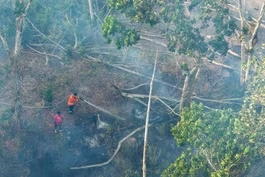
AMNA NAWAZ: Southeast Asia is enduring a punishing year of extreme weather, and experts warn the ongoing storm season could be one of the most intense in years, with even more powerful systems possible in the months ahead.
Special correspondent Patrick Fok reports from Singapore on how the El Nino climate pattern could fuel more extreme conditions in the coming months.
PATRICK FOK: A sudden gush of water floods the chamber.
These young ones dressed in protective gear are hanging on.
In this simulated experience at the Lvxing Disaster Training Center in Eastern China, they keep smiles on their faces, but the danger they're preparing for is real.
LIU ZIHAO, Manager, Lvxing Disaster Simulation Training Center (through translator): When a disaster strikes, many people, because they have no prior experience, lack proper understanding of such events.
They lose their lives in the very first moment simply because of fear, which causes them to lose control of their bodies.
PATRICK FOK: The center trains how to navigate typhoon-force winds, flash flooding, and even rescues.
It opened just over a year ago to help prepare China's citizens for increasingly unpredictable and extreme weather.
The country has faced a barrage of monster storms.
Late last month, a rare atmospheric pattern saw four tropical cyclones spinning simultaneously across the Northwest Pacific and South China Sea, adding to weeks of extreme conditions across the region.
One of the most powerful storms hit in early August.
Typhoon Dolphin tore through Southern Japan and the Philippines before slamming into China's east coast with torrential rain.
More than a million people were evacuated from at-risk areas.
Dolphin was unusual for more than its strength.
It lasted 16 days, hurtling nearly 4,000 miles across the Asia-Pacific.
Forecasters say typhoon activity this season could run 60 percent above the historical average.
But there are growing concerns about what lies ahead, with weather experts warning a developing El Nino could bring even more extreme conditions.
This natural shift in Pacific Ocean temperatures disrupts weather patterns.
But some scientists are asking how a changing climate could alter its impact.
THEODORE KEEPING, Climate Scientist, Imperial College: What we do know is that, if an El Nino event occurs, climate change means the weather patterns that we'd normally have seen in an El Nino have become more extreme in many cases for hot extremes, for extreme rainfalls, for droughts than they would have been historically.
PATRICK FOK: The effects have been stark across Asia.
In Hong Kong, Dolphin coincided with a record-breaking heat wave with temperatures over 100 degrees Fahrenheit.
Its circulation suppressed rainfall, drawing hot, dry air over the city; 67-year-old Ng Sui Ying had to work through it.
She endures long hours cleaning at this housing estate.
NG SUI YING, Cleaner (through translator): It's very hot.
What can you do?
This is the job.
For some people, it's even more grueling.
This is what it's like when you're poor.
PATRICK FOK: Hong Kong has a three-tier heat stress at work warning system to alert employers when conditions become dangerous.
But the guidelines are not legally binding.
IVAN LIN, Society For Community Organization (through translator): They are only recommendations and carry no legal force.
We hope they can go a step further and be written into law, giving frontline workers guaranteed protection.
PATRICK FOK: In the Western Philippine island of Palawan, the threat is to people's livelihoods.
Farmers like Reneeboy Pocmabuan are readying rice seedlings before the typhoon season worsens.
When severe storms hit, the fields are flooded.
If crops remain submerged for several days, they run out of oxygen, rot, and die.
RENEEBOY POCMABUAN, Rice Farmer (through translator): Of course, we are scared we won't have enough rice to feed ourselves.
So it's important we harvest before the storms come.
PATRICK FOK: And the worries many face here extend beyond the fields.
The conflict in the Middle East has already pushed up fuel and transport costs.
A major hit to the harvest could add further pressure on food prices and the wider economy.
According to the Philippine government, a string of severe storms last year capped 2025 economic growth at 4.4 percent, marking the country's weakest performance since the COVID pandemic.
It's a pattern seen right across the region, and extreme weather already this year has cost Asian economies tens of billions of dollars.
For farmers like Reneeboy, the storm season is a calculation, what to plant, when to harvest, and how much to risk.
And across Asia, millions of people are facing similar uncertainty, as the next storm looms.
For the "PBS News Hour," I'm Patrick Fok reporting from Singapore.
GEOFF BENNETT: With the new school year under way, millions of American parents are gearing up to cheer their kids on in sports, not necessarily for their school's team, but for one of the thousands of travel or club teams that have cropped up across the country.
AMNA NAWAZ: Roughly five million kids are competing on these private teams, and many benefit from that participation, including some who get college scholarships.
But youth travel sports also come with increasing costs and challenges.
As Stephanie Sy tells us, those trade-offs and concerns are getting more attention.
STEPHANIE SY: American youth sports have become a 40 billion dollar business.
Us parents, knowing that sports build character and are one of the few reliable ways to get your kids off screens, find family life subsumed by club sports.
So who built this ecosystem and who's making the most money from it?
In many cases, it's private equity firms that have found ways for so-called vertical integration.
And they're racking in profits on everything from backpacks to blocs of hotel rooms.
Parents are bearing the costs.
MAN: Stay-to-play tournaments should be called pay-to-stay tournaments.
Here's how it works.
You sign up for the tournament, and then you are told that you have to stay at their hotels.
You have to use the little -- magic little link that they send you.
It was basically like being stuck into a timeshare.
You have no choice.
WOMAN: Something nobody prepared me for as a mom was how expensive it is to have kids in sports.
I honestly don't know how you moms of multiple kids in sports do it, because my son is currently in soccer, and the fees are insane, OK?
Me and my best friend were actually talking about it yesterday, OK?
Camps are $250, $350 a week.
And how do you guys do it?
Like... MAN: You all, we need to talk about youth traveling sports teams.
Because why let kids enjoy their childhood when you can just turn every weekend into a high-stakes overpriced Hunger Games with 11-year-olds in matching compression sleeves?
STEPHANIE SY: Tom Farrey, the founder and director of the Aspen Institute's Sports and Society Program, has been following these developments for years in youth sports and joins me now.
And, Tom, I think Hunger Games kind of sums it up for a lot of us.
When I was growing up, it was all rec league or your school sports team.
That's where you played, unless you were really good, in which case maybe you did AYSO soccer.
When did all of this start changing?
TOM FARREY, Founder and Executive Director, Aspen Institute's Sports and Society Program: In the 1990s.
So it was the chase for the athletic scholarship.
It's not the only reason, but in the early 1990s, there was about $250 million a year that was distributed through NCAA Division I division schools to schools for athletic scholarships.
Today, that's north of $4 billion.
And while that money is still hard to acquire for parents and kids, it's still a lot of chum that's been thrown into the waters of youth sports.
And then you tack on enforcement of Title IX, which opened up many more opportunities for girls and got parents thinking about supporting their career.
Then you have youth sport tourism cities, thinking about heads and beds and bringing kids to these -- and families to these communities, Tiger Woods, the 10,000 hours rule.
No Child Left Behind deprioritized school-based activities.
Then you had the economic crisis of 2008, which gutted municipal budgets, and they started by cutting park and rec budgets.
That's where the private sector really began to dig into youth sports, and then you had COVID, where they dug in even further.
STEPHANIE SY: OK, so we know that the demand is there from parents, who want the best for their kids, maybe a scholarship, maybe just fear of their kid missing out, not making the high school team.
And if everyone's doing it, I have to do it too.
How are we now seeing business capitalize on that psychology?
TOM FARREY: Well, they're creating these early-forming travel teams, which usually when I was a kid only existed really in high school.
Then they moved down to the middle school ages, and now they're all the way down to really first and second grade.
So we're sorting the weak from the strong well before kids grow into their bodies, minds, and their interests, and increasingly we're sorting kids based upon the ability of their families to pay for that activity, for the ability to stroke $2,000, $3,000, $4,000 checks a year.
STEPHANIE SY: How is this contributing to inequalities within sports?
TOM FARREY: I mean, so, I mean, the kids who get pushed aside are the kids from lower-income homes.
They're the kids who are the late bloomers.
They're the late starters.
They're the ones who just want to play and have fun with their friends, which is the rationale for most kids to play sports.
STEPHANIE SY: And those might be students that might have been eligible for scholarships and a path toward college.
I mean, talk more about this opportunity gap that we're seeing in what many are calling a pay-to-play system at this point.
TOM FARREY: Yes, we talk about how youth sports has become so competitive.
I would argue just the opposite.
It's become anticompetitive, meaning we're structurally pushing aside a lot of kids who could actually go on to be our best athletes.
We saw that with the U.S.
men's soccer team during the World Cup.
And we have more kids in uniform than any nation in the world, but because we don't make room for sustained experience for our very, very best athletes, our team consistently underperformed.
So, yes, they got they got to the round - - they made it out of their group.
But we should be a lot better than we are, and it's because our system is not set up in a way to make sure that the Odell Beckham Jr.s, who did play soccer when he was younger, have a pathway to staying in the game as it gets more expensive.
STEPHANIE SY: I think we can't ignore the profit motive in all of this, Tom, right?
Private equity has its hands in so much these days, including, controversially, in professional sports.
Is it more concerning when it comes to kids?
TOM FARREY: Well, look, I think, in fairness to private equity, a lot of the problems that we're talking about are, stay-and-play in hotels, things getting expensive and exclusionary very early on, they were all in place when I wrote my book back in 2008 on the state of youth sports in America.
What private equity did is see a really disjointed environment, where $40 billion a year are being spent by parents alone, where there's a need for more standards and professionalization and back office efficiencies.
They came into the space and then in some cases have kind of just wrung more and more money out of the families that can afford to youth sports arms race.
In other cases, again, out of fairness, there have been private equity groups who are attacking and creating more lower-cost local experiences.
And so I think we need to be incentivizing private equity to act like shepherds in the space, and not just an opportunity to monetize every kid out there.
STEPHANIE SY: Tom, what are potential solutions to the problems you have just outlined?
TOM FARREY: We need leadership.
We need, frankly, the government from the federal to the state to the local level to step up appropriately.
And that simply means creating standards, minimum standards, under which all programs should engage kids.
All kids should play for coaches who pass background checks, who've been trained in minimum key competencies in working with youth.
This could be done without government becoming too overly burdensome, and I think parents want it.
They want their kids to play in safe environments, and they want their kids to have access to sport.
And, I mean, schools need to step up as well.
They need to reinvest in school-based programs.
STEPHANIE SY: That is Tom Farrey with the Aspen Institute's Sports and Society Program joining us.
Thank you, Tom.
TOM FARREY: Thanks for having me.
AMNA NAWAZ: All week, we're marking the anniversary of 9/11.
Twenty-five years ago, the passengers of United Airlines Flight 93 stormed the cockpit, forcing the hijacked jet to crash in Shanksville, Pennsylvania.
But before the world knew of their bravery, members of Washington, D.C.
's Air National Guard were prepared to make their own sacrifice.
Nick Schifrin has one of their stories.
HEATHER PENNEY, Former Pilot, D.C.
Air National Guard: On that day, ordinary people rose to extraordinary things, and we saw the best of who we can be as America.
NICK SCHIFRIN: Twenty-five years ago, Heather Penney was a pilot in the Washington, D.C., Air National Guard, call sign Lucky, and she felt lucky to be the first female Washington, D.C., Air National Guard pilot and continue the family legacy.
HEATHER PENNEY: My daddy was a fighter pilot.
He flew A-7s in Vietnam.
He did bombing missions over North Vietnam.
And as a little girl, I actually found some of his mission tapes from Vietnam.
It was the most harrowing, exciting, sort of meaningful thing that I could think of.
And so I was just on fire to be a fighter pilot.
It wasn't until I was in graduate school that Congress had opened up combat aviation to women.
First thing I did was apply to the Air National Guard.
WOMAN: It's Tuesday, September 11, 2001.
NICK SCHIFRIN: And 25 years ago, she was on duty as the day began under a blue sky.
HEATHER PENNEY: Oh, gosh, the sky was so blue.
It was crystal blue, and it was a perfect flying day.
Tech Sergeant Dave Callahan knocks on the door and he says: "An aircraft just hit the World Trade Center."
We assumed it had to be a Cessna, like a little airplane, bounced off the building, right?
We didn't take it seriously.
And it wasn't until he came back a second time, he said: "A second aircraft hit the other World Trade Center, and it was on purpose."
And that's when we knew our nation was under attack.
WOMAN: Lord Jesus!
NICK SCHIFRIN: By then, the towers had fallen.
The Pentagon was hit.
And they thought more hijacked planes were flying toward Washington, D.C.
PETER JENNINGS, ABC News: There are indeed reports that there are possibly one or two more planes that have been hijacked.
NICK SCHIFRIN: Penney and her wingman, then-Lieutenant Colonel Marc Sasseville, were ordered in the air.
In an oral history, your commander, Brigadier General David Wherley, remembers that he spoke to you and Colonel Sass, he's known, and said "You have weapons-free flight lead control.
Do you understand what I'm asking you to do?"
What did he mean?
HEATHER PENNEY: We had the authorization to use lethal force.
The problem was Sass and I didn't have weapons.
Missiles had not gotten to the flight line yet.
We would have had to ram our jets into what we then knew was the target, an airliner.
NICK SCHIFRIN: A civilian airliner.
HEATHER PENNEY: A civilian airliner with innocent Americans on board.
NICK SCHIFRIN: Did you pause?
HEATHER PENNEY: No.
We had seen how the terrorists had aimed for the towers.
We could see from the flight line the smoke from the Pentagon.
We knew that if any other terrorist was headed towards D.C., the heart of our nation, the capital of the free world was in danger.
And we needed to do whatever we could to protect that.
We also knew that the fate of those innocents was already sealed.
There was nothing we could do about that.
NICK SCHIFRIN: Did you and Sass have a plan?
HEATHER PENNEY: So what Sass would do is, he would ram his jet into the cockpit, take out the terrorists, take out the flight controls, ensure that the engine controls the throttles, that that was absolutely gone.
And then I would -- I would hit the tail.
I would aerodynamically destabilize the aircraft and it would go straight into the ground.
NICK SCHIFRIN: The way you just described that is the technical means that you and Sass were thinking in the moment.
But it was also a suicide mission.
HEATHER PENNEY: It would have been a suicide mission.
And neither one of us hesitated.
Everyone on the base, any individual who had ever raised their right-hand would have wanted to be in that two-ship to protect our nation.
It was my job.
And if God had put me in that place at that moment, then that was my purpose.
And that has never changed.
But I will say this.
Sass and I were a mission failure because we didn't get launched in time, because we didn't reach 93 in time, because the Pentagon was hit.
There were so many failures in the system because our nation wasn't ready.
NICK SCHIFRIN: Today, she tries to ensure the nation is ready, as the director of studies and research at the Mitchell Institute, a think tank focused on airpower.
HEATHER PENNEY: In the mid-90s, when the nation cut our Air Force in half, which was the reason why I was sent on a suicide mission, we have gotten even smaller.
The F-16 that I scrambled with on that day is still in the air force inventory.
It is still flying.
The young men and women, those airmen that are going and doing what our nation has asked them to do are doing so in aircraft that are older than they are.
I do what I do today at the Mitchell Institute so that I can advocate for what our airmen need so that they are not also sent on a suicide mission.
JOHN PENNEY, Father of Heather Penney: It's an honor to be here this evening as a father of a fighter pilot.
NICK SCHIFRIN: And Heather and her father John have even spoken together about their careers in aviation and how their paths could have crossed on 9/11.
What did your daddy do after he was in the military?
HEATHER PENNEY: My dad, after he left the Air Force, became a pilot for United Airlines, and he was a captain for United Airlines on 9/11.
NICK SCHIFRIN: Did it ever cross your mind that he could be piloting 93?
HEATHER PENNEY: It was the equipment he was flying.
He had been flying up and down the East Coast through August and through September.
But it never crossed my mind that he could have been one of the pilots.
But that would not have mattered.
Those pilots were already dead.
I had a job to do.
NICK SCHIFRIN: A job, an ultimate sacrifice that she didn't have to make, thanks to the courage of the passengers of United 93.
The iconic line connected to United 93 is "Let's roll."
HEATHER PENNEY: "Let's roll."
NICK SCHIFRIN: The last known word spoken by Todd Beamer before he and the other passengers stormed the cockpit.
What do you think about that today?
And how do you relate to that courage and sacrifice?
HEATHER PENNEY: I still get chills down my spine.
What they were willing to do that day gives me hope.
Not only am I intensely grateful for their sacrifice and what they were willing to do for all of us.
Not a single passenger on 93 was a service member.
There were no firefighters.
There were no EMT nurses.
There was no law enforcement.
They were just ordinary, everyday Americans.
And yet they were willing to fight the terrorists, to seize control of the cockpit and sacrifice their lives to protect us.
It proves to me that heroism isn't something unique, that that exists inside every single one of us.
NICK SCHIFRIN: Heather Penney, it's an honor.
Thank you so much.
HEATHER PENNEY: It is a privilege to be here.
It has been a privilege to serve my nation.
And thank you for helping remember what happened on that day.
AMNA NAWAZ: And that is the "News Hour" for tonight.
I'm Amna Nawaz.
GEOFF BENNETT: And I'm Geoff Bennett.
For all of us here at the "PBS News Hour," thanks for spending part of your evening with us.
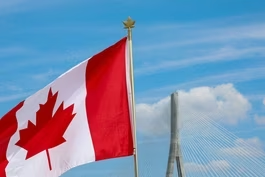
Canadian tariffs on U.S. take effect, marking turning point
Video has Closed Captions
Canadian tariffs on U.S. goods take effect, marking turning point in relations (2m 29s)
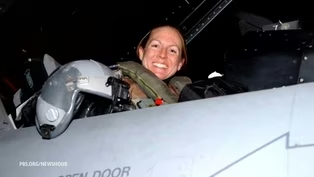
Fighter pilot reflects on order to stop Flight 93 on 9/11
Video has Closed Captions
Fighter pilot reflects on order to sacrifice herself to stop Flight 93 on 9/11 (8m 10s)
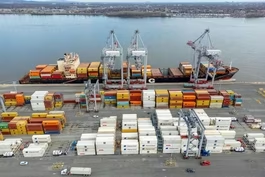
How U.S.-Canada trade dispute is impacting both economies
Video has Closed Captions
How the U.S.-Canada trade dispute is impacting the economy on both sides of the border (6m 28s)
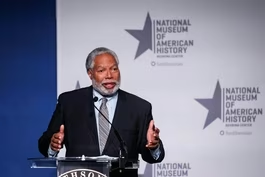
Lonnie Bunch on political pressure facing the Smithsonian
Video has Closed Captions
Lonnie Bunch on his legacy and protecting the Smithsonian from political pressure (10m 53s)
News Wrap: NYC officials aware of toxic air after 9/11
Video has Closed Captions
News Wrap: NYC officials release documents showing city was aware of toxic air after 9/11 (5m 41s)
Southeast Asia endures year of extreme weather amid El Nino
Video has Closed Captions
Southeast Asia endures punishing year of extreme weather amid super El Niño (5m 21s)
Trump’s trade war with Canada looms over key races
Video has Closed Captions
Trump’s trade war with Canada looms over key congressional races (4m 25s)

Youth sports become big business, putting stress on families
Video has Closed Captions
Youth sports become big business, putting stress on families and leaving some behind (7m 54s)
Providing Support for PBS.org
Learn Moreabout PBS online sponsorship New Episode
- News and Public Affairs

Today's top journalists discuss Washington's current political events and public affairs.
 New Episode
- News and Public Affairs

FRONTLINE is investigative journalism that questions, explains and changes our world.
 New Episode
 New Episode
 New Episode
 New Episode


 New Episode
 New Episode
 New Episode
Support for PBS provided by:
Major corporate funding for the PBS News Hour is provided by BDO, BNSF, Consumer Cellular, American Cruise Lines, and Raymond James. Funding for the PBS NewsHour Weekend is provided by...