
July 7, 2026 - Full Show
7/7/2026 | 26m 45sVideo has Closed Captions
Watch the July 7, 2026, full episode of "Chicago Tonight."
Concerns over the city’s budget as the mayor says some revenue sources haven’t materialized. And reports of immigration enforcement are surging around the country — what’s happening in Chicago?
Problems playing video? | Closed Captioning Feedback
Problems playing video? | Closed Captioning Feedback
Chicago Tonight is a local public television program presented by WTTW
WTTW video streaming support provided by members and sponsors.
July 7, 2026 - Full Show
7/7/2026 | 26m 45sVideo has Closed Captions
Concerns over the city’s budget as the mayor says some revenue sources haven’t materialized. And reports of immigration enforcement are surging around the country — what’s happening in Chicago?
Problems playing video? | Closed Captioning Feedback
Where to Watch Chicago Tonight
Chicago Tonight is available to stream on pbs.org and the PBS app.

WTTW News Explains
In this Emmy Award-winning series, WTTW News tackles your questions — big and small — about life in the Chicago area. Our video animations guide you through local government, city history, public utilities and everything in between.Providing Support for PBS.org
Learn Moreabout PBS online sponsorship>> Hello and thanks for joining us on Chicago Brandis Friedman.
Here's what we're looking at.
Reports of increased immigration enforcement are surging around the country.
We talked with community groups in Chicago about what they're seeing.
And a look at efforts to monitor air pollution across Chicago's neighborhoods amid the summer heat.
>> First off tonight, the city is facing a 130 million dollar budget shortfall for this fiscal year.
And the mayor isn't mincing words on who he says is to blame.
Mayor Brandon Johnson gave his mid-year budget report this afternoon and called out older people who passed the spending plan saying the revenue source is real relies on have not materialized.
Johnson did not support this budget that went into effect in January without his signature.
His plan had included millions in new taxes on large corporations.
>> I'm I'm working hard to avoid layoffs and cutting.
Services.
Hopefully it's a lesson learned by certain members of city Council because these challenges won't disappear in one budget.
we think about the long-term sustainability of our economy, what I put forward has produce the type of dividends that.
I anticipated.
What they have put forward has literally produce the type of shortfall that we're experiencing today.
>> But older people who crafted the spending plan are accusing Johnson of failing to fully implement the spending plan.
In a statement, 39th Ward Alderman Samantha Nugent says, quote, Mayor Johnson and his administration have spent 6 months slo-mo slow walking the implementation of new revenues and efficiencies designed to close our budget deficit and prevent this administration from creating excuses to raise taxes on businesses, jobs and working families.
Chicagoans deserve transparency and the truth from the mayor instead of attempts to shift blame away from the failures of his administration.
Us Attorney Andrew Boutros is responding today to even more calls for his resignation.
This time members of City Council's ethics and Government Oversight Committee voted in favor of a non-binding resolution that slams Boutros for the botched Broadview 6 case sparking a mass exodus of prosecutors allowing grand jury irregularities and breaches of trust with judges.
The measure now heads to the full City Council on July.
15th.
In a statement Boutrous responded that he will not be bullied into dropping public.
Corruption matters are closing out.
Newly opened ones.
He says, quote, No one faces this level of coordinated opposition and performative performative.
The at Rick's unless they are viewed as representing an existential threat to a system that is largely corrupt and broken when this sort of coordinated panic sets in, it means that our federal leaders are on to something big.
Westside neighbors who've experienced severe flooding may begin to see some relief once a new underground rainfall storage system is in place.
>> Flooding is this something that is new to any city in the United States?
But what is new is the unusual, an exponential amount of flooding that we all are experiencing.
So if anyone thinks that climate change is a real to put it in perspective, we received more rain over the 4th of July weekend.
Do we have traditionally received entire month of July >> the city of Chicago and the Metropolitan Water Reclamation District partnered to install 2 wings storage units which serve as additional holding tanks and or neighborhood streets and are attached to existing sewer infrastructure.
The 2 units will be placed in the areas you see here by capturing and temporarily storing excess storm water during heavy rainfall.
2900 homes and businesses should see reduced flooding across the 28.
29 37 thwart major storms in the summer of 2023.
Lead to severe flash flooding and damage across those West side neighborhoods.
A cardiologist is the latest Chicago in to join the race for Mayor Dr.
Leeson need began her career as a nurse before becoming an interventional cardiologist while working at Hines VA Hospital, she spoke out about failures in patient care, but she says put veterans at risk.
Nice says her campaign priorities include affordability, trusted leadership for safer city and fiscal responsibility that protects the next generation from inherited debt.
She joins the 6 other candidates so far that you see on your screen with more expected.
Current Mayor Brandon Johnson has yet to formally announce whether he'll seek a second term.
Up next, the U.S.
sees an uptick in ICE arrests.
That's right after this.
>> Chicago tonight is made possible in part by the Alexander and John Nichols family.
The Pope Brothers Foundation.
And the support of these donors.
>> Immigration-related arrests are surging nationwide.
Ice and Border Patrol made more than 10,000 arrests within a span of 5 days at the end of June.
According to a report by The New York Times and here in Chicago, immigrant rights advocates say they can feel the impact.
Joining us to talk about this, our Maria Orozco outreach coordinator at Street Vendors Association of Chicago.
Immigrant Justice Community organizer at Asian Americans Advancing Justice Chicago and Diana Rashid State, director of legal defense at the Resurrection Project.
Thanks to all of you for joining us.
And first to you.
What kind of immigration enforcement have you been seeing are getting reports about in the last month?
>> Yeah.
In the past couple of weeks, we've definitely seen uptick of immigration enforcement and it's different than what we saw in the fall during Operation Midway Blitz where it was a lot more violent, a lot more flashy, but we've seen a lot of vice president at courts and really targeted Like obviously that they've shown up people's homes or even at grocery store, like very obviously targeting folks on the ground.
>> Diana is someone who feels requests for legal assistance.
What if you noticed over the past month?
Yeah, we notice a significant increase and the requests and the referrals that weekend from community members and from hot lines like the rapid response hotlines across the city and the state over the course of we keep track on a weekly basis of this data.
And in June, we noticed near doubling those requests from what we had seen in prior months, including March April and May.
When you say you're doubling, what kind of numbers are we talking about?
>> We're talking about we had seen of the detained referrals and request that we had been getting on a month.
It was hovering around 9200 referrals per month for the prior months.
>> And we saw just over 170 and in June, the so a significant increase over the prior previous months.
Maria, what effect is this enforcement having on communities?
Has a big effect because it it's affecting Americans are working class.
A lot of our vendors are being >> detained.
Some are being detained outside of the court.
The something we haven't seen.
been seeing few months they're starting to not come outside for 2 vendor stuff like that.
Their turf fight.
They're hearing ice coming into the homes.
They did detain one outside of his house and then another 2 outside reports.
So it is affecting the way that they're living in the way that they're making their income as well.
>> How would you say arrest tactics have changed since Midway Blitz, which of course we heard about the fall where they could turn up in any neighborhood.
>> I see that they are still showing These are still wearing their mask.
We've got some reports.
them and you see them or in their mask and then same vehicles with no license plates.
they're also still attacking some vendors.
I do know that they're also tackling some of the just people that are members, of course, and there's scaring them and still hurting them.
It's not as bad as it used to.
I know it decrease a little bit, but the tactics are still there.
They haven't better and such.
>> Ellen, for Midway Blitz to now.
How are you seeing Chicagoans respond?
>> I live about Chicago is that we continue to show strong for neighbors and some of the infrastructure that was built during operation Midway Blitz, especially around mutual aid.
And these rapid response network continue.
And people, even though we don't have the national tension in the same way before the volunteers and neighbors have stepped up during the fall, continue to step up today and continue to recognize ice vehicles in their neighborhoods called Family Support Network Hotline, which is 855-435-7693, like people are still manning the hot every day.
And so Chicago in still show up strong for their neighbors.
>> Dianna, explain how intensive legal assistance for immigration detention can be and why that is.
Yeah, it's very resource late labor intensive to be able to from from the very like to even reach someone who is detained to track down where they are detained because they're constantly being transferred.
We longer have ice attention here in Illinois, but they're quickly transfer to other states and often time the database that ice updates with people's information for poor.
They've been transfer to delayed and not updated.
So even finding the person to be able to schedule illegal consultation with them is a huge hurdle.
And then secure their release very resource intensive now because of recent policy changes at from the Board of Immigration Appeals, the Department of Justice saying that individuals who entered with out inspection are not eligible for immigration bond.
In many cases, it requires a habeas petition filed in federal district court to be able to secure some of these really sand.
That something that is you know, enormous change from the previous administration and something that was not necessary before.
So now you add layers of administrative burdens of legal work of additional expertise that's required.
Maria, you know, we're talking about how street vendors have been particularly by ice at court Tell me most little more about that.
What's happening to A few weeks ago, we had 2 vendors that were actually find in the city of Chicago downtown area for bending into downtown.
>> It is prohibited.
And then CPD find them and give them court at a different location that where they're normally Sena appear, which is an administrative hearing and they were sent a different court where they can misdemeanors and could see.
And when these 2 vendors, unfortunately, they When they stepped outside, they were detained and right away.
They transferred to Kentucky, a believer, Indiana.
both of them and they did end up signing their deportation other and their fortunately back home.
Now.
And it's very unfortunate.
And then we've been trying to get as much resources we can different networks to try to get should do their ports through zoom.
Luckily, we have help from the city that they helped us get lawyer and make sure these fines and these tickets are being.
You forgot they court through zoom today.
So they're not giving them any tickets anymore.
So we it's a process in order to try to get this through.
So but it's we've helped 15 last week on Thursday.
We just courtroom at the office and we were able to dismiss the case.
Ellen, what should people know about how this impacts the Asian-American community?
>> I think obviously the Latino community has been targeted and but the Asian-American community, although not as visible one in 8 Asian immigrants in Illinois is on document.
And what we're seeing is actually there's a lot of fear and panic in our communities and we stay quiet and don't access resources in the same way because we are not as visible.
So our communities are deeply impacted by the continual escalated immigration enforcement.
Of Diana, just a few seconds left.
What what legal rights remind people love regardless of their citizenship status >> we have the right to speak with a lawyer and they should reach out to organizations.
We have resources through city funding through state funding which have been critical to be able to provide a lifeline to people to be able to provide legal information and legal advice to know if there is relief that they can access in their case or is Mariah side in some situations, they may decide that they don't want to continue with fighting their case because of indefinite detention, Great Britain they have to make of what is a very tough choice and thanks to the 3 of you for joining us.
Best of luck to you and your Maria, Rosco, and and Rashid things, everyone.
Thank Thank you.
>> Up next, how air pollution is affecting the lives of Chicagoans and what's been done to combat the issue.
The Chicago Department of Public Health says air pollution is impacting the life expectancy of black and Latino residents in Chicago last fall.
Cdph and University of Illinois, Chicago joined forces to shrink this gap by installing nearly 300 quality.
My air quality monitors around the city, the most in the United States.
Now the project is facing its biggest test yet the summer heat high temperatures tend to make air quality worse, especially for communities on the city's south and west sides.
Joining us to talk more about the project and how air pollution affects millions throughout the city are syrup earned all open Air Chicago Project Leader and University of Illinois Chicago School of Public Health Professor Grace Adams, Environmental Health Project administrator at the Chicago Department of Public Health.
And Jamie Groff's, Earl founder and executive director of the Southwest Collective neighborhood Organization working to improve the quality of life on Chicago's Southwest Sides.
Thanks to all of you for joining us.
Grace on start with you.
The American Lung Association's 2026.
State of the Air report ranks the Chicago's Airpot Lucian.
We're in a Chicago area is air pollution as one of the worst in the country.
What is your reaction to that?
>> I'm not surprised.
You historically Chicago has seen, you know, poor air pollution.
We've seen air quality issues across the board.
Experiences have been voiced from all of our community members.
You know, I'm not surprised to hear that.
And I'm really hopeful that, you know, this project is the next step in addressing that.
>> Sarah, what kind pollutants are in the air?
What makes air pollution air pollution is >> the >> formed in the atmosphere south of emissions from there.
It of sources specifically industrial mobile sources like cars, trucks and also more and more wildfire smoke.
It air pollutants.
directly emitted into the atmosphere or they are formed in the atmosphere to chemical reactions.
But in summary and pollution contamination of that we breathe.
And with chemicals, toxic gases and particles that released from there.
It pollution.
Sources air pollution does it impacts all of us because we all breathe the air or is it mostly a concern for those with respiratory There are vulnerable populations that are at higher risk for adverse health effects air pollution.
>> And these are specifically children.
>> Pregnant women and the >> Grace, tell us more about opening Chicago and how it works.
coming to you, Jamie.
To worry.
>> opener.
Chicago is community network of 277 air sensors across the city.
And so its collecting on concentrations of fine particulate matter and nitrogen dioxide, which are 2 of the pollutants.
My colleague just mentioned.
And so all of these sensors, there's one and at least every community area and at least one in every ward.
So that way we are getting full citywide coverage and we can understand, you know, what's happening at the hyper local level and you know where encouraging residents to really take advantage of this tool and use as like health education piece.
You know what they can do?
We're putting that power of public health in the hands of the public syrup, the open air Chicago map.
Or I'm gonna put that up on the screen for our viewers to see it because this is what it looked like earlier this afternoon.
>> Why do you think it is important to have these monitors on a neighborhood level?
>> It is very important to measure air quality, particularly in our because as you mentioned, the American Lung Association identified Chicago as one of the most polluted cities in in the country.
In terms of particulate matter pollution.
It is the 13th most pollutant in didn't pollute prelude to that.
A city in the nation.
And in terms of ozone, it's to 15 the 15th most polluted city.
on top of it, as we have witnessed in 20, it's 3 Both in this that the wildfire smoke from Western U.S.
and the and Canada formed unhealthy conditions for our residents Chicago.
And in addition, we are experiencing higher temperatures reaching 90 degrees longer periods in the summer and that serves a means to trap pollutants to to the high pressure system, to trap to pollutants over the city for longer periods of time and all of what kind describing serves as higher air pollution burden associated higher health risk for our Chicago residents, but particularly for residents in the South East, south and west in parts of the city due to this proportion air pollution in DOS specific community.
Right.
And I want to get into that.
We all remember, of course, last summer and the summer of 2023 when the skies orange and the days were ugly.
Jamie, tell us a little bit more about how poor air quality, how it disproportionately affects the resident said that Sarah just mentioned on the city's south and west sides, OK?
So if you take it back, 100 years or so the areas that you're talking about to the southwest in the southwest side and from the southwest side.
>> We're all very industrial in nature.
And so you're seeing like a key word being thrown around here, which is industrial industry.
What does that >> It means that there's a lot happening.
A lot being made a lot being trans transported across like our into interstates, our rivers, our airways, so there are some neighborhoods where that is happening a lot more than others and they happened to be on the south, the West and the Southwest and southeast sides.
>> these are folks that are, you know, naturally lower income.
We are, you know, Jordy black and brown.
And and you know, because you have low income, you also have less ability to, you know, afford health insurance.
And so you're starting to see a lot of this domino effect across generations.
And so it's not just this generation that has this issue.
You know, this.
These are chronic issues that are generational for families.
You know, I have asthma.
And so does my kid, for example, I'm pregnant and I have complications because, you know, when I'm out in the heat, really hard to walk around and move, for example, people need to about, you know, going out into their communities when the air quality is high or when the air quality is poor.
>> And why is that important information?
>> It's super important.
And the reason important is because you need to know when it's safe to go outside.
So, you like mention, if you are pregnant, you know, you may have a little bit more complication.
The normal, something you're not used to.
And that is labored breathing, especially as you get into the final trimester.
You might have a child asthma or another respiratory issue.
You might have an elderly parent or someone living with you like an aunt or an uncle who might have a respiratory difficulty.
And so knowing when those days are moderate, severe or just straight up orange, should stay home or maybe make alternate arrangements for the day.
That's important to know.
Yeah.
Grace, how can air quality be so different?
Just a few miles apart.
So it's based off of hot like the actual monitors that we're using in this network are, you know, Hyper-local they're getting.
>> Granular information.
And so it's like what's happening right there when you're looking at your weather app, for example, and you're seen air quality, you know, on that screen, it's different because it's pulling in from, you know, the federal reference monitors and like those are not so close together in the city.
And so as a result, or, you know, aggregate like how you can look at it from a city perspective.
And so this network allows us to actually see what's going on in your area.
And so each of those little dots on the map really shows you like what your're sense or is.
And you know what that quality is going to be.
If you go outside and so that's what we're really trying to like.
Stress to people, syrup.
We've seen an increase in poor air quality over the last several years.
Why is that?
Why is it worse in the summer?
Obviously the heat is a factor.
>> As I noted that there are variables is student associated with that.
One on the wildfire at the so it's that we've been experiencing, particularly we experienced in June July 2023. and July August 2025. increased number of days during the summer with temperatures reaching up to 9 to decrease and higher.
That serves pollution entrapment with the high pressure system causing trapped men pollute comes the city the staff thing higher exposures to harmful air pollutants and also the higher temperatures serve as a catalyst for chemical reactions in the atmosphere.
So that formation highway summer, ation of and other pollutants.
Yep.
Okay.
A lot.
We're out of time amid a lot policy makers to pay attention to all.
Have to leave it there, Sir.
Robert Grace Adams and Jay McGraw, thanks, everybody.
Thank and that is our show for this Tuesday night.
You can stream Chicago tonight on our W T Tw YouTube Channel every evening.
>> And catch up on any programs you may have missed and join us tomorrow night at 5, 30 10 candidate for Chicago.
Mayor Matt Brewer joins us to discuss his vision for the city mom around now for all of us here at Chicago Brandis Friedman, thank you for watching.
Stay healthy and safe and have a good night.
>> Closed captioning is made possible by Clifford and Clifford Law offices, a Chicago personal injury and wrongful death that
 New
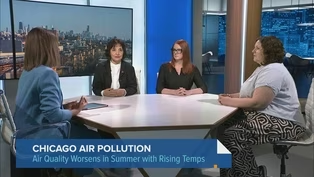
NewChicago's New Air Pollution Monitors Face Intense Summer Heat
Video has Closed Captions
Air pollution is impacting the life expectancy of Black and Latino residents, according to CDPH. (10m 31s)
 New
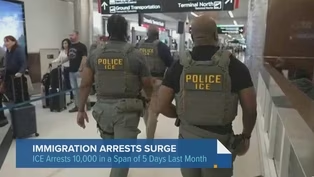
NewReports of ICE Activity Surge. What Community Groups Are Seeing in Chicago
Video has Closed Captions
Immigration-related arrests are surging nationwide. (8m 29s)
Providing Support for PBS.org
Learn Moreabout PBS online sponsorship New Episode
- News and Public Affairs

Top journalists deliver compelling original analysis of the hour's headlines.

- News and Public Affairs

Today's top journalists discuss Washington's current political events and public affairs.

 New Episode
 New Episode
 New Episode
 New Episode
 New Episode

 New Episode
 New Episode
Support for PBS provided by:
Chicago Tonight is a local public television program presented by WTTW
WTTW video streaming support provided by members and sponsors.