
Legendary Tigers of India
Season 44 Episode 13 | 53m 59sVideo has Audio Description
The story of legendary tigers of India told by a man who’s devoted his life to keeping them alive.
The story of the legendary tigers of Ranthambhore Fort told by the man who’s devoted his life to keeping them alive.
See all videos with Audio DescriptionADProblems playing video? | Closed Captioning Feedback
Problems playing video? | Closed Captioning Feedback
Major support for NATURE is provided by The Arnhold Family in memory of Henry and Clarisse Arnhold, Sue and Edgar Wachenheim III, Sarah and Sandra Lyu in memory of Seung...
Legendary Tigers of India
Season 44 Episode 13 | 53m 59sVideo has Audio Description
The story of the legendary tigers of Ranthambhore Fort told by the man who’s devoted his life to keeping them alive.
See all videos with Audio DescriptionADProblems playing video? | Closed Captioning Feedback
Where to Watch Nature
Nature is available to stream on pbs.org and the PBS app.
Buy Now
Explore More Ways to Watch
Bring the beauty and wonders of wildlife and natural history into your home with classic NATURE episodes.Providing Support for PBS.org
Learn Moreabout PBS online sponsorship♪♪ ♪♪ -First magical moment when I saw a tiger in Ranthambhore, it was absolutely mesmerizing.
It's a moment where you lose yourself somewhere within yourself.
This is the best place in the world to see wild tigers.
For centuries, India's rulers battled over Ranthambhore Fort.
Today, it's home to a family with an extraordinary story.
♪♪ ♪♪ ♪♪ ♪♪ It's about what you don't know is going to happen.
And that's the great joy of Ranthambhore.
♪♪ ♪♪ [ Tiger growls ] ♪♪ ♪♪ ♪♪ ♪♪ [ Birds chirping ] -March 1984.
A day that rewrote tiger history.
I was helping my brother-in-law Tejbir film a tiger as it watched sambar deer feed in the lakes.
What happened next shocked us.
♪♪ ♪♪ ♪♪ ♪♪ No one had ever filmed a tiger killing in deep water before.
But then no one had really filmed wild tigers at all.
And I was there in the heart of it.
In the jungles of northwestern India, there is a magical fort called Ranthambhore.
It has stood for more than a thousand years.
♪♪ There are three lakes a few hundred feet from each other.
And it's full of wildlife.
♪♪ ♪♪ Something happening every minute.
♪♪ More wild tigers live in India than anywhere else on Earth and this is one of their most important strongholds.
And when a tiger walks through the lakes.
The sound, the magic, the explosion of activity.
♪♪ So, yes.
The lake's a place to die for.
♪♪ But in 1976, when I first came to Ranthambhore it wasn't known for tigers.
Back then, no one really knew anything about wild tigers.
Myself included.
I'm Valmik Thapar.
I'd grown up a city-boy.
I was very busy in Delhi making documentary films.
My first marriage was collapsing.
And one afternoon I just walked out of my house, leaving everything behind and caught a train to Ranthambhore.
I went on a whim to escape the city.
It took me nearly a day to meet Fateh Singh, the director of the park, and he looked me up and down and said, "What do you want?"
I said, "I want to go to the forest."
He said, "But nobody goes to this forest.
It's an unknown area."
When I was passing the old gate, as you went past the gate and you crossed the rise of a hill, there in the distance was Ranthambore Fort, looking at you.
And it grabbed me.
And that moment changed my life.
I wasn't a scientist or a naturalist, an activist or a conservationist.
I was simply a filmmaker who fell in love with the beauty of this place.
And with its tigers.
For the next half century, I've had the great privilege of being amongst them.
All tiger life revolves around the female.
And across the decades, five tigresses became like family.
Now, for the first time, I'm able to piece together the story of their matriarchal clan and tell you how these five revealed the secret life of tigers.
None are closer to my heart than my first Ranthambhore tiger -- Padmini.
She lived through some very dark times.
♪♪ Not that long ago, people estimated there were 100,000 tigers in India.
When Europeans and their guns arrived in the 18th century, a massacre began.
It makes me sick to think of the maharajas, the queens and kings who flushed out tigers and hammered them with their guns.
I mean, one of our maharajas, just one single man, killed 1,300 tigers and boasts about it.
The kings, the rulers, the emperors, the rich -- They all had tiger skins in the house.
I mean, even the Duke of Edinburgh and Queen Elizabeth had gone to Ranthambhore and shot tigers there.
In the early 1970s, the Prime Minister Indira Gandhi banned tiger hunting.
A census had revealed that there were just 1,800 wild tigers left in India.
♪♪ And she set up Project Tiger.
It was a wildlife conservation program with one aim -- to protect India's remaining tigers.
In this land where the tiger roams, it is not only an animal, but a symbol.
For thousands of years, India has had a culture that goddesses ride a tiger to defeat evil.
The tiger is sacred.
The guardian of the forest.
In 1973, we set aside nine areas of the country for tigers.
The old fort of Ranthambore, with its lakes and forests, was the smallest of these special tiger reserves.
And then began a long, difficult task -- rehoming the many people and cattle that lived within the boundaries.
Such sacrifices were made for the tiger.
Now, in the heart of Ranthambhore, it was thought that just 12, maybe 13 tigers remained.
And they only ever came out at night.
♪♪ ♪♪ ♪♪ I didn't think I had a hope of seeing one.
But I went out anyway with some of the park guards and a searchlight to try.
Anywhere and everywhere.
Just couldn't find tigers.
The director of the park, Fateh Singh Rathore, had slowly become my tiger guru.
He knew every inch of this tiger reserve.
Huge twirling mustache, very tough, with a great sense of humor.
♪♪ And one day we drove too close to the water.
[ Water splashes ] So, we were floating in the shallow water of a lake.
A head appeared.
It was my first Ranthambhore tiger.
We called her Padmini.
♪♪ I was 23, and I'd never felt such a connection to any living thing before.
How sad that these few photos are the only record of my times with her.
But she deserves her place in this history.
She went on to have five cubs.
Four survived.
And it was the beginning of Ranthambhore's clan of tigers.
She led that clan.
She was like the godmother of all the tigers I've known in Ranthambhore.
And she was the mother of my next tiger, the one who brought me the most joy.
The beginning of Ranthambhore's golden age.
♪♪ In the 1980s, Ranthambhore was a place transformed.
♪♪ Tigers shed their nocturnal cloak.
They suddenly had no fear of man.
And the visibility, the low savanna grasslands here, meant you could see the tigers and watch their behavior like nowhere else on Earth.
Noon was my favorite.
She was called Noon because she was really active at noon.
Noon was a delight.
She was absolutely the opposite of Padmini.
She was the new generation of tigers that had grown without the fear of man.
♪♪ I watched Noon drive away other females; fight them over prey.
Force out her sister.
[ Roaring ] I began to understand that the few square kilometers around the lakes were her territory.
She had claimed the richest tiger turf, one teeming with prey.
And now the hunters and people were gone, it was a Tiger Paradise.
Pure magic.
It was around this time that I bought some land on the edge of Ranthambhore.
More and more, this is where I wanted to be -- alongside the tigers, learning more about their lives.
Ah, wow!
This is Noon's mate.
A big male called Genghis.
One day back in 1983, he had appeared suddenly by the lakes.
From where?
We don't know.
No one was monitoring the tigers in those days.
What we did know was that males move around much more than females.
As adults, they leave their family.
They seek out new, big territories that give them access to several females and lots of prey.
Areas like the lakes.
I remember a day, a few months after he arrived.
Sambar deer had congregated in huge numbers to feast on succulent water plants.
But deer weren't the only animals in the water.
There are about 120 crocodiles in the lakes.
♪♪ ♪♪ It's one of the only places in the world where sambar deer face both predators.
We thought tigers only hunted them on land.
But then we saw Genghis make that extraordinary kill.
♪♪ ♪♪ ♪♪ ♪♪ ♪♪ ♪♪ ♪♪ ♪♪ I couldn't believe that I was seeing an enormous tiger rushing into the water, killing a sambar.
And we were lucky.
♪♪ This was the time to record for the world what Ranthambhore was giving, because so far, the world had no real wild pictures of tigers.
And Ranthambhore's tiger population was growing.
There were thirteen tigers when I first arrived.
Now we thought there were 45.
They were the best days of my life.
Days I thought would never end.
♪♪ I thought I would have another season with Genghis.
I didn't know, but that was the last time I saw Genghis in my life.
♪♪ ♪♪ When it happened, it was like a nightmare.
Sometime in 1991, I was with Fateh Singh, my tiger guru, and we were wondering what happened to a few of the tigers that we were watching.
We could no longer find them.
And Fateh Singh felt that they were missing and maybe they could have been poached.
And I said no, not possible.
Who would poach these incredibly beautiful animals?
♪♪ But then began our year of horror -- poachers started to be caught with skins.
♪♪ ♪♪ It knocked Fateh Singh and me out.
We just couldn't believe that this was a possibility.
-The price of bones is soaring as tiger numbers plummet.
India's tigers are being murdered so the Chinese can turn their bones into folk cures for fevers and rheumatism.
-I think the population all over India is going down.
I think the primary reason for this is poaching and the bone trade to meet the Chinese demand for medicinal derivatives.
I think the tiger faces probable extinction in the next decade.
Fateh Singh had no time for poachers.
If he found a poacher, he would charge after him, take him to jail.
He believed that this was the only way Ranthambhore would survive.
And he was beaten up himself.
He nearly died.
His driver jumped on his body to save him and took the beating.
This is a letter my Tiger guru Fateh Singh wrote at that time.
"It is a massacre.
When the police chief showed me the skin, I could not control myself.
Tears were rolling down my cheeks.
It's heartbreaking, and sometimes I feel guilty that I taught them to have faith in human beings.
All the tigers were shot at point blank range, just innocently looking at the man with the gun."
I think both Fateh and I felt that over the years we'd worked very hard with the tigers.
They'd lost their fear of man, and they treated the poachers in the friendliest of ways and they lost their lives.
Because by now we had learned to identify individuals by their stripes, we could say with certainty that 30 tigers, tigers that we knew, were gone.
Around the lakes just 15 terrified tigers remained, and I was determined to do all I could to keep them alive.
I entered the arena of government.
Sat on endless committees.
I started a charity with local people.
I wrote books.
I made a TV series.
I'm Valmik Thapar.
It was the most time I'd spent away from Ranthambhore.
But then my next lake tigress drew me back in.
♪♪ Of all the tigers, she is the one who would teach me most about the tiger's life.
We called her Machli, which means fish, because she had marks like fish bones on her cheek.
♪♪ She was born during the crisis.
And for the first two years of her life she had stayed with her mother, as all tiger cubs do.
♪♪ [ Indistinct whispering ] ♪♪ Now, Machli was nearing adulthood.
I guess soon she would need a territory of her own.
But when and how would she carve one out?
Tigers communicate with each other silently.
They leave their scent in their territories.
This can attract conflict or repel conflict.
And through this process of territorial marking they talk to each other.
♪♪ Fateh and I watched the pair closely, certain their time together was coming to an end.
The lakes were rich with prey, but there was only enough for one resident tigress.
Would her mother force Machli out?
The bond Machli once shared with her mother was gone.
And replaced with aggression.
♪♪ [ Growls ] [ Growling ] This time, Machli was the one to back down.
♪♪ ♪♪ At the edge of the lakes is my favorite place.
Raj Bagh -- the ruined garden of the Kings.
Now tigers hold court here.
I suspected Machli would soon try to overthrow her mother so she could rule these ruins.
Her mother too sniffed out the threat.
♪♪ ♪♪ To me, Machli seemed a little afraid.
But she stood her ground.
♪♪ ♪♪ ♪♪ ♪♪ I wasn't sure who'd won the confrontation, but shortly after this, Machli's mother left.
Maybe it was the threat of constant conflict.
Maybe she sacrificed her territory for her daughter.
Either way, Machli now ruled here.
♪♪ Later that year, Fateh and I realized that a new male had arrived at the lakes.
He soon picked up Machli's scent.
We called him Bumboo Ram.
And gradually he got closer to Machli, leaving markers of his own.
♪♪ ♪♪ Then, one day, Machli approached him.
He was aged 6 or 7.
And in his prime.
♪♪ ♪♪ It wasn't long before Machli decided she was ready to mate.
[ Soft growling ] [ Aggressive growl ] The ferocity of tiger mating always impresses me.
[ Growling ] I was excited by the thought of a new generation.
It was like a new dawn.
The dark days of hunting and poaching had long gone, I thought.
This was the chance for the clan to truly thrive.
It was a very happy time for me.
I'd met my wife, Sanjna, and had a son, Hamir, named after one of Ranthambhore's greatest rulers.
And soon Machli herself had a litter.
Two cubs.
♪♪ This is family life amongst the tiger.
This is the beauty of Ranthambhore.
They are both male cubs.
She is really looking after them at the moment.
Oh, wow.
Look at them.
Learning the ways of the mother.
It was an absolute delight watching these boys grow up.
But then one day we heard rumors that trouble was headed their way -- Their father had vanished and a new male was patrolling the area.
We called him Nick.
♪♪ Without the protection of their father, Machli's family were in danger.
I'm really worried about these two cubs because they are young male cubs.
There could be a new resident male in the area.
So the tigress has to be really careful.
She's got to keep them well-protected.
She has to defend them and chase away any male intruder.
In fact, she's bound to fight the male so that he keeps her distance from the cubs.
♪♪ Nick was a huge male in his prime.
I shuddered to think what he could do to the cubs.
♪♪ He could easily kill them in order to mate with Machli and father a litter of his own.
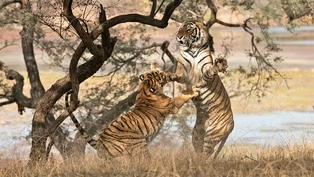
♪♪ A few days later, I found Machli being pursued by Nick.
♪♪ ♪♪ He was definitely interested in mating.
♪♪ ♪♪ Would she give in and let him mate with her, or would she try and fight him off?
♪♪ ♪♪ At first, it looked like she was keeping away from Nick so he couldn't get behind her and mount her.
But Nick was really enticed by her scent.
♪♪ ♪♪ It didn't look like he would give up.
♪♪ ♪♪ ♪♪ ♪♪ For Machli -- Victory.
For Nick -- An injury that would make it hard to hunt.
Now he knew the cubs had a mother who would risk it all to protect them.
♪♪ ♪♪ ♪♪ ♪♪ A few months later, I saw the most extraordinary moment between a tigress and her cubs.
♪♪ ♪♪ Machli suckled them.
♪♪ Her cubs were almost two years old.
There would have been no milk for them at this age.
Perhaps it was Machli's way of telling them it was time to say goodbye.
♪♪ ♪♪ ♪♪ ♪♪ After that, everything changed.
I never saw the family together again.
And the cubs struck out to find territories of their own.
♪♪ In 2004, I was very busy with a Supreme Court committee, and we were hearing regularly that there was something going wrong in Sariska.
150 kilometers from the Ranthambhore Tiger Reserve, that poachers were out.
Nobody was sure about it.
The government of the day refused to admit that there was a problem, even though the director of the park was crying out for help.
Every tiger in Sariska by September 2004 had been poached and killed.
Sariska had no tigers, and then in central India, not so far from Ranthambhore, the Panna Tiger Reserve, all the tigers went extinct there, so poaching took a massive turn.
♪♪ ♪♪ When it happened the second time it was the same Chinese pressure.
It was the illegal trade.
And a new demand for ornamental tiger skins.
It was again trying to keep your tiger safe.
How are you going to do it the second time around?
♪♪ ♪♪ "Scattered thoughts.
June 2005.
The future of the tiger is bleak.
God help us."
[ Thunder crashes ] The monsoon of that year was a critical moment.
It's a time when the rains lash the forest with incredible force.
Ranthambhore completely shuts down.
The roads are washed away.
The perfect cover for poachers to strike.
I had no idea where Machli was or if she was still alive.
♪♪ I kept busy in Delhi, working with the then Prime Minister to create a moment of huge change.
In the end Project Tiger was scrapped and and the National Tiger Conservation Authority was launched.
This time because of various connections with the Empowered Committee, with the Supreme Court Committee, we declared a red alert and an emergency in Ranthambhore.
200 armed men were sent in to surround the periphery and to flush out any intruder, and it created a scare.
We knew that there were problems in Ranthambhore.
Fateh Singh, who had by now retired, said that half the tigers of Ranthambhore had been poached and there were barely 21 tigers left, terrified tigers who'd experienced a second round of poaching.
I think the lake tigers must have known what was going on, because on the edges of their territory there were vacant areas.
The tigers on the outer areas had vanished, and the silence of death hung in the air.
Every tiger on the lakes would have known that.
♪♪ ♪♪ Luckily the area around the lakes was the inner sanctum.
It was very difficult for poachers to get to the lake area.
♪♪ So, the lake tigresses has survived because the area around is fortified, there are gates and entry points.
There are lots of forest guards.
So the poachers were not going to take a risk in this area.
♪♪ So the lake tigers kept on producing cubs that would go out and repopulate areas where tigers had been poached.
And that's what happened.
That's what saved Ranthambhore.
And that's what saved Machli.
She survived yet another crisis.
And her final litter would grow up and spread out all over Ranthambhore and beyond.
♪♪ ♪♪ ♪♪ ♪♪ When I first went to Ranthambhore, it was a tiny patch of 300 square kilometers.
Today, adjacent to it are three tiger reserves, and we have 5,000 square kilometers where tiger populations can go to, where tigers can migrate to.
That's success.
That required hard work by a bunch of people.
♪♪ And one of those people is my colleague, Dr.
Dharmendra Khandal.
He has data of 20 years of Ranthambhore's tigers.
And that enables us to really look back and work out for the first time exactly how Ranthambhore's tigers are related.
Today, we know that Machli's genes are in 75% of all Ranthambhore tigers.
Including my next tiger, Krishna.
One of Machli's daughters.
And a tigress that shook my being.
She ruled the lakes for a while.
And had four little cubs of her own.
It's very rare to find a tigress with four small cubs.
And there was an incredible afternoon when she took her cubs and walked to the palace den.
To get to the palace den you have to cross a little bit of water.
And that's where a few big crocodiles lie, waiting to get their chance on anything that passes.
♪♪ She carefully negotiated the water carrying the weakest cub in her mouth while the others followed her.
♪♪ ♪♪ ♪♪ ♪♪ ♪♪ ♪♪ ♪♪ ♪♪ She lost one of the cubs.
[ Cries out ] ♪♪ It brought tears to my eyes that day.
♪♪ One of the cubs that survived still lives around the lakes today.
She was named Arrowhead because she has two pointy eyebrows, like two arrows, on her forehead.
She's family, she always surprises me and I see much of her today.
For a while, she ruled the lakes.
But today, this territory is no longer hers and she should not be here.
Recently she started behaving in unpredictable ways.
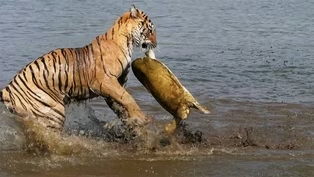
I was startled when I saw on a camera's viewfinder Arrowhead arriving at the lakes and finding a way to attack an enormous softshell turtle.
♪♪ ♪♪ ♪♪ ♪♪ And she not only grabs a turtle in the shallow water, she picks it up and rushes back into the grass and starts to devour it.
Was she, like Genghis all those years before, not afraid of crocodiles in the lakes?
Well, what I saw next made me think that she was not fearless, but desperate.
Arrowhead's back in the lakes.
And this time she chases after a small crocodile.
She charges into the water, misses the baby crocodile, but she doesn't realize she's in a deep place.
And there are bigger crocodiles.
Big crocodiles pounce on her under the water.
Then I don't know how, she manages to free herself.
♪♪ And then, a short while later, someone filmed her eating a crocodile.
♪♪ ♪♪ Suddenly, memories of years ago came flooding back.
And I remembered that my nephew Jaisal had filmed this.
Arrowhead's grandmother Machli wrestling and eventually killing a 4-meter crocodile.
No one had ever recorded such a thing before or since.
Severe droughts had driven Machli to behave in this way.
What was driving Arrowhead?
♪♪ A few days later, we found out.
She had been pregnant and in desperate need of protein for her milk.
Now her cubs have been filmed just weeks old.
Oh, they are lovely shots.
Absolutely lovely.
♪♪ It's amazing.
This is really valuable, precious footage.
They are barely able to crawl.
[ Cubs meowing ] Wow.
It's amazing.
This is the secret life of tigers.
♪♪ But how will Arrowhead keep them alive?
She no longer rules the lakes.
And she's finding it difficult to survive.
She's desperate because she has very little prey to hunt.
Trespassing into the lake territory as she'd done before is much more risky with such small cubs.
♪♪ ♪♪ Today the lakes are ruled by another tigress -- Riddhi.
She too has three cubs, three mouths to feed.
She is one of Arrowhead's older daughters from a previous litter.
So now we have mother and daughter with three cubs each, in bordering territories.
What will happen?
We have no idea.
Which of them will survive?
Will they meet?
Will they fight?
Will they play?
I can't wait to see this new family drama play out.
Today, 70 tigers live across this landscape instead of the 13 we began with 50 years ago.
And I wonder which of them will become like family.
♪♪ When I am asked what I have done with my life, the only answer I can give is this -- That I have been amongst the wild tigers that roam Ranthambhore's magnificent lakes and helped them to thrive.
And my love for five tigresses in particular has molded me.
Padmini.
Noon.
Machli.
Krishna.
And Arrowhead.
Piecing together the story of their matriarchal clan has been the privilege of my life.
♪♪ They have been like a family to me.
And I can only hope that this story of their secret lives will help others to love them as I do.
And endeavor to fight for their future.
♪♪ ♪♪ ♪♪ ♪♪ ♪♪ To learn more about what you've seen on this "Nature" program, visit PBS.org.
♪♪
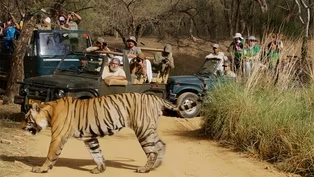
Behind the Scenes: The Fight to Save India’s Tigers
Video has Closed Captions
Clip: S44 Ep13 | 6m 26s | Go behind the scenes of "Legendary Tigers of India." (6m 26s)
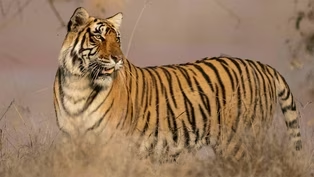
Poachers Return: How Trust Made India’s Tigers Vulnerable
Video has Closed Captions
Clip: S44 Ep13 | 3m 15s | These tigers had lost their fear of humans — and it cost them their lives. (3m 15s)
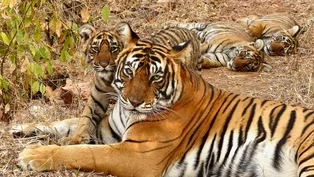
Preview of Legendary Tigers of India
Video has Closed Captions
Preview: S44 Ep13 | 30s | Uncover the story of the revival of northwestern India’s legendary tiger clan. (30s)
Tiger Mom Fights to Protect Her Cubs
Video has Closed Captions
Clip: S44 Ep13 | 3m 14s | Faced with a powerful male, a mother tiger must choose: mate, or protect her cubs. (3m 14s)
Why This Tiger Hunts Turtles… And Crocodiles
Video has Closed Captions
Clip: S44 Ep13 | 3m | A tiger’s dangerous behavior shocks researchers, until the reason is revealed. (3m)
Providing Support for PBS.org
Learn Moreabout PBS online sponsorship New Episode
- Science and Nature

Explore scientific discoveries on television's most acclaimed science documentary series.




 New Season








Support for PBS provided by:
Major support for NATURE is provided by The Arnhold Family in memory of Henry and Clarisse Arnhold, Sue and Edgar Wachenheim III, Sarah and Sandra Lyu in memory of Seung...